

Throughout church history, movements claiming unique spiritual authority have often been defended through personal experiences, extraordinary testimonies, and unquestioned loyalty to their leaders. This topic is especially significant to me because I spent more than a decade in the Word of Faith and New Apostolic Movement and even served as a pastor within that environment. Over time, my study of Scripture led me to conclude that many of the movement’s teachings and practices were unbiblical, and that much of what was presented as spiritual power was often manufactured rather than the genuine work of the Holy Spirit.
The new apostolic movement surrounding Kathryn Krick reflects many of these same concerns. While followers point to miracles, deliverances, and large gatherings as evidence of God’s approval, Scripture calls believers to test teachings, discern spirits, and compare every claim against the Word of God (Acts 17:11; 1 John 4:1). I have several other articles dealing with modern apostles (here), word of faith theology (here, here, here), women as pastors (here), and charismatic extremes (here, here); all of which are related to Krick’s ministry. This article, however, examines the claims I have personally seen online defending her ministry: Do these claims stand up under the authority of Scripture?
Claim: “To Challenge our Leader is to ‘Touch God’s Anointed’.”
One of the most common responses to biblical criticism of Kathryn Krick’s ministry is, “Touch not God’s anointed, and do my prophets no harm” (Ps. 105:15). This reflects an immature understanding of the biblical concept of the anointed.
In the Old Testament, prophets, priests, and kings were anointed with oil as they were set apart for their unique covenant offices. Yet all of these offices ultimately pointed to Christ—the true Anointed One (the Messiah). Those temporary offices found their fulfillment in Him. In these last days, God has spoken definitively through His Son (Heb. 1:1–2), fulfilling the prophetic office. Christ now possesses all authority in heaven and on earth (Matt. 28:18), fulfilling the kingly office. He offered Himself as the perfect sacrifice and continues to intercede for His people (Heb. 7:25; 10:12–14), fulfilling the priestly office.
The New Testament rarely speaks of “the anointing” as a special status possessed by a select few. In fact, the noun anointing appears only twice, both in 1 John 2 (vv. 20, 27). There, the anointing is not reserved for elite leaders but belongs to all believers through their union with Christ and the indwelling Holy Spirit. The New Testament emphasis is not on protecting supposedly untouchable “anointed” individuals, but on abiding in Christ, testing every teaching, and holding all leaders accountable to Scripture (Acts 17:11; 1 John 4:1).
Ironically, those who most loudly claim to be “God’s anointed” are the very ones who should welcome biblical examination. Under the New Covenant, no pastor, prophet, or self-proclaimed apostle is beyond correction. The only Anointed One who is above all challenge is Jesus Christ Himself.
Claim: “The shaking, screaming, falling, and convulsing are the power of the Holy Spirit.”
A common defense of modern deliverance ministries is that dramatic manifestations—shaking, screaming, convulsing, and collapsing—are evidence of the Holy Spirit at work. Some even argue that the events of Pentecost must have looked similar because the crowd accused the disciples of being drunk (Acts 2:13). But this claim reads modern practices back into the biblical text rather than allowing Scripture to speak for itself.
Throughout the Gospels, violent convulsions, screaming, and loss of bodily control are consistently associated with demonized unbelievers during exorcisms—not with Spirit-filled believers receiving God’s blessing (Mark 1:26; 9:20, 26; Luke 9:42). The Holy Spirit produces the opposite effect. His fruit includes self-control (Gal. 5:22–23), not chaos or the loss of personal control.
Nor does Acts 2 support these modern manifestations. The disciples were accused of being drunk because they were joyfully declaring “the mighty works of God” in languages they had never learned—not because they were writhing on the ground, screaming uncontrollably, or collapsing under someone’s touch. Peter did not explain that the Spirit had caused the disciples to lose physical control. Rather, he pointed to Joel’s prophecy, showing that God was pouring out His Spirit so that His people would proclaim His truth.
Some also appeal to instances where people fell before God. Yet these accounts bear little resemblance to what is commonly seen in modern miracle meetings. Consider Ezekiel. He was not standing in a prayer line while someone laid hands on him. He was caught up in an overwhelming prophetic vision, beholding the visible glory of God, hearing the audible voice of the Lord, and receiving direct revelation that would become part of Holy Scripture (Ezek. 1–3). His experience was part of an extraordinary prophetic commissioning, not a recurring worship phenomenon.
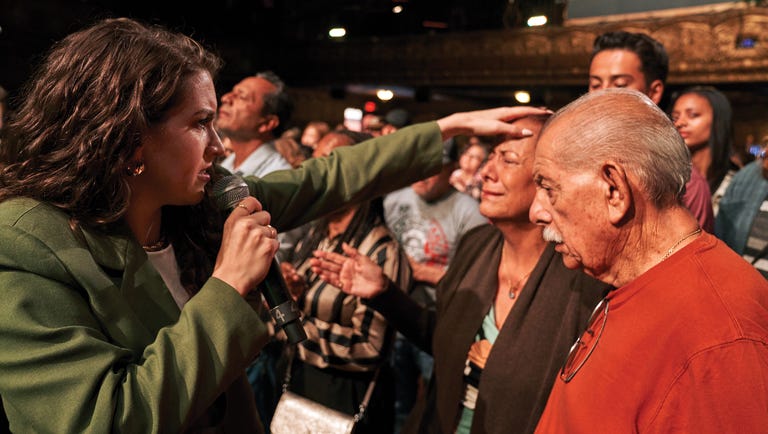
I recently saw a video of a woman beginning to shake “uncontrollably” as Kathryn laid hands on her. Yet, even while supposedly unable to control her movements, she was able to prepare for the fall by reaching up and pulling the scrunchie from her hair. By contrast, Ezekiel was not in control of his movements. He fell on his face before the glory of God, and then “the Spirit entered into me and set me on my feet” (Ezek. 2:2). Later, “the Spirit lifted me up and took me away” (Ezek. 3:12, 14; cf. 3:24; 8:3; 11:1, 24). He did not decide when to fall, nor could he simply stand up at will. The Spirit Himself directed these unique revelatory events. This stands in stark contrast to the carefully orchestrated scenes common in many modern deliverance meetings, where people voluntarily line up to receive a touch from a minister, fall into the arms of catchers, and moments later rise to repeat the experience. Ezekiel’s encounter authenticated God’s revelation through a prophet; it was never presented as a pattern for ordinary believers seeking a spiritual encounter.
The only other notable instance of people falling in the immediate presence of Christ occurred when the soldiers came to arrest Him. At Jesus’ declaration, “I am He,” they drew back and fell to the ground (John 18:6). Yet these were unbelievers overwhelmed by Christ’s divine authority—not worshipers receiving a blessing or believers experiencing a fresh anointing.
Finally, the New Testament consistently presents corporate worship as orderly and intelligible. While discussing the most spectacular spiritual gifts, Paul insists that “God is not a God of confusion but of peace” and commands, “Let all things be done decently and in order” (1 Cor. 14:33, 40). Biblical spirituality is not measured by the intensity of physical manifestations but by faithfulness to Christ, submission to Scripture, and the Spirit’s transforming work in producing holiness, love, and self-control.
Claim: “Persecution And Perseverance Validate This Ministry.”
This claim confuses biblical persecution with biblical correction. Persecution involves hostility or suffering inflicted upon someone because of their faithfulness to Christ. But exposing teachings that contradict Scripture is not persecution—it is discernment. Christians are commanded to test teachings and hold all ministries accountable to the Word of God (Acts 17:11; 1 John 4:1).
Jesus Himself challenged the false interpretations and traditions of the religious leaders of His day (Matt. 15:1–9; Mark 7:6–13). Was Jesus persecuting the Pharisees by exposing their error? No. He was proclaiming truth. In fact, they were the ones who persecuted Him because He confronted their teachings and authority (John 11:47–53).
The idea that opposition automatically validates a movement is also faulty reasoning. Many groups that historic Christianity would reject, including Jehovah’s Witnesses, Mormons, and other religious sects, use the same argument: “We are being opposed, therefore we must be right.” But both true and false teachers can face opposition. The question is not whether a ministry is criticized, but whether it is faithful to Scripture.
Likewise, the claim that a ministry’s growth proves God’s approval misuses Acts 5:38–39. When Gamaliel advised the Jewish council, saying, “If this plan or this undertaking is of man, it will fail; but if it is of God, you will not be able to overthrow them,” he was not giving a promise from God or establishing a biblical test for validating ministries. He was a Pharisee offering a cautious argument to persuade the council not to interfere with the apostles.
Using Gamaliel’s words to argue that success or growth proves God’s endorsement ignores the broader testimony of Scripture. False prophets can gain followers (Matt. 24:11), false teachers can attract crowds (2 Tim. 4:3–4), and outward success is never the measure of truth.
The biblical standard is not, “Is this movement growing?” The standard is, “Is this teaching true?” A ministry is not validated by opposition or popularity, but by its faithfulness to Christ and submission to the authority of Scripture.”
Claim: “Born-again Christians can be inhabited by demons and need repeated deliverance.”
One of the defining claims of the modern deliverance movement is that genuine, born-again Christians can be inhabited by demons and therefore require repeated deliverance sessions from specially appointed ministers. Yet this teaching is nowhere found in the New Testament.
In the Gospels, those who are demonized are unbelievers, not regenerated followers of Christ (Mark 1:23–26; 5:1–20; 9:17–27). Jesus cast demons out of those who were under demonic bondage, but He never taught His disciples that the indwelling presence of demons was a normal condition for those who had been made new by the Spirit. After Pentecost, when the apostles established churches and addressed every kind of spiritual problem—from immorality and false teaching to division and persecution—they never instructed believers to seek exorcism or attend deliverance sessions.
The reason is simple: the New Testament describes conversion itself as a deliverance. Paul writes that God “has delivered us from the domain of darkness and transferred us to the kingdom of his beloved Son” (Col. 1:13). This is not a partial deliverance awaiting completion through a minister’s intervention. It is a finished work accomplished through Christ.
Believers have been united to Christ (Rom. 6:5), sealed with the Holy Spirit (Eph. 1:13–14), and made the temple of God: “Do you not know that you are God’s temple and that God’s Spirit dwells in you?” (1 Cor. 3:16; cf. 6:19). Scripture gives no indication that the Holy Spirit shares His dwelling place with an indwelling demon.
This does not mean Christians cannot experience spiritual warfare. Believers can be tempted (1 Cor. 10:13), deceived (2 Cor. 11:3), accused (Rev. 12:10), and attacked by the enemy (Eph. 6:11–18). But the biblical response is not to seek a deliverance specialist. James does not say, “Find someone with a special anointing to cast it out.” He says, “Submit yourselves therefore to God. Resist the devil, and he will flee from you” (James 4:7). And Ephesians 6 points us to simple, ordinary means of grace for the battle: truth, righteousness, the gospel of peace, faith, salvation, and the Word of God—along with prayer (Eph. 6:14–18).
Christians do not need repeated deliverance from demons because Christ has already delivered them from the kingdom of darkness. The believer’s calling is not to chase freedom through endless deliverance experiences, but to stand firm in the victory Christ has already secured. “He disarmed the rulers and authorities and put them to open shame, by triumphing over them in him.” (Col 2:15)
Claim: “Those who question these practices are being Pharisaical.”
Another common response from defenders of modern deliverance movements is to accuse critics of being “Pharisees”—as though examining teachings, questioning experiences, or testing ministries is a form of religious pride. But this misunderstands both Jesus’ rebuke of the Pharisees and the biblical command to exercise discernment.
The Pharisees were not condemned because they tested truth. They were condemned because they elevated human traditions above God’s Word (Mark 7:6–13), sought honor for themselves (Matt. 23:5–7), and rejected Christ despite the testimony of Scripture (John 5:39–40). Biblical discernment is not Phariseeism; it is obedience.
The Bereans were praised, not condemned, because they examined even the apostle Paul’s teaching against Scripture: “They received the word with all eagerness, examining the Scriptures daily to see if these things were so” (Acts 17:11). If the Bereans were commended for testing an apostle, then no modern preacher, prophet, or minister is above biblical examination.
Jesus Himself warned that false prophets would arise and deceive many (Matt. 24:11, 24). John commanded believers, “Do not believe every spirit, but test the spirits to see whether they are from God” (1 John 4:1). Paul cautioned that false apostles disguise themselves as “apostles of Christ” and as “ministers of righteousness“, just as “Satan disguises himself as an angel of light” (2 Cor. 11:13–15). He instructed the church to “test everything; hold fast what is good” (1 Thess. 5:21).
Therefore, questioning claims of modern deliverance and prosperity ministries is not a lack of faith—it is an act of faithfulness. The question is not whether someone claims miracles, experiences, or spiritual power. The question is whether those claims align with the teaching of Christ and the apostles.
True humility does not mean refusing to examine claims. True humility means submitting every claim—including those made by influential ministers—to the authority of God’s Word.
Claim: “We Reverently Address Kathryn as ‘Mama’ because She is Our Spiritual Mother.”
A recent video featuring self-proclaimed apostle Kathryn Krick has drawn attention because someone addressed her as “Mama.” Defenders may point out that the apostle Paul referred to Timothy and Onesimus as his “sons” in the faith (1 Tim. 1:2; Philem. 10), and even told the Corinthians, “I became your father in Christ Jesus through the gospel” (1 Cor. 4:15). Doesn’t that justify calling a spiritual leader “Mama” or “Father”? Not necessarily.
Paul certainly embraced the reality of spiritual parenthood. Those who lead others to Christ and faithfully disciple them often develop a fatherly or motherly relationship with those they serve. But there is an important distinction between describing a relationship and adopting an honorific title.
In the New Testament, Paul never instructs believers to address him as “Father,” nor do we find anyone calling him by that title. Instead, he simply describes the pastoral relationship he has with those he has nurtured in the faith.
This becomes especially significant in light of Jesus’ words: “Call no man your father on earth, for you have one Father, who is in heaven” (Matt. 23:9). Whatever the precise scope of Jesus’ warning, it clearly cautions against elevating religious leaders with titles that can foster undue reverence and dependence.
Calling a ministry leader “Mama” functions in much the same way. It moves beyond acknowledging loving discipleship and toward conferring a position of spiritual prominence. This concern is amplified when the leader also claims the office of apostle, since such movements often place extraordinary authority in a single personality.
Krick’s followers not only call her “Mama,” but some also bow or kneel before her as an expression of honor. Her defenders argue that this is a cultural expression of honor in Africa and point to Old Testament examples of people bowing before others (Gen. 23:7; 1 Sam. 24:8). But whatever cultural or covenantal significance such gestures had under the Old Covenant, the New Testament gives us a very different pattern for honoring spiritual leaders. When Cornelius fell down before Peter, Peter immediately told him, “Stand up; I too am a man” (Acts 10:25–26). Likewise, when John fell down to worship before an angel, he was twice commanded, “You must not do that!” and told to worship God (Rev. 19:10; 22:8–9). In the New Testament, the honor and veneration that surrounded the Old Covenant’s representatives is redirected to Christ. Christian leaders are to be honored (1 Tim. 5:17), but they are never presented as figures before whom believers should bow in reverence. The pattern is clear: honor the servant, but worship and bow before Christ alone. Healthy church leadership is real, but it is marked by humility, servanthood, and accountability—not by cultivating titles and practices that encourage personal exaltation.
Claim: “Other Christians Are Not Experiencing the Power and Revival That Is Present at Our Meetings.”
The assumption behind this claim is that God’s power and true revival are primarily identified by extraordinary manifestations, dramatic experiences, or unusual events occurring in a particular gathering. However, this is not how Scripture defines the work of the Holy Spirit.
In the New Testament, God’s power is first and foremost the power that saves, transforms, and sanctifies His people. Paul says that the same immeasurable power that raised Christ from the dead is at work in every genuine believer (Eph. 1:19–20). It is the power that strengthens us by His Spirit (Eph. 3:16), enables us to put sin to death (Rom. 8:13), and produces a life increasingly conformed to Christ (Rom. 8:29). Paul declares that “the gospel…is the power of God for salvation to everyone who believes” (Rom. 1:16).
Biblically, revival is not primarily defined by miracles, manifestations, or extraordinary experiences. Throughout Scripture, revival is God renewing His covenant people when they have grown spiritually cold or wandered into disobedience, restoring them to repentance, faithfulness, and obedience. The psalmist’s prayer, “Will you not revive us again?” (Ps. 85:6), was a plea for restored fellowship with God, not a request for signs and wonders.
The prophets looked forward to the greater fulfillment of this renewal in the New Covenant. God promised, “I will give you a new heart, and a new spirit I will put within you… And I will put my Spirit within you, and cause you to walk in my statutes and be careful to obey my rules” (Ezek. 36:26–27). The defining evidence of God’s Spirit would be a transformed people who increasingly walk in obedience to Him. This promise is fulfilled in Christ. Through regeneration, believers receive new hearts and are indwelt by the Holy Spirit (John 3:5–8; Titus 3:5–6). The Spirit’s work is not primarily to create dramatic moments, but to produce holiness and Christlike character: love, joy, peace, patience, kindness, goodness, faithfulness, gentleness, self-control (Gal. 5:22–23).
Claim: “You Shouldn’t Judge a Ministry Bearing So Much Fruit”
Along with Paul, I’m genuinely thankful when the Gospel impacts someone eternally, even if conveyed through a corrupt ministry (Php. 1:15-18). Jesus Himself agreed that, insofar as someone does works in alignment with His will, they are not against Him (Mk 9:38-40). Nevertheless, we need to be careful how we define “fruit.”
Mormons, Jehovah’s Witnesses, and other cultic groups testify to dramatic life changes, God’s “felt” presence, and answered prayers. Such personal experiences do not validate a ministry.
Jesus said we would know false prophets by their fruits (Matt. 7:15–20). Yet many who prophesy, cast out demons, and do miracles in His name will hear the frightful words at the judgment: “I never knew you” (vv. 22–23). Therefore, those supernatural phenomena are not the fruit by which a true or false prophet is ultimately identified. Jesus points us instead to something deeper: whether a person hears His words and does them (vv. 24–27).
The same principle appears in Deuteronomy 13. God acknowledged that a false prophet might actually perform a sign or wonder that comes to pass. The decisive test was not the miracle, but whether the prophet’s teaching led God’s people astray after other gods (Deut. 13:1–3). Likewise, Jesus warned that many false prophets would arise in the last days and deceive many. John tells us to test the spirits, and the Bereans were commended for examining even the Apostle Paul’s teaching by Scripture. That’s not a Pharisee spirit—that’s biblical discernment.
I rejoice whenever anyone truly comes to Christ. As Paul said, he could rejoice even when Christ was preached by people with wrong motives (Phil. 1). But rejoicing over conversions is different from giving unquestioning approval to every ministry’s doctrine and practices.
The question isn’t whether people are sincere or whether lives appear changed. The question is: Is the ministry teaching and practicing what the New Testament actually commands? That’s the standard every one of us should welcome.
While many followers loyally support Krick due to the viral “fruit” of her deliverance ministry, Krick herself maintains an unwavering alignment with her spiritual father, GeorDavie, despite explosive public allegations. According to an investigative report by Jubilee Cast, GeorDavie faces severe scrutiny over alleged sexual abuse and spiritual misconduct, with whistleblowers claiming Krick ignored these warnings and rebuked the accusers. This blind, undiscerning support undermines her platform’s integrity. Within ministry accountability standards, shielding a compromised leader and disregarding serious ethical harm is itself classified as “bad fruit,” proving that a ministry cannot be validated by emotional manifestations alone if it fails the fundamental test of spiritual discernment. Instead of defensively crying out, “Judge not lest ye be judged“—a passage dealing with hypocrisy, not righteous judgment—Krick’s followers should instead follow Paul’s command to deal swiftly with a case of unrepentant sexual immorality: “Is it not those inside the church whom you are to judge?” (1 Cor. 5:12).
Claim: “We are Going Deeper Than Others into the Mysteries of God.”
One hallmark of many hyper-charismatic movements is an obsession with hidden spiritual mysteries. Followers are encouraged to seek secret revelations, prophetic “downloads,” heavenly insights, or symbolic meanings that supposedly unlock deeper levels of God’s will. While this may sound spiritual, it is not the emphasis of the New Testament.
Under the Old Covenant, God often revealed His hidden purposes through prophets (Amos 3:7). But the coming of Christ marked a major shift in redemptive history. The New Testament presents prophecy primarily as a ministry of “edification, exhortation, and comfort” (1 Cor. 14:3), centered on “the testimony of Jesus” (Rev. 19:10). The Spirit’s primary work is to glorify Christ (John 15:26), not to continually unveil new Gospel secrets.
Paul’s use of the Greek word mystērion (“mystery”) is especially instructive. Throughout his letters, two truths consistently emerge.
First, the mystery was the Gospel itself—especially God’s plan to unite Jews and Gentiles in Christ. Paul speaks of “the mystery of the gospel” (Eph. 6:19), “the mystery of Christ” (Col. 4:3), and explains plainly that this mystery is “that the Gentiles should be fellow heirs, and of the same body” (Eph. 3:6). The mystery was Christ’s redemptive work and its worldwide scope.
Second, the mystery is no longer hidden. Paul repeatedly says it “was kept secret” but “now is made manifest” (Rom. 16:25-26; Col. 1:26). The mystery was concealed in previous ages but has now been revealed through Christ and His apostles. It is not an ongoing stream of new doctrinal revelations for future prophets to uncover.
This has important implications. The Holy Spirit certainly grants wisdom, insight, and illumination into Scripture, but that is very different from revealing new truths of universal significance. If modern prophets can unveil new Gospel mysteries beyond what the apostles recorded, then where does that leave the sufficiency of Scripture? What prevents today’s revelations from becoming tomorrow’s Scripture?
The New Testament points us in the opposite direction. Believers are not told to search for hidden mysteries but to understand the will of God already revealed (Eph. 5:17; Col. 1:9). The faith has been “once for all delivered to the saints” (Jude 3), and the church is “built on the foundation of the apostles and prophets” (Eph. 2:20)—not upon an ever-expanding foundation of modern revelations.
The greatest mystery has already been unveiled: Christ crucified, risen, reigning, and gathering one people from every nation. Our calling is not to chase new mysteries, but to faithfully proclaim the One who has already been revealed.
Claim: “By Challenging Our Miracles You May Be Blaspheming the Holy Spirit”
One of the most troubling tactics in some hyper-charismatic circles is the claim that questioning the miracles or prophecies of modern apostles and prophets amounts to blasphemy of the Holy Spirit. This accusation is not only biblically unfounded—it weaponizes one of Scripture’s most sobering warnings to discourage discernment.
Jesus’ warning about blasphemy of the Holy Spirit arose in a very specific context. The religious leaders were not honestly evaluating questionable miracle claims. They had witnessed undeniable miracles performed by Christ Himself and, rather than submitting to the obvious work of God, deliberately attributed the Holy Spirit’s work to Satan out of envy, pride, and hardened unbelief (Mark 3:22-30; Matthew 12:22-32).
The Gospels even indicate that these leaders knew Jesus’ miracles were genuine. Nicodemus admitted, “We know that You are a teacher come from God, for no one can do these signs unless God is with him” (John 3:2). After the raising of Lazarus, the chief priests and Pharisees acknowledged, “This man performs many signs” (John 11:47), yet their concern was preserving their own position, not determining whether the miracles were authentic.
This is a far cry from a sincere Christian who tests modern miracle claims against Scripture, as believers are repeatedly commanded to do (1 Thess. 5:21; 1 John 4:1). The Bereans were commended for examining even the Apostle Paul’s teaching (Acts 17:11). Biblical discernment is an act of obedience, not unbelief.
To equate thoughtful testing of modern claims with the Pharisees’ willful rejection of Christ is to rip Jesus’ warning from its context. The Pharisees knowingly called God’s unmistakable work satanic. Christians who cautiously evaluate contemporary miracle claims are simply following Scripture’s command to “test the spirits.”
Ironically, labeling all skepticism as blasphemy of the Holy Spirit often functions as a shield against biblical accountability rather than a defense of God’s honor.

