

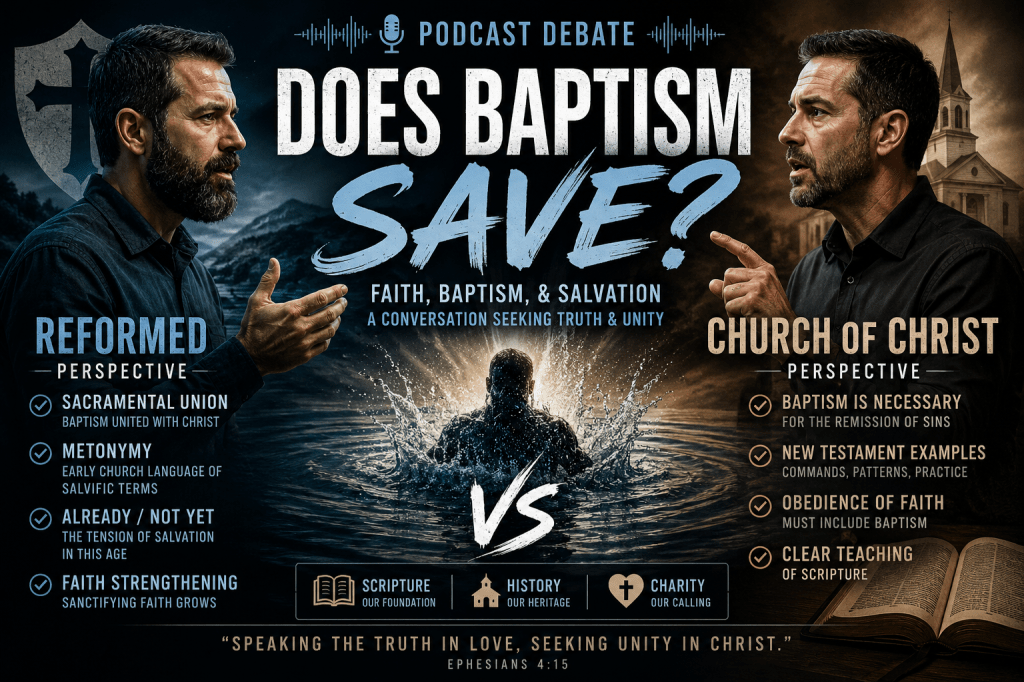
Podcast discussion: https://answersinthemiddle.com/wp-content/uploads/2026/05/podcast_baptism.m4a
Debate script:
“Waters of Grace: A Reformed and Church of Christ Conversation on Baptism”
Host: Welcome back to Waters of Grace. Today we’re discussing one of the most debated issues in Christian theology: baptism and salvation. Joining us are two guests. First, a Reformed theologian, Caleb, who holds to a sacramental and means-of-grace understanding of baptism. And second, Daniel, from the Churches of Christ tradition, who strongly affirms baptism as necessary for salvation. Gentlemen, thanks for joining us.
Opening Statements
Daniel (Church of Christ):
Thanks for having me. I’ll be direct: the New Testament consistently connects baptism with salvation, forgiveness of sins, and union with Christ. The Holy Bible says in Acts 2:38, “Repent and be baptized… for the forgiveness of sins.” Jesus says in Mark 16:16, “He who believes and is baptized shall be saved.” Peter plainly says, “Baptism now saves you” in 1 Peter 3:21.
The early church fathers overwhelmingly interpreted these passages straightforwardly. Baptism is not a mere symbol; it is the God-ordained moment where one enters Christ and receives the blessings of the gospel.
Caleb (Reformed):
I appreciate much of that emphasis. Honestly, many evangelicals have reduced baptism to a bare public symbol disconnected from grace, and I think that’s a mistake historically and biblically. The Reformed tradition has always regarded baptism as a true means of grace and a sacrament through which God genuinely works.
But I’d frame things differently from my brother Daniel. I would not say the water itself mechanically regenerates someone. Rather, baptism is a divinely appointed occasion where the Holy Spirit may produce and/or strengthen faith through what reformed teachers call sacramental union.
In sacramental union, God closely joins the sign and the thing signified without confusing them. So Scripture can speak very strongly about baptism because God truly acts through it — yet the external sign and the inward grace are not identical.
Baptism and Salvation Language
Host: Daniel, what would you say to someone who claims the salvation related baptism passages are using figures of speech?
Daniel:
I’d say that interpretation would’ve sounded foreign to the early Christians. When Peter says baptism saves, he means baptism saves. When Ananias tells Paul, “Rise and be baptized and wash away your sins,” he means exactly that.
The Church Fathers consistently tied remission of sins and new birth to baptism itself. That historical consensus matters.
Caleb:
I agree the Fathers had an extraordinarily high view of baptism, and modern low-sacramental evangelicalism often ignores that. But there’s an important nuance here.
The Fathers often used what theologians call metonymy or sacramental language. In Scripture and early Christianity, closely related saving realities are frequently spoken of interchangeably. Faith, repentance, baptism, regeneration, union with Christ, and salvation are often verbally fused together because they normally occur together in conversion.
For example, sometimes Scripture says we are saved by faith. Other times by grace. Other times by calling on the Lord. Other times by baptism. That doesn’t mean every term is functioning identically or independently.
The early church could speak of baptism as regeneration because baptism was the normative visible occasion where repentance, faith, Spirit reception, and entrance into the covenant community converged.
Daniel:
But doesn’t that weaken the plain force of the text? If baptism is merely associated with salvation, why speak so strongly?
Caleb:
Because God really does work through baptism. Reformed theology doesn’t deny efficacy — it denies automaticism.
Take Acts 2. Peter doesn’t preach “faith alone” abstractly detached from baptism. He presents a unified conversion event: repent, be baptized, receive the Spirit. Baptism is not an empty ceremony added afterward. It is part of the covenantal response of faith.
But the Reformed position would say the Spirit is the efficient cause of regeneration, not the water itself. Baptism is an instrument or occasion through which the Spirit ordinarily works; but not always.
Scripture itself gives us exceptions. Cornelius receives the Spirit before baptism in Acts 10. The thief on the cross is saved apart from baptism. Salvation is ultimately through faith in Christ alone.
Sacramental Union
Host: Caleb, unpack sacramental union more. That’s probably unfamiliar to many listeners.
Caleb:
Sure. In Reformed theology, God joins His promises to physical signs. The sign truly communicates and presents Christ to believers, yet the physical element itself does not contain saving power inherently.
So when Peter says, “Baptism now saves you,” he immediately clarifies: “not the removal of dirt from the flesh, but the appeal of a good conscience toward God.” The saving reality isn’t bare water; it’s Christ communicated through faith by the Spirit.
The Westminster tradition would say the grace signified in baptism is really exhibited and conferred by the Holy Spirit to those whom that grace belongs unto — in God’s appointed time.
That means baptism can be a converting event, a faith-strengthening event, or even later become effectual as someone grows into the promises signified there.
Daniel:
But the danger there is separating faith from obedience. In the New Testament, believers were baptized immediately. There wasn’t this category of an unbaptized Christian comfortably remaining outside baptism.
Caleb:
On that point, I strongly agree. The New Testament treats refusal of baptism as deeply serious. Faith and baptism belong together covenantally.
Where I’d differ is saying every unbaptized believer is necessarily damned. Even many Fathers who strongly affirmed baptismal regeneration acknowledged extraordinary cases — martyrdom (or baptism of blood), desire for baptism (or baptism of desire), and catechumens who died before baptism.
That shows even they recognized God is not absolutely bound to the sacrament, though we are bound to obey Christ regarding it.
Already / Not Yet Salvation
Host: Caleb, you mentioned a faith-strengthening aspect of baptism. How does this connect to salvation?
Caleb:
This is hugely important. In Scripture, salvation is past, present, and future.
Believers have been saved from sin’s guilt. We are being saved through sanctification. And we will be saved finally at glorification.
Because of that, sacramental language can operate across multiple dimensions of salvation.
For example, baptism can be said to “save” not only because it accompanies conversion, but because it strengthens faith and conforms believers to Christ throughout the Christian life. In that sanctifying sense, baptism participates in our ongoing salvation journey toward final glorification.
That fits passages like 1 Peter 3:21 remarkably well. Peter isn’t talking about magic water; he’s talking about covenantal union with Christ through a faith-filled appeal to God.
Daniel:
I actually appreciate some of that. Churches of Christ often emphasize baptism’s role in entering Christ, but perhaps we don’t always emphasize its lifelong significance enough.
Still, I worry your framework risks uncertainty. If baptism is merely an occasion where grace may occur, how does someone know when they were truly regenerated?
Caleb:
Ultimately, assurance rests in Christ received by faith, not in pinpointing a metaphysical moment. Sometimes regeneration precedes baptism slightly, sometimes it accompanies it, sometimes it follows it; and it always serves as a profound strengthening and sealing occasion.
The key is that God genuinely uses Word and sacrament together. Baptism is not “just symbolic,” but neither is it an automatic ritual that works apart from faith and the Spirit.
Common Ground
Host: It sounds like there’s more agreement here than people might expect.
Daniel:
Definitely more than I anticipated. We both reject the idea that baptism is optional or merely ceremonial.
Caleb:
And we both affirm that baptism is deeply tied to salvation biblically and historically. Where we differ is primarily how God works through it.
Daniel:
I’d still say Scripture presents baptism as the normative moment of forgiveness and entrance into Christ.
Caleb:
And I’d say baptism is the normative sacramental occasion where God conveys and seals His promises through faith by the Spirit — without reducing regeneration to the mechanics of water itself.
Closing Remarks
Host: Final thoughts?
Daniel:
If you believe in Christ and have not been baptized, obey Him. The apostles never treated baptism as optional.
Caleb:
And don’t reduce baptism to a mere public testimony. God truly meets His people through His appointed means. Baptism is a gospel event — a visible Word proclaiming union with Christ, forgiveness, cleansing, and resurrection life.
Host: Gentlemen, thank you both for a thoughtful and charitable discussion.

