

In Part One, we focused on the timing of the Second Coming with respect to the millennium. I’ve made an attempt to bridge the great divide between Premillennialism and Amillennialism, by carrying the two non-negotiables of amillennialism into the premillennial framework.
What About the Nature of the Millennium?
Isn’t there still a great divide in the way the amills and premills understand what happens during the millennium? Don’t all premills take a wooden literal approach to Israel’s restoration prophecies in Old Testament, applying those to the millennium? Don’t all amills take a purely symbolic approach to those same prophecies, applying them to the church in the now-occurring millennium? While these differences seem insurmountable, I suggest that there is a possibility of reconciliation. Even Augustine, who advocated amillennialism, was open to (and once held to) a form of Premillennialism that shared some spiritual affinities with amillennialism:
This opinion [a future literal millenium after the resurrection] might be allowed, if it proposed only spiritual delight unto the saints during this space (and we were once of the same opinion ourselves); but seeing the avouchers hereof affirm that the saints after this resurrection shall do nothing but revel in fleshly banquets, where the cheer shall exceed both modesty and measure, this is gross and fit for none but carnal men to believe. But they that are really and truly spiritual do call those of this opinion Chiliasts. [0]
While premills may not go as far as Augustine proposed, there are camps of premills and amills that come close to having the same understanding about the nature of the future kingdom on earth.
Earthy Amillennialism
Let’s start with Vern Poythress. I was pleased to read his article, “Currents within Amillennialism”[5]. In this article, Poythress claims “certain features of inaugurated eschatology have opened doors toward greater friendliness on the part of amillennialists”[6]. He then advocates an “earthy amillennialism”, one which stresses the consummate fulfillment of the Old Testament promises in the New Heavens and Earth; not just spiritual fulfillments, but semi-literal fulfillments, including the judeo-centric ones:
Hope for a new earth thus gives us a picture that is startlingly similar to premillennialism. I believe that Jesus will return bodily to the world, that all people will be judged, and that the earth itself will be renewed. Jesus will reign over the nations and usher in an era of great peace and prosperity. Faithful Jews will possess the land of Palestine, as well as the entirety of the renewed earth. When I hear premillennialists describe what happens in the millennial kingdom, I respond, “I believe that too.” If I may play with words, I would say that I am an optimistic premillennialist. I believe the things that premillennialists typically say about the millennium.[7]
I think that earthy amillennialists should find no problem in affirming that all faithful Jews will join with Abraham in inheriting the land of promise and fully enjoying the blessing of God in the new world. Amillennialism should not be understood as disinheriting Jews, but rather affirming the incorporation of Gentiles into the family of promise through their union with Christ. Hence, Gentiles also will share with Jews as coheirs in Christ (Eph. 3:6; Rom. 8:17). The question is not whether Jews will come into possession of the wealth of privileges of Old Testament promises (they will), but whether a new middle wall of partition will be erected by granting them some unique priestly or religious status from which Gentiles are excluded (Eph. 2:14).[8]
Spurgeon’s Historic Premillennialism
Now let’s turn to Charles Surgeon. I was pleased to discover his millennial view at the online “Spurgeon Archive”[9]. Although a historic premillennialist (not a dispensational), Spurgeon held a position which maintained significant literality of the Old Testament promises regarding the restoration of Israel, aligning them with the New Testament affirmation in Romans 11:26-31. However, like amillennialists, he denied that there would be an eschatological temple with literal sin offerings. He preferred, instead, to view the temple prophecies as pictures of the millennial church gathering in some Christian building.
The hour is approaching, when the tribes shall go up to their own country; when Judea, so long a howling wilderness, shall once more blossom like the rose; when, if the temple itself be not restored, yet on Zion’s hill shall be raised some Christian building, where the chants of solemn praise shall be heard as erst of the old Psalms of David were sung in the Tabernacle . . . I think we do not attach sufficient importance to the restoration of the Jews. We do not think enough about it. But certainly, if there is anything promised in the Bible it is this. I imagine that you cannot read the Bible without seeing clearly that there is to be an actual restoration of the Children of Israel . . . For when the Jews are restored, the fullness of the Gentiles shall be gathered in; and as soon as they return, then Jesus will come upon Mount Zion with his ancients gloriously, and the halcyon days of the millennium shall then dawn; we shall then know every man to be a brother and a friend; Christ shall rule with universal sway.[10]
With the amillenialists, he also upheld the oneness of the people of God, and the fact that in Christ the believing Gentiles are part of the seed of the Abraham (Gal 3:29), and now participate in the salvific blessings of the true Israel (Rom 2:28-29), the remnant (Rom 9:27, 11:5). While keeping some functional distinction for saved Jews, he affords the Gentiles with the same spiritual privileges:
If we read the Scripture’s aright the Jews have a great deal to do with this world’s history. They shall be gathered in; Messiah shall come, the Messiah they are looking for—the same Messiah who came once shall come again—shall come as they expected him to come the first time. They then thought he would come a prince to reign over them, and so he will when he comes again. He will come to be king of the Jews, and to reign over his people most gloriously; for when he comes Jew and Gentile shall have equal privileges, though there shall yet be some distinction afforded to that royal family from whose loins Jesus came; for he shall sit upon the throne of his father David, and unto him shall be gathered all nations.[11]
Notice that Spurgeon and Poythress describe similar future circumstances – the fulfillment of Israel’s peace, prosperity, and land promises to His unified people – with one primary difference, the timing. Spurgeon places the reign in the millennium, whereas Poythress, who doesn’t hold to a future millennium, places it in the New Heavens and Earth instead. Who is correct? Perhaps they both are!
In the Old Testament, there only seems to be one kind of restoration prophecy, not a millennial kind versus a New Heavens and Earth kind. For example, compare Isaiah 11 with Isaiah 65:
The wolf shall dwell with the lamb, and the leopard shall lie down with the young goat, and the calf and the lion and the fattened calf together; and a little child shall lead them. 7 The cow and the bear shall graze; their young shall lie down together; and the lion shall eat straw like the ox. 8 The nursing child shall play over the hole of the cobra, and the weaned child shall put his hand on the adder’s den. They shall not hurt or destroy in all my holy mountain; for the earth shall be full of the knowledge of the LORD as the waters cover the sea. (Isa 11:6-9, ESV, Emphasis added)
“For behold, I create new heavens and a new earth, and the former things shall not be remembered or come into mind … 25 The wolf and the lamb shall graze together; the lion shall eat straw like the ox, and dust shall be the serpent’s food. They shall not hurt or destroy in all my holy mountain,” says the LORD. (Isa 65:17-25, ESV, Emphasis added)
Notice these texts are describing the same state of affairs – universal prosperity and peace in the earth, even in the animal kingdom. Isaiah 11 is typically attached to the millennium by Premills. Isaiah 65, however, calls this state of affairs the “New Heavens and Earth”. Another example of this is found in Isaiah 66:
For as the new heavens and the new earth that I make shall remain before me, says the LORD, so shall your offspring and your name remain. 23 From new moon to new moon, and from Sabbath to Sabbath, all flesh shall come to worship before me, declares the LORD. 24 And they shall go out and look on the dead bodies of the men who have rebelled against me. For their worm shall not die, their fire shall not be quenched, and they shall be an abhorrence to all flesh. (Isaiah 66:22-24, ESV, Emphasis added)
This passage is also typically attached to the millennium by Premills, even though Isaiah seems to correlate it to the “new heavens and the new earth”, and it fits the description of the lake of fire that John places parallel with his new heavens and new earth (Rev 21:8, 22:15, 14:10-11). These observations should beg the question – What if the millennium is simply the onset of the new heavens and new earth? This could explain many phenomena:
- The fact that Peter’s discussion about the second coming (2 Pet 3:1-13) has us looking forward to the “new heavens and earth” (2 Pet 3:13), rather than some other transitional period before the New Heavens and Earth.
- The fact that some Old Testament millennial texts call the earthly reign the “the new heavens and the new earth” (Isa 65:17ff, 66:22ff)
- The fact that Revelation has many prophecies commonly attributed to the earthly millennial kingdom fulfilled in its new heavens and earth section (Rev 21-22). Several Isaiah 60 prophecies are fulfilled in Revelation 21:22-26. Isaiah’s millennial lake of fire scene (Isa 66:24) is placed outside of John’s New Jerusalem (Rev 21:8, 22:15). Several of Ezekiel’s prophecies regarding a restored Jerusalem (Ezek 40-48) are fulfilled throughout Revelation 21. His river of life (Ezek 47:1-9) is seen in Revelation 22:1-2. His twelve city gates (Ezek 48:30-34) are seen in Revelation 21:12-13. Dave Mathewson makes a great point: “all the occurrences of OT texts about the restoration of Israel and the promised blessings of the kingdom are found in Revelation 21:1-22:5, not in Revelation 20:4-6”[12]. Therefore, if Isaiah 60-66 and Ezekiel 40-48 are millennial in nature, then so is Revelation 21:1-22:5.
- The prophetic suggestion that mortals exist in the new heavens and earth. Isaiah prophesied, “For behold, I create new heavens and a new earth … No more shall there be in it an infant who lives but a few days, or an old man who does not fill out his days, for the young man shall die a hundred years old, and the sinner a hundred years old shall be accursed” (Isa 65:17, 21). This couples well with John’s vision of the leaves that are for the “healing of the nations” (Rev 22:2). The prophesied presence of mortals in need of healing potentially supports the Mortal Nations View described in Part 1.
Taking the above facts into account, it is best to understand the scene of Revelation 21 as recapitulating to the beginning of chapter 20.
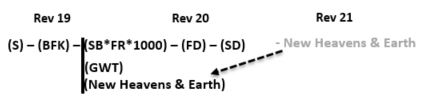
In this scheme we could envision the New Jerusalem descending to the New Earth at the onset of the millennium (Rev 21:2). Then, after the millennium, the deceived nations (either mortal or demonic) gather around this “beloved city” to attack it (Rev 20:9).
One might argue that there are differences between the New Jerusalem and the Millennial Jerusalem that prevent them from being identified as the same city. The New Jerusalem is vastly larger, excludes all sinners, contains no death or curse, and has no temple (Rev. 21–22). The Millennial Jerusalem is much smaller, includes mortal inhabitants who later rebel, experiences death, and centers on a temple (Ezek. 40–48; Isa. 65).
To address this issue, some scholars–particularly those of the Mortal Nations View–propose that the New Jerusalem functions as a heavenly “satellite city” during the Millennium, inhabited by glorified saints. It descends from heaven (Rev. 21:2) and coexists with earthly Jerusalem, where mortals dwell, forming integrated yet distinct realms. Life and healing flow from the heavenly city to the earthly, though mortals cannot enter the sinless heavenly realm. Its apostolic foundations link it to the glorified church (Rev. 21:14), while shared gates and Christ’s throne connect both cities (Ezek. 48; Rev. 21–22; Matt. 25). [13]
A more simple solution–especially for the Demonic Nations View which does not need a mortal habitation–is to propose that the Ezekiel prophecies regarding the New Jerusalem are fulfilled in a modified way due to historical contingencies. This is an approach taken by Richard Pratt, and which I propose in my series, “Back to the Future”.
Some may hesitate to accept my proposed recapitulation, assuming it to be a novel proposal. Yet it is already reflected in J. Webb Mealy’s New Creation Millennialism model, a position embraced by the Reformed Baptist scholar, Thomas R. Schreiner:
New creation millennialism acknowledges and embraces the many clear indications in Rev. 21:1-8 that this is yet another revelation of Christ’s and his Father’s coming in glory—this time with the Bride. This implies not only that the Beloved City of Rev. 20:9 is identical with the New Jerusalem, but also that the resurrection of the unrepentant is to be understood as taking place on earth in the context of the new heavens and the new earth. [14]
If only more theologians would follow his lead — Earthy amillennialists of the Poythress type rewinding the New Heavens and Earth to align with Revelation 20, and premillennialists of the Spurgeon type making the necessary adjustments to embrace a single, parallel resurrection and judgment scene in Revelation 20. I believe the two sides could arrive at a very similar position in the middle ground.
I have much hope that my proposal can nurture fruitful discussions about Millennialism and the church can continue to merge towards a Middle Ground that doesn’t compromise scripture, but actually aligns with it!
Press the SUBSCRIBE button at the bottom to get emails when we publish new articles.
Click on the Link to our Middle Ground Theology Facebook Page at the bottom to interact with our growing community.
End Notes:
[0] Augustine, City of God, XX, 7.
[5]Currents within Amillennialism. Vern Poythress. Published in the Presbyterion 26/1 (2000) 21-25.
[6] ibid
[7] ibid
[8] ibid
[9] Charles H. Spurgeon and the Nation of Israel: A Non-Dispensational Perspective on a Literal National Restoration. by Dennis M. Swanson, Head Librarian and Director of Israel Studies, The Master’s Seminary Sun Valley, California. 2000. http://www.romans45.org/spurgeon/misc/eschat2.htm
[10] Spurgeon, “The Church of Christ,” NPSP 1:213-14.
[11] Spurgeon, “The Leafless Tree,” NPSP, 3:114
[12] Sung Wook Chung and David Mathewson. Models of Premillennialism. Cascade Books * Eugene Oregon, 2018. Kindle Version.
[13] “The new heavens and new earth are said to be created, but the new Jerusalem comes down from heaven. Some believe, therefore, that the heavenly Jerusalem will be a satellite city throughout the millennial reign of Christ and in this city resurrected and translated saints will dwell. By contrast, those in their natural bodies will live on the millennial earth itself. While there is no clear Scripture which supports this concept and it must be held merely as an inference, it would solve a number of problems incident to the relationship of resurrected and translated beings to those still in their natural bodies who will conduct themselves in a normal way on the earth.” https://bible.org/seriespage/4-millennial-kingdom-and-eternal-state
[14] J. Webb Mealy. THE NEW CREATION MILLENNIALISM PARADIGM: A RADICAL BIBLICAL-ESCHATOLOGICAL ALTERNATIVE TO EVERLASTING TORMENT. Found at: https://rethinkinghell.com/2018/09/19/the-new-creation-millennialism-paradigm-a-radical-biblical-eschatological-alternative-to-everlasting-torment/
 The Middle Ground
Chad, I just happened upon your two posts about finding a new model of the millennium that is sensitive to the literary workings of Revelation 20 and also coheres with the major outlines of the eschatological story in other biblical books. I congratulate you for your creative and independent thinking.
That said, I encourage you to look more deeply into new creation millennialism, which you can read about in my short monograph New Creation Millennialism, available on Amazon.
New Creation Millennialism: Mealy, J. Webb: 9781082468544: Amazon.com: Books
I certainly respect your desire not to end up with the Book of Revelation teaching a doctrine that is not mentioned anywhere else in Scripture (i.e. a two-stage resurrection of the dead–the faithful at Christ’s coming in glory, and everyone else a long time later), but your solution saves a single resurrection of all by introducing another unique and unparalleled idea–that there is a whole age in which mortal children of sinners, who are allowed into the age to come without being resurrected or born of the Spirit, multiply and live as un-tempted sinners for a whole age, and ultimately succumb to the devil’s temptation after that age. So you have solved one problem by creating another.
In my view, the most elegant solution is to recognize that a universal judgment of all humanity at Christ’s coming in glory does not entail a universal resurrection of all humanity at Christ’s coming in glory. Instead, the universal judgment determines who among the living and the dead is worthy to be transformed or resurrected into incorruptible life. When we frame the issue that way, then the judgment of “the rest of the dead” by their deeds in mortal life is not deferred until after the thousand years; on the contrary, their judgment by their deeds as mortals results in a negative verdict, and their sentence is precisely to be refused resurrection for a thousand years, so that they remain in the prison of Hades, in the underworld along with the devil, for the entire period (Rev. 20:3, 5 || Isa. 24:21-23; cf. Rev. 1:18; cf. Mt. 5:25-26; 18:21-35). While they are being punished in the underworld, the resurrected faithful witnesses reign with Christ, as promised earlier (Rev. 2:10; 5:10; 11:18).
Amillennialists like to point out, as though it is embarrassing to premillennialists, that Revelation 20 is the only place in the Bible that mentions a thousand-year period. But that is arbitrary. If Jesus had revealed all that he had to reveal, he wouldn’t have given John a Revelation.
A better question to ask, rather than whether the thousand years appears anywhere else in Scripture, is this: is the idea of a selective resurrection for the faithful alone at the great judgment of all humanity found anywhere else in Scripture?
To that question, the answer is that this idea appears in five other places. The first is in Isaiah 26:
14 They [the oppressors] are dead, they will not live; they are shades, they will not arise;
19 Your dead shall live; their bodies shall rise. You [faithful ones] who dwell in the dust, awake and sing for joy! For your dew is a dew of light, and the earth will give birth to the shades.
The second is in Lk. 20:35:
34 And Jesus said to them, “The sons of this age marry and are given in marriage, 35 but those who are considered worthy to attain to that age and to the resurrection from among the dead (οἱ δὲ καταξιωθέντες τοῦ αἰῶνος ἐκείνου τυχεῖν καὶ τῆς ἀναστάσεως τῆς ἐκ νεκρῶν) neither marry nor are given in marriage…
You cannot have a resurrection from among the dead, if all the dead rise simultaneously. Just as Jesus rose from among the dead, leaving the rest of the dead in the underworld, so those who are considered worthy of a part in that age will also rise from among the dead, leaving the rest of the dead in the underworld. This is explicitly a partial, exclusive resurrection.
A little less explicit is Jesus’s reference to “the resurrection of the just” in Luke 14. He says that if you are kind to the downtrodden in this life you will be repaid at the resurrection of the just. So the resurrection of the just is a Time point, and it does not seem to be the same time point as the resurrection of those who are not just. At the very least, it is an exclusive resurrection, but it is not totally explicit that this is a temporal distinction rather than a qualitative distinction. But it reads more naturally as a temporal distinction. So that passage gets a place in our list.
The fourth passage is 1 Corinthians 15:21-24:
21 For as by a man came death, by a man has come also the resurrection of the dead. 22 For as in Adam all die, so also in Christ shall all be made alive. 23 But each in his own cohort: Christ the firstfruits, then at his coming those who belong to Christ, 24 then comes the end, when he delivers the kingdom to God the Father after destroying every rule and every authority and power.
Note that different cohorts rise at different times. It is Christ first, then those who are his at his coming, then, presumably, those who are not his at the end, when his ministry of bringing resurrection to all mankind has been completed. The idea that not all will rise when Jesus comes glory is explicit here.
The fifth item is also completely explicit: Philippians 3:10-11:
10…that I may know him and the power of his resurrection, and may share his sufferings, becoming like him in his death, 11 that by any means possible I may attain the out-resurrection from among the dead (εἴ πως καταντήσω εἰς τὴν ἐξανάστασιν τὴν ἐκ νεκρῶν).
So it’s clear that Revelation 20 does not sit all by itself in scripture as affirming that at the great coming judgment at Christ’s coming in glory only the faithful will be resurrected. It has five companion passages. The idea that there is to be, at Christ’s coming in glory, a judgment of all humanity based on their deeds in mortal life, is solidly biblical. The corollary, that judgment requires resurrection, turns out not to be correct. Rev. 19:19-20:10 spells out what is indicated in a less-than-fully-explicit way in Isa. 24:21-23; 26:10-11, 14-19; 27:1-5; 66:22-24; Lk. 20:35-36; 1 Cor. 15:21-24; Phil. 3:10-11. And why shouldn’t it? Why should not Jesus in Revelation make more explicit matters that he adumbrated or referred to briefly elsewhere in Scripture?
Sincerely,
J. Webb Mealy
LikeLike
Greetings in Christ J. Webb Mealy! I’m very honored you discovered and read through my posts. I heard about your view from Tom Schreiner a while back, which led me to read a good bit of your paper, and even quote it in those posts. I love that you discovered the same recapitulations, with the difference in the nature of those remaining in the millennium. Let me read through your comments here, and respond back if I have questions. I’m always open to healthy dialog and revision. Many blessings! Chad
LikeLiked by 1 person
Dr. Mealy, as I stated, I’m honored that you interacted with my proposal. It shares the same recapitulations as New Creation Millennialism (NCM), yet advocates the survival and rebellion of mortal nations, rather than the resurrection and rebellion of immortal nations, as espoused by NCM (and Francis Nigel Lee).
It seems that one of your major issues with my view is the presence of mortal survivors. However, this doesn’t seem to be precluded by scripture, and may even have sufficient precedent. For instance, Jesus, in His glorified state, interacted with mortal beings after His resurrection (Matthew 28:9-10). Similarly, resurrected Old Testament saints entered Jerusalem and were seen by many (Matthew 27:52-53). Several Old Testament prophecies demand the existence of mortal survivors after the restoration, such as Isaiah 24:6, 60:14, 65:21, and Zechariah 14:16. While it could be argued that the fulfillments of these prophecies are mutated in light of realized eschatology, the same could be said of the Old Testament prophecies hinting at two resurrections. So perhaps it’s hard to rely on the Old Testament for concrete hermeneutical guidance in Revelation.
With that said, my biggest challenges with NCM are in the context of Revelation itself. Throughout Revelation, the nations are depicted as mortal. To suggest that the nations surrounding the beloved city are of a different nature (i.e. immortal) may introduce a disjunction in the meaning of the term “nations”. Secondly, I’ve always understood Hades to be the intermediate state and the Lake of Fire to be the Second (and final) Death. Revelation 20 explicitly states that the wicked are thrown into the Lake of Fire following the Great White Throne Judgment scene. It’s hard for me to envision them being raised out of that estate. Finally, I have a hard time understanding what it means for the immortal nations to be “deceived” after the millennium (Rev 20:8). These wicked nations had already been deceived and were sent to the Lake of Fire because of that very deception. Were they at some point undeceived during their time in the Lake of Fire? Or was this deception some other type of deception?
Yet with all these challenges, I still find NCM quite compelling. And I still see weaknesses in my proposal. A significant one is the lack of a clear judgment scene for the innocent underage survivors. They transition from an innocent state in the millennium directly to being destroyed after the rebellion, without a narrated judgment scene. This still bothers me.
Anyhow, I am very thankful for this interaction, and I hope it is a fruitful, God honoring discussion. Many blessings!
Chad
LikeLike
Dear Chad,
I’m happy to continue the discussion in this forum if that works for you; otherwise it could turn into an email discussion or even a taped and published video dialogue.
You speak of //the resurrection and rebellion of immortal nations, as espoused by NCM//. I myself do not espouse that idea. Jesus tells the parable of the talents, whose implication is that if a person has shown themselves responsible in the use of the gifts and powers of mortal life, a greater portion of life and responsibility will be given them in the age to come and the resurrection. The unrepentant have not shown themselves responsible users of these gifts, and so it would not make sense for God to give them incorruptible life or any greater powers of agency than they were given in mortal life. Hence my belief is that they will be given the undeserved gift of a new portion of life, i.e. resurrection, but they will still be mortal, pending divine examination of their behavior. They may feel their oats and think they are invulnerable, but they will not be. When they allow themselves to be deceived by the devil all over again, and they give in to their covetous and violent impulses, fire will come down from heaven and devour them. Such is the second death, the death of the resurrected person (Rev. 20:7-10 || Isa. 26:10-11 || Isa. 66:22-24 || Heb. 10: 26-31). Christ’s death on the cross for all has redeemed them from the prison of Hades (Rev. 1:18), but they have spurned that gift and turned to wickedness all over again. This time they will not be imprisoned, but removed irrevocably from the creation.
//It seems that one of your major issues with my view is the presence of mortal survivors. However, this doesn’t seem to be precluded by scripture, and may even have sufficient precedent. For instance, Jesus, in His glorified state, interacted with mortal beings after His resurrection (Matthew 28:9-10). Similarly, resurrected Old Testament saints entered Jerusalem and were seen by many (Matthew 27:52-53).//
I grant you that these passages do not preclude the notion of mortals co-existing with immortals.
//Several Old Testament prophecies demand the existence of mortal survivors after the restoration, such as Isaiah 24:6, 60:14, 65:21, and Zechariah 14:16.//
I do not think that Isa. 24:6 “demands” the existence of mortal survivors. The “few” who are left can be understood as the faithful remnant, whom we hear welcoming God with praises in 24:13-16a:
13 For thus it shall be in the midst of the earth among the nations, as when an olive tree is beaten, as at the gleaning when the grape harvest is done. 14 They lift up their voices, they sing for joy; over the majesty of the LORD they shout from the west. 15 Therefore in the east give glory to the LORD; in the coastlands of the sea, give glory to the name of the LORD, the God of Israel. 16 From the ends of the earth we hear songs of praise, of glory to the Righteous One. (Isa 24:13-16a ESV)
As for Isa. 60:14, if you take note of the intentional cross-references from Revelation 21 to Isaiah 60, you will find that Rev. 21:11 || Isa. 60:1-2 + 60:19; Rev. 21:24 || Isa. 60:3, 5; Rev. 21:23 + 22:5 || Isa. 60:19-20; Rev. 21:25 || Isa. 60:11. All of Rev. 21:1-22:5 has the new creation as its context, and although John says in Rev. 21:24 that “By its [the New Jerusalem’s] light will the nations walk, and the kings of the earth will bring their glory into it,” he also immediately goes on to clarify:
25 and its gates will never be shut by day–and there will be no night there. 26 They will bring into it the glory and the honor of the nations. 27 But nothing unclean will ever enter it, nor anyone who does what is detestable or false, but only those who are written in the Lamb’s book of life. (Rev 21:25-27 ESV)
He is saying that all the promises to the Judahites about foreigners coming and bringing tribute to Jerusalem in Isaiah 60 have their fulfillment in the full ingathering of all the faithful of all nations in the new creation—no sinners, no one but those written in the Lamb’s Book of Life, will ever enter it. There will never again be any such thing as a foreigner or a vassal. Everyone who enters the New Jerusalem will be a citizen. So John’s way of making allusions to the promises in Isaiah 60 prove the opposite of what you think Isaiah 60 “demands.”
As for Isa. 65:21, that verse sits a little uncomfortably with the idea that only the resurrected (or transformed) faithful will have a part in the millennial kingdom of Jesus and his faithful. I prefer to think that God revealed in a partially-veiled way, in Isaiah 65, future realities that would be even more magnificent than they could imagine. He gave them the picture of people living as long as a tree, but the truth is even more wonderful—everlasting life. We can see a similar partially-veiled revelation in Isaiah 60. The Jews couldn’t imagine Gentiles ever being friendly, let alone being invited to be a part of the nation. The promise “they will come bow down to you” hides an ever greater promise—that we will all, Jews and Gentiles alike, love and serve one another in awe of the God-given dignity of us all.
As for Zech. 14:16, if we took it by itself, it would be another example of a partially-veiled revelation of something even greater—the faithful Gentile nations will not just come up annually to the feast; they will become full citizens of the New Jerusalem, beloved brothers and sisters of the faithful Jews. You will have to have room for this kind of hermeneutic if you are not so literalistic as to believe that in the age to come you will be the slave of a Jew (see Isa. 14:1-2). It seems undeniable that God in some places in the prophets of the OT expresses promises in language and imagery that the Jews could understand in their context, but their fulfillment, in reality, will be far more wonderful than they could have conceived. I could give many more examples.
It is Zech. 14:17-18 that does not sit well at all with NCM. In the Hebrew, it appears to presume that there will be people who refuse to come up and worship the LORD, who will be cursed with drought. I have made a strong case that the LXX (the Septuagint) has the correct text here, in an article that is currently under review by the scholarly journal Vetus Testamentum. In the LXX, those verses do not say that there will be recalcitrant nations in the age to come, forced by starvation to come and worship God. That is an ugly picture, and I do not think it is what Zechariah wrote. I think the translator of the LXX had before him what Zechariah wrote. This, incidentally, was what all Christians for the first three hundred years of this era read in their Old Testaments. They all read the LXX, and the lion’s share of NT quotations of the OT follow the LXX.
//While it could be argued that the fulfillments of these prophecies are mutated in light of realized eschatology, the same could be said of the Old Testament prophecies hinting at two resurrections.//
I don’t actually think there is much hint at all of “two resurrections” in the OT. What there is is a clear denial that when God comes in glory to rescue and resurrect the faithful, their persecutors *will not* rise (Isa. 26:14; cf. 26:19).
//So perhaps it’s hard to rely on the Old Testament for concrete hermeneutical guidance in Revelation.// I agree: it is important to rely on John’s ways of indicating, by his way of alluding to OT passages, how he understands their fulfillment, as in the case of the multiple allusions to Isa. 60 in Rev. 21 in the context of the new creation.
//With that said, my biggest challenges with NCM are in the context of Revelation itself. Throughout Revelation, the nations are depicted as mortal. To suggest that the nations surrounding the beloved city are of a different nature (i.e. immortal) may introduce a disjunction in the meaning of the term “nations”.//
The word “nations” does not contain within itself any reference to mortality or immortality. “The nations that are in the four corners of the earth” (Rev. 20:8) is John’s way of alluding to Ezekiel 38, where Gog comes from the farthest north region known to the Israelites, Persia comes from the farthest east, Put, Cush, and Sheba come from the farthest South, and Tarshish comes from the farthest west.
//Secondly, I’ve always understood Hades to be the intermediate state and the Lake of Fire to be the Second (and final) Death.//
I agree. Hades, according to Revelation, is the prison of the dead (Rev. 1:18; 6:7-8; 20:13; cf. Isa. 24:21-22). To be released from there is to be given bodily life again, i.e. to be resurrected. I do not hold that people are brought out of the lake of fire—people are consumed there, incinerated there, never to appear again in God’s creation (cf. Rev. 20:7-10 || Isa. 27:1-5).
//Revelation 20 explicitly states that the wicked are thrown into the Lake of Fire following the Great White Throne Judgment scene.//
Agreed. Though Rev. 20:4-5 is recapitulated (negatively) in Rev. 20:12, and Rev. 20:8-9 is recapitulated in Rev. 20:13-15.
//Finally, I have a hard time understanding what it means for the immortal nations to be “deceived” after the millennium (Rev 20:8). These wicked nations had already been deceived and were sent to the Lake of Fire because of that very deception.//
It was only the beast and the false prophet who were sent to the lake of fire when Jesus came in glory; “the rest” of the world’s unrepentant sinners were simply slain, sending them to Hades for a thousand years (Rev. 19:19-21). When Jesus came in glory, they all understood the truth, and became undeceived (Isa. 26:9b). Then they had to spend the millennial age incarcerated with the devil, so they could be under no illusions that he was a powerful and independent god, let alone God. He was, for the whole period, just as impotent and humiliated as they were (cf. Isa. 24:21-23). But this was only “until the thousand years were completed” (identical phrase, 20:3, 5). After that, he, and they, went back to wallowing in the mire of their covetousness and violence all over again. Isaiah prophesies the same thing:
9b For when your judgments are in the earth, the inhabitants of the world learn righteousness. 10 If favor is shown to the wicked, he does not learn righteousness; in the land of uprightness he deals corruptly and does not see the majesty of the LORD. 11 O LORD, your hand is lifted up, but they do not see it. Let them see your zeal for your people, and be ashamed. Let the fire for your adversaries consume them. (Isa 26:9-11 ESV)
//Were they at some point undeceived during their time in the Lake of Fire? Or was this deception some other type of deception?//
They were undeceived when Jesus came in glory and judged them and all humanity for their sins in mortal life, rewarding the repentant and the faithful and incarcerating the unrepentant and the unbelieving. They remained undeceived in Hades for the entire thousand years; they could not fool themselves, nor could the devil fool them. Facing who they were and what they had done and what they deserved was their punishment, and they knew they were being justly punished. But when he and they were released, they went back to their old ways of self-deception and violence, proving their incorrigibility. It was that response to the undeserved gift of resurrection life, and not their sins in mortal life (for which they had already paid in the prison of Hades), that got them the irrevocable sentence of the second death—annihilation:
13 And the sea gave up the dead who were in it, Death and Hades gave up the dead who were in them, and they were judged, each one of them, according to their deeds. 14 Then Death and Hades were thrown into the lake of fire. This is the second death, the lake of fire. (Rev 20:13-14)
LikeLike
Dear Chad,
//It seems that one of your major issues with my view is the presence of mortal survivors.//
I responded in my first reply to the passages you put forward in favor of mortals surviving Christ’s coming in glory, but I did not put forward the passages which, in my mind rule out mortals surviving. The following three are in the Book of Revelation itself:
12 When he opened the sixth seal, I looked, and behold, there was a great earthquake, and the sun became black as sackcloth, the full moon became like blood, 13 and the stars of the sky fell to the earth as the fig tree sheds its winter fruit when shaken by a gale. 14 The sky vanished like a scroll that is being rolled up, and every mountain and island was removed from its place. (Rev 6:12-14 ESV)
17 The seventh angel poured out his bowl into the air, and a loud voice came out of the temple, from the throne, saying, “It is done!” 18 And there were flashes of lightning, rumblings, peals of thunder, and a great earthquake such as there had never been since man was on the earth, so great was that earthquake. … 20 And every island fled away, and no mountains were to be found. (Rev 16:17-18, 20 ESV)
11 Then I saw a great white throne and him who was seated on it. From his presence earth and sky fled away, and no place was found for them. (Rev 20:11 ESV)
To put it bluntly, no mortal human can survive the complete scrambling of the earth’s surface and the removal of its atmosphere. There would have to be extremely strong reasons, in Revelation itself, to suppose that anyone could possibly survive such a radical dissolution of the cosmos.
And of course, Peter gives just as completely un-survivable a picture of what happens when the Lord comes:
5 …the heavens existed long ago, and the earth was formed out of water and through water by the word of God, 6 and…by means of these the world that then existed was deluged with water and perished. 7 But by the same word the heavens and earth that now exist are stored up for fire, being kept until the day of judgment and destruction of the ungodly. … 10 But the day of the Lord [Jesus] will come like a thief, and then the heavens will pass away with a roar, and the heavenly bodies will be burned up and dissolved, and the earth and the works that are done on it will be exposed [or, possibly, burned up]. 11 Since all these things are thus to be dissolved, what sort of people ought you to be in lives of holiness and godliness, 12 waiting for and hastening the coming of the day of God, because of which the heavens will be set on fire and dissolved, and the heavenly bodies will melt as they burn! 13 But according to his promise we are waiting for new heavens and a new earth in which righteousness dwells. (2 Pet 3:5-7, 10-13 ESV)
Because I understand “Gog and Magog” to be “the rest of the dead,” who were incarcerated in the underworld with the devil for the thousand years (compare Rev. 20:3, 5), and who were released from the underworld by resurrection when he was released (compare Rev. 20:5, 7), I do not need to find some way for mortal humans to survive the radical collapse of the cosmos and its radical renovation in the new creation. What Paul says in 1 Cor. 15:50, “flesh and blood cannot inherit the kingdom of God,” turns out to be true. No mortal survives to take part in the kingdom when it comes in its full glory at Christ’s return.
LikeLike
Thank you for the clarifications, and the humble discourse.
I agree that your narrative of “deception -> non-deception -> deception” is potentially viable as you explained it, and that some (though not all) of my references to mortals surviving could potentially be references to the faithful remnant. I think the hermeneutic hinges upon the type/antitype relationships of Gentiles and Zion. In some prophecies, such as Zechariah 14, the Gentile antitype fits better with those who are not part of spiritual Zion, i.e. not glorified. Regarding the impossibility of them entering the New Jerusalem (Rev 21:25-27), I agree with you. The major prophets consistently depict the Gentiles bringing their honor, wealth, and praise (during the Feast of Tabernacles) to Israel, but not necessarily being integrated into Israel. Though they will serve Zion materially, they remain in distinct lands, with distinct kings, and perhaps only bring such honor to the anterior, not interior, of the New Jerusalem (which appears to be a distinct locale within the New Earth). As for the non-survivability of mortals in the fiery reshaping of the earth in the seventh and final bowl of judgment, I admit that I don’t have an explicit mechanism for their survival. Yet I do see God’s sealing of others for the express purpose of protecting them from such judgments (e.g. the 144K in Rev 7). If God wants them there, He can protect them, as He protected Israel in Goshen during the horrific judgments of Egypt.
I’m glad that you agree with me on the finality of the Second Death/Lake of Fire. However, it seems that to do so, you insert a seeming artificial millennial stretch between Revelation 20:13 and 20:14; One which isn’t evident in the grammar, nor supported by the seeming punctiliar “judgement+cast into fire” scene in Mt 25:31-46. I do, however, appreciate the attempt to line up the Lake of Fire of 20:14-15 with the fires that destroy the post-millennial rebels. Believe me, I thought about making that same intersection before! I just couldn’t sell myself on that stretch. Perhaps you can sell me on it.
Many Blessings!
Chad
LikeLike
I wonder if you mean to say you cannot see a millennial age between Rev. 20:12 and 20:13, rather than between 20:14 and 20:15 (20:15 simply recapitulates 20:14). I think 20:12 recapitulates the judgment of the dead that is mentioned in 11:18 and 20:4-5, so that the unrepentant dead, including those just slain at the battle of Har Magedon, stand before God unresurrected in the underworld, the heavens and the earth having been stripped from above them (20:11). They are exposed like sardines in a can with the lid rolled back. They are judged by their deeds as recorded in the books, i.e. the deeds they did in their mortal lives. We learned from 20:4-5 that the result of this judgment was that the witnesses of Christ were vindicated, and rose to reign with Christ for a thousand years, whereas the rest of the dead, including those who had attempted to resist Christ’s coming to reign in 19:19-21 (cf. 17:14) were not found worthy of resurrection, i.e., they were condemned for their deeds in the judgment, and were sentenced to a thousand-year delay in resurrection, which is to say, a thousand years of incarceration in Hades. Verse 12 perfectly recapitulates 20:4-5, with focus on those condemned, because in Revelation, the spirits of the faithful go to heaven and to blessed rest, not to imprisonment in the underworld of Hades (cf. 6:9-11; 13:6; 14:2-3, 13; 19:14). The next step in the judgment of these denizens of the underworld, as astute readers know from having just read Rev. 20:5-10, is to be resurrected and judged on the basis of their behavior, their deeds, as resurrected people, and that is what is expressed concisely in 20:13:
And the sea gave up the dead who were in it, Death and Hades gave up the dead who were in them, and they were judged, each one of them, according to their deeds (Rev. 20:13).
This time there are no books to be consulted. These are new, currently happening deeds, deeds done while on probation after release from the underworld. And just as all the unrepentant resurrected ones surrounded the community of the faithful, the Beloved City, and were drenched in consuming fire (v. 9), so
14 Death and Hades were thrown into the lake of fire. This is the second death, the lake of fire. 15 And if anyone’s name was not found written in the book of life, he was thrown into the lake of fire. (Rev 20:14-15 ESV)
The Book of Life is the citizen-rolls of the glorious kingdom of God the Father and God the Son, Jesus Christ, the citizen-rolls of the New Jerusalem. Those who were not the glorified citizens, and priestly kings co-reigning with Christ, stood resurrected before the New Jerusalem, the great and shining throne of God (cf. Rev. 21:10-11; Jer. 3:17), committed deeds worthy of fiery destruction, and received the penalty appropriate for such behavior: the second death, inundation in a pool of fire (note that the word λίμνη usually means a pool left after a deluge: cf. Ps. 107:35 LXX and LSJ definition 1). Rev. 20:13-15 narrates, in courtroom imagery, the same event that is narrated as a repulsed attack on the beloved community of the resurrected faithful in the following passages:
10 If favor is shown to the wicked, he does not learn righteousness; in the land of uprightness he deals corruptly and does not see the majesty of the LORD. 11 O LORD, your hand is lifted up, but they do not see it. Let them see your zeal for your people, and be ashamed. Let the fire for your adversaries consume them. (Isa 26:10-11 ESV)
20 Come, my people, enter your chambers, and shut your doors behind you; hide yourselves for a little while until the fury has passed by. 21 For behold, the LORD is coming out from his place to punish the inhabitants of the earth for their iniquity, and the earth will disclose the blood shed on it, and will no more cover its slain [cf. Isa. 66:23-24]. 1 In that day the LORD with his hard and great and strong sword will punish Leviathan the fleeing serpent, Leviathan the twisting serpent, and he will slay the dragon that is in the sea. 2 In that day,
A pleasant vineyard, sing of it!
3 I, the LORD, am its keeper; every moment I water it.
Lest anyone punish it, I keep it night and day.
4 I have no wrath!
Will someone bring me thorns and briers to battle?
I will march against them, I will burn them up together.
5 Instead, let them lay hold of my protection!
Let them make peace with me! Let them make peace with me! (Isa 26:20-27:5)
22 For as the new heavens and the new earth that I make shall remain before me, says the LORD, so shall your offspring and your name remain. 23 From new moon to new moon, and from Sabbath to Sabbath, all flesh shall come to worship before me, declares the LORD. 24 And they shall go out and look on the dead bodies of the men who have rebelled against me. For their worm shall not die, their fire shall not be quenched, and they shall be an abhorrence to all flesh. (Isa 66:22-24 ESV)
9 And they came up on the broad plain of the earth and surrounded the camp of the saints and the beloved city, but fire came down from heaven and consumed them. (Rev 20:9)
It is true that there is no mention of a long delay between the judgment of the dead in the underworld based on their past deeds in mortal life in v. 12 and their resurrection and judgment based on deeds done in resurrection in vv. 13-15. The point of this seems to be (1) that from God’s perspective it is all one judgment with two stages, the second of which proves the wisdom of the first, and (2) that which was presented as a corporate judgment in v. 9 is also, at the same time, an individual judgment, as pictured in vv. 13-15. This dual presentation, first as a battle scene (20:7-10) and then as a courtroom scene (20:13-15), also reproduces the same dual presentation of Christ’s coming in glory: first as a battle scene (19:11-21), then as a courtroom scene (20:4-6; cf. Dan. 7:9-27, which also has both battle and courtroom imagery).
LikeLike
Ok, I didn’t realize you were keeping the “judgment” in v13 with the lake of fire event in v14-15. Does this not create a blatant mis-sequence of the vanishing of the “sea”? If Revelation 21:1, which introduces the New Heavens and Earth and recapitulates the onset of the millennium, states that “the sea was no more”, how is it that the dead could be given up from the “sea” a thousand years later (20:13). You may want to keep v13 with v12 to correct this mis-sequence (although that still wouldn’t alleviate my aforementioned concern about the artificial stretching of a punctiliar judgment scene). My view, which teaches one unified judgment scene at the onset of the millennium, avoids this problem altogether. In my view, those pulled from “hades” are those who were in hades throughout history, especially affected by the Pale Horse “death and hades” in the times of tribulation preceding the millennial period (Rev 6:8). The later destruction by fire is not the same as the earlier casting into the lake of fire, though the ones destroyed by fire are, by implication, submersed into that same lake. Nevertheless, I appreciate the storyline you’ve built up for the closing scene of Revelation. It is believable and compelling. This is a great discussion!
Chad
LikeLike
Dear Chad,
I am enjoying our discussion a lot.
//I didn’t realize you were keeping the “judgment” in v13 with the lake of fire event in v14-15. Does this not create a blatant mis-sequence of the vanishing of the “sea”?//
There are a couple ways to approach the interpretation of the phrase “the sea was no more” in Rev. 21:1. My preferred way is to understand that John’s general perceptive orientation is looking up:
1 Then I saw a new heaven and a new earth, for the first heaven and the first earth had passed away, and the sea was no more. 2 And I saw the holy city, new Jerusalem, coming down out of heaven from God, prepared as a bride adorned for her husband. (Rev 21:1-2 ESV)
The first thing that John actually sees is a new heaven, with a corresponding new earth, and then, after remarking that there is no more sea, he sees, coming down out of heaven, the New Jerusalem. The New Jerusalem, which will be God’s sanctuary on earth when it comes down (cf. 21:3), is to be understood as the community of the faithful who have passed on, which Paul calls “the Jerusalem above, who is our mother” (Gal. 4:26), and the author of Hebrews calls “Mount Zion and to the city of the living God, the heavenly Jerusalem” (Heb. 12:22). The faithful of all time, when they die, go to live with God in heaven, which, in biblical cosmology, lies up beyond the solid dome of the sky, what is called the rāqîaʿ (H7549 – rāqîaʿ – Strong’s Hebrew Lexicon (esv) (blueletterbible.org). The fact this expanse is imagined to be solid is testified to by two facts: (1) in order to go up to heaven John has to pass through a door (Rev. 4:1), and (2) when John gets on the top side of it, it appears to be a sea of glass or ice (Rev. 4:6). Later on, when John sees the Father and the Son come in glory to judge humanity, that expanse rips apart like a torn scroll (https://www.youtube.com/watch?v=5O4EuSqcXhw), and in a passage apparently narrating the same dissolution of the heavens and the earth, the present cosmos, chunks of ice fall down from heaven on people (cf. Rev. 16:20-21; 6:14; 20:11). I think we can agree that this cosmic dissolution, which includes the removal of the icy dome of separation between God’s throne room and sanctuary in this age and the realm of humanity on earth, takes place at Christ’s coming in glory with his Father, and not after the thousand years. The punch line of all this: when John says “the sea was no more,” he is referring to the sea of glass/ice, the rāqîaʿ, the sea of separation between God’s realm and the realm of humanity. Hence the following verse makes spectacular sense:
3 And I heard a loud voice from the throne saying, “Behold, the dwelling place of God is with man. He will dwell with them, and they will be his people, and God himself will be with them as their God. (Rev 21:3 ESV)
God comes down with the faithful in the new creation, and for them there will never again be any separation between themselves and their creator. In fact, the entire New Jerusalem, on the new earth, will be the holy of holies, the place of God’s most intense and intimate presence and self-revelation (cf. Rev. 21:16, 18, 22; 22:1, 4). The throne of God, which used to be above the icy expanse, will be in the New Jerusalem, and, in fact, the entire New Jerusalem will be his glorious throne (Jer. 3:17). There will never again be a heaven “out there” to go to in order to get a greater revelation of God’s presence or character.
In a word, the sea that John no longer sees is the sea that formerly separated God’s realm from the earth. It is true that this creates some tension with his use of the earthly sea in 20:13.
This leads to my less-preferred interpretation of Rev. 21:1. If one just couldn’t imagine that John could talk about two different cosmic elements with the same name within a short space in his narrative, one could see the sea that is removed as the sea as the chaotic deep, one of the entrances to the underworld. At Christ’s coming in glory, for the faithful on the earth in the new creation, there will be no entrances to the underworld, no wild, mostly uncontrolled tossing sea. The water image in the new creation is the river of the water of life, which flows from the throne of the Father and the Son (God and the Lamb), in Rev. 21:1. The old, wild, even deadly, sea is no longer there. But where does the river of life go? Can’t we imagine that in the new creation, the new rivers flow down to create a new, harmonious sea that is not a deadly place, but a place of burgeoning life, as in Ezek. 47:1-9; Joel 3:18; Zech. 14:8? In that case, the new, so-to-speak resurrected sea of the new creation gives up resurrected humans who died in it when it was in its old, corruptible state (Rev. 20:13).
I can’t say that I like this interpretation that much. It feels somewhat forced, like your device of imagining all the innocent children at the time of Christ’s coming in glory being miraculously carried over into the new creation without being resurrected. It seems too ad hoc.
//You may want to keep v13 with v12 to correct this mis-sequence (although that still wouldn’t alleviate my aforementioned concern about the artificial stretching of a punctiliar judgment scene).//
I don’t agree that Rev. 20:11-15 reads as a “punctiliar” judgment scene. There is a sequence of events:
It is only if you assume that Rev. 20:11-15 must describe a judgment that takes place on one single occasion that you are forced to take v. 13 as an elaboration of v. 12. The relationship between these two verses, when read as a mini-recapitulation rather than a sequence, was so peculiar that the famous Revelation commentator and scholar of apocalyptic literature R.H. Charles believed that the text at this point had to be corrupt. He could not believe John could have written it that way. But most people are used to reading it a certain way and they just tune out the oddity of it.
//The later destruction by fire is not the same as the earlier casting into the lake of fire, though the ones destroyed by fire are, by implication, submersed into that same lake.//
So this is the attack of the innocent kids, and presumably their offspring, after the thousand years, when they are tempted by the devil for the first time. Notice that you’ve got bits and pieces sticking out. People die during the thousand years on your model (from Isa. 65), so what happens to them? They lived as mortals, so don’t they get judged by their behavior, don’t they get resurrected? Yet in your model there is no further judgment scene after the one that attends Christ’s coming in glory. And what about this passage?
5 The rest of the dead did not come to life until the thousand years were ended. This is the first resurrection. 6 Blessed and holy is the one who shares in the first resurrection! Over such the second death has no power, but they will be priests of God and of Christ, and they will reign with him for a thousand years. (Rev 20:5-6 ESV)
I think John is clearly hinting that “the rest of the dead” (5a), who will not be resurrected until the thousand years are over, will be subject to “the second death” (6b), the death of the resurrected person (the person who has died but who has lived a second time). We later have confirmed that the deluge of fire, which creates a pool of fire that inundates and incinerates the resurrected rest of the dead (cf. Rev. 20:3, 5, 9-10) is this “second death” (Rev. 20:14), and that it befalls everyone who is not a citizen of the Beloved City, the New Jerusalem. The NCM model, in which Rev. 20:7-10 and 20:13-15 both narrate, from different angles, the resurrection, misbehavior, and final destruction of “the rest of the dead” after the thousand years, responds to all the literary clues John gives his readers, and leaves no bits and pieces sticking out.
I haven’t gone into detail about the relationship between Rev. 19:19-20:3 and Isa. 24:21-23, and between Rev. 20:7-10 and Isa. 26:10-11 + 26:20-27:5, but those relationships solidify the NCM reading, and, as far as I know, nothing in Isaiah 24-27 lends support to the concept of an age in which untempted mortals rub shoulders with resurrected saints. I am hoping you will invest the time to read New Creation Millennialism and get the full argument.
LikeLike
I appreciate your attempt to explain the mis-sequence of the vanishing of the sea. In Revelation 21:1, the statement “the sea was no more” can be better associated with the symbolic “sea of humanity” and the origin of the beasts rather than the “sea of glass” before God’s throne. Throughout Revelation, the sea often symbolizes chaos, evil, and the source of opposition to God. For instance, the beast in Revelation 13:1 rises out of the sea, representing forces hostile to God. The absence of the sea in Revelation 21:1 signifies the removal of these chaotic and evil forces in the new creation. The “sea of glass” mentioned in Revelation 4:6 and 15:2 is a different concept. It represents purity, calmness, and the majesty of God’s throne. This sea is not associated with chaos or evil but with the serene and holy presence of God. Therefore, the vanishing sea in Revelation 21:1 is more fittingly linked to the chaotic and evil aspects of the sea of humanity and the beasts, indicating their ultimate defeat and the establishment of a new, perfect order.
/* It is only if you assume that Rev. 20:11-15 must describe a judgment that takes place on one single occasion */
I’m all for letting progressive revelation modify my understanding of an event. Nevertheless, the symbolic nature of Revelation would bring some pause in that endeavor. I think your proposal is harder to swallow because of the more specific time indicators of other much clearer narrative accounts of the judgment:
2 Thess 1:7-10: The wicked receive “eternal destruction” (not temporary in hades) “when the Lord Jesus is revealed from Heaven”, and “on the day He comes to be glorified.
Mt 25:31-46: “When the Son of Man comes” and he “sit[s] on his glorious throne”, he gathers everyone, says something to the one group (come into the kingdom), and says something else to the other group (go to eternal fire). Stretching this narrative is entirely artificial.
/* People die during the thousand years on your model (from Isa. 65), so what happens to them? */
These are valid questions. I would estimate that there is an even more glorious fulfillment of the promise in Isa 65:20, where the survivors perhaps live the entire millennium, surpassing even the oldest of ages in the pre-flood world. Surely the New Heavens and Earth would have even more life sustaining capacities than the pre-flood (post-fall) world.
LikeLiked by 1 person
Wow, I think for once I will be able to give a concise reply!
I agree that those two passages present a problem if one is looking for a reading of Rev. 19-22 that links up smoothly with standard readings of all other passages that speak of Christ’s coming in glory. I was actually thinking today about that issue. What I will say here is that I am more certain that Rev. 19:19-20:3 should be read as revealing the same events as Isa. 24:21-23, and that Rev. 20:3, 4-5 indicate that “the rest of the dead” do not rise when Jesus comes in glory (cf. also Lk. 20:35; 1 Cor. 15:23; Phil. 3:11) than I am that “eternal” (Gr. αἰώνιος, Heb. עוֺלָם) always and in every forward-looking context means everlasting. One solution to this mismatch between the clear narrative of the end in Revelation and certain other passages is to understand that John is shown a model that is premillennial with a two-stage judgment of the unrepentant, but that in chronological terms it is not intended to be taken literally. Beckwith, Mounce (latterly), Fee, Schüssler Fiorenza, and most Roman Catholic Revelation commentators would take this route. I personally don’t like it because it seems to leave the story of the end in Isaiah 24-27 out in the cold. The narrative of a finite punishment of the unrepentant, followed by a final invitation by God to reconcile with him and come under his protection (Isa. 26:20-27:5 || Rev. 20:7-10), resulting in irrevocable destruction, has its own narrative logic, and it in fact makes beautiful theological sense. The way I express it is this: God will not turn the lights out on those created to be his children without giving them every opportunity to turn to him and live. I like to think that the last words God says to those headed to final perdition is “Come under my protection! Make peace with me! Make peace with me!” (Isa. 27:4-5)
That is a reasonable move, as far as it goes. If I thought your reading worked in general, this move would be acceptable.
Episode 157: The Bad Place, with J. Webb Mealy (Part 2) | Rethinking Hell
LikeLike
That was a slightly shorter response! I appreciate the thoroughness in your responses, though. It’s always a blessing to discuss the wonders of eschatology with a brother in the Lord.
Perhaps I am more of a stickler on understanding the word Eternal in Matthew 25 as the same word Eternal applied to the righteous entering the kingdom. To me, that’s a matter of immediate textual consideration, rather than the broader possibilities of that Greek word (which I don’t disagree with).
Considering Isaiah 24, I think your interpretation hinges on the equation of the phrase “many days” and 1,000 years. But many days could mean literally, “many days.” In fact, the allusion to the cosmic signs in verse 23 seems to relate that entire passage to what happens at the parousia, not after the 1,000 years. Those cosmic signs are narrated in both the Olivet Discourse and the Sixth Seal of the tribulation, all references to pre-millennial events. It’s just as, and maybe even more, probable, that those punishments are correlated to the trumpets of judgment that occur over a period of more than 5 months. Each trumpet has a visitation of further punishments.
Nevertheless, your interpretation of Isaiah 24 is workable as well, especially with the added imagery of them being locked up, though the Book of Revelation doesn’t mention such a locking up of anyone other than Satan himself.
LikeLiked by 1 person
Still working towards conciseness…
//Perhaps I am more of a stickler on understanding the word Eternal in Matthew 25 as the same word Eternal applied to the righteous entering the kingdom. //
I agree that, thanks to the parallelism, whatever is being affirmed about the punishment of the goats in Mt. 25:46 must be the same thing as what is being affirmed about the life of the sheep in that verse. As I discuss in the noted portion of the interview linked above, I think Jesus is saying that the goats, whom he has not found worthy of a part in that age (cf. Lk. 20:35), will go off to age-long punishment, whereas the righteous will go off to age-long life. This does not mean that he thinks (as does the author of 4 Ezra) that their life will then end. Jesus believes that the life of the age to come actually goes on forever (Lk. 20:36 etc.), just as the angel says to Daniel in the Aramaic and the Old Greek of Daniel 7:18: “The holy ones will receive the kingdom, and will possess the kingdom for the age, and for the age of the ages.” To affirm that the faithful will live and reign for the age to come (Rev. 20:4, 6) is not to deny that they will also live and reign “for the ages of the ages” (εἰς τοὺς αἰῶνας τῶν αἰώνων, 22:5).
//the Book of Revelation doesn’t mention such a locking up of anyone other than Satan himself.//
17 When I saw him, I fell at his feet as though dead. But he laid his right hand on me, saying, “Fear not, I am the first and the last, 18 and the living one. I died, and behold I am alive forevermore, and I have the keys of Death and Hades. (Rev 1:17-18 ESV)
In Revelation, Jesus reveals Hades as a prison to which he holds the keys. By dying for every human being, he now possesses the authority and power from the Father to release every human being from death. See my 2019 Rethinking Hell conference presentation, “In Christ All Will be Made Alive: Jesus Christ’s Death as the Ransom that Frees Every Human Being from Death.”
In Christ All will be Made Alive: Jesus Ransoms Every Human Being from Death – J Webb Mealy RHC 2019 – YouTube
LikeLike
Perhaps it did not go without saying that when Jesus slays “kings…captains…mighty men…all men, both free and slave, both small and great” in Rev. 19:18-21 (cf. the universality of the list of the unrepentant sinners in Rev. 6:15), he sends them to the prison of Hades. He of course immediately sends the beast and the false prophet to the lake of fire (19:20 || Dan. 7:11). Hades and “the abyss” (20:1) are simply two terms for the same underworld prison. The latter can be used of humans (e.g. Rom. 10:7), but it is not conventional to speak of Hades in relation to the imprisonment of angels. The distinction is terminological, not cosmological. Rev. 19:19-20:3 closely parallels Isa. 24:21-22.
LikeLike
The “bottomless pit” (or “abyss”) and Hades are generally considered distinct realms based on their descriptions and contexts in Revelation. The bottomless pit is described as a place from which demonic locusts emerge to torment people. It is also referenced in Revelation 20:1-3, where Satan, the king of demons, is bound for a thousand years. The “abyss” is used in other parts of the New Testament, such as Luke 8:31, where demons beg Jesus not to send them into the abyss. This suggests it is a place of confinement for evil spirits. Hades, on the other hand, is often referred to as the realm of the dead. In Revelation 1:18, Jesus says He holds the keys of death and Hades, indicating His authority over the realm of the dead. In Revelation 20:13-14, Hades gives up the dead who are in it, and then death and Hades are thrown into the lake of fire, which is the second death.
LikeLiked by 1 person
I don’t know about you, but I am of the opinion that the beast who appears to be slain but comes back to life refers to an individual–the last emperor of the last evil empire in human history. He is the one who assassinates (or plots the assassination of) three other leaders (cf. Dan. 7:8, 20, 24; Rev. 13:1; 17:3). This individual appears to have died, and to have been resurrected. It is twice said of him that “he comes up out of the abyss” (Rev. 11:7; 17:8), because, as I mentioned, the abyss is another name for the underworld of the dead: “6 …Do not say in your heart… ‘Who will descend into the abyss?’ (that is, to bring Christ up from the dead).” (Rom 10:6-7 ESV) This is the same word as occurs in Rev. 20:1, and it corresponds nicely to the word “the pit” (bôr) in Isa. 24:22. Jesus himself says that when he comes in glory and judges the human world, he will send those who have lived selfishly “into the eternal fire prepared for the devil and his angels” (Mt. 25:41), in a saying that itself has close ties to Isa. 24:21-23 (cf. esp. 25:31 || Isa. 24:23). The underworld may have been speculatively subdivided by various Jewish apocalyptists and rabbis, just as heaven was speculatively subdivided. But for Jesus there is simply the underworld, the penalty box of creation, to which both angelic and human rebels will be confined when the great judgment comes. Jesus himself is capable of representing the underworld of Hades as a fiery place (Lk. 16:23-24), and so, in Revelation, is the abyss (Rev. 9:1-2).
It is a mistake to conclude, from the simple fact that it is not conventional to describe the underworld as “Hades” when angelic beings are being discussed, that Hades is imagined as a separate place from “the pit” or “the abyss.” Isaiah, the most authoritative prophetic voice in the Hebrew Bible, prophesies that angelic and human beings will be co-imprisoned for a long time at the great coming judgment (Isa. 24:21-23 || Mt. 25:31, 41 || Rev. 19:19-20:3). It is a serious mistake to miss this close commonality.
LikeLike
The reference to abussos in Romans 10:6-7 draws on its Old Testament usage in Deuteronomy 30:12-13, where its Hebrew counterpart, yam (sea), signifies an unreachable place, metaphorically emphasizing the completeness of Christ’s work. The term’s normative use in the LXX as “sea” supports this interpretation, distinguishing it from the more specific concept of Hades. Given this usage, I remain uncomfortable broadly attaching it to Hades.
As for Antichrist, though I agree that an antichrist principle is at work through the ages, I believe the final and greatest manifestation is yet to come. Paul made it clear that the man of sin, who aligns in every way with the little horn of Daniel 7, is destroyed at the coming of Christ (2 Thess 2:8).
LikeLiked by 1 person
19 “For thus says the Lord GOD: When I make you a city laid waste, like the cities that are not inhabited, when I bring up the deep (Heb. təhôm, Gr. ἄβυσσος) over you, and the great waters cover you, 20 then I will make you go down with those who go down to the pit (Heb. bôr, Gr. βόθρος), to the people of old, and I will make you to dwell in the world below, among ruins from of old, with those who go down to the pit (Heb. bôr, Gr. βόθρος), so that you will not be inhabited; but I will set beauty in the land of the living. (Ezek 26:19-20 ESV)
21 On that day the LORD will punish the host of heaven, in heaven, and the kings of the earth, on the earth. 22 They will be gathered together as prisoners in a pit (Heb. bôr); they will be shut up in a prison, and after many days they will be punished. (Isa 24:21-22 ESV)
15 “Thus says the Lord GOD: On the day the cedar went down to Sheol I caused mourning; I closed the deep (Heb. təhôm, Gr. ἄβυσσος) over it, and restrained its rivers, and many waters were stopped. I clothed Lebanon in gloom for it, and all the trees of the field fainted because of it. (Ezek 31:15 ESV)
5 The waters closed in over me to take my life; the deep (Heb. təhôm, Gr. ἄβυσσος) surrounded me; weeds were wrapped about my head (Jonah 2:5 ESV)
In the OT, the deep sea is imagined to be bottomless, and to be a manifestation, accessible, just like springs (see Deut. 8:7, with təhôm, ἄβυσσος), at the surface level of the cosmos, of the abyss of the underworld. People feared going down to the underworld by drowning in the sea. That is why the sea is mentioned in Rev. 20:13 as giving up its dead, i.e. those who drowned in it. That is also why the beast of Revelation 13 comes up out of the sea–he has returned from the realm of the dead. In the same way, the second beast is seen coming up out of the land, as though magically rising from the grave. This apparent resurrection on the part of these two figures seems, to me, to explain why they go immediately into the lake of fire, which is the second death.
//The term’s normative use in the LXX as “sea”//
If you are talking about ἄβυσσος, this is an incorrect statement. It is often paired with the sea because the sea is one of the main familiar manifestations of the abyss in the cosmos. But it also naturally refers to springs and other entrances to the underworld, which is, in the OT, imagined to be watery. If you do a word study, you will definitely see that it is regarded as one way of talking about the realm of the dead. The word ἄβυσσος is not even used in the LXX’s translation of the Deuteronomy passage that Paul is quoting in Rom. 10:6-7. He commandeers that verse to speak about Christ having died. He came up from the abyss at his resurrection, and he of course did not die in the sea. The Apostles’ Creed makes the idea that Christ actually went to the underworld, which it expresses as ᾅδης, an article of faith. I think your line of reasoning in resisting the connection between Rev. 19:19-20:3 and Isa. 24:21-22 is a distraction.
LikeLiked by 1 person
Thanks for that clarification. I agree that, while abussos is normatively expressed as the sea (hebrew tehom), and remains distinct from the Hebrew word sheol, there can be overlap in the sense that the “deep” is the scary, dangerous, watery realm that closes over the subterrestrial sheol. Ultimately the story of creation starts with this mysterious layer, long before death and sheol (Gen 1:3), and ends with this layer being removed (Rev 21:1), introducing the New Creation, where the mystery and danger is removed.
Yes, I can see that Isaiah 24 is a primary text for you. I am perhaps leaning more heavily on progressive revelation and the didactic clarity of Paul’s understanding of a single judgment. I am not seeing as much strength in tying Revelation’s demonic pit, to sheol, and then sheol to the “prison” of Isaiah 24, when Isaiah 24 makes no mention of the death and resurrection of those imprisoned subjects, and no reference of the prison being subterrestrial, and no reference to the verb “punished” changing in form from before the “many days” to after the “many days”. It could just as easily be interpreted in light of progressive temporal punishments (over 5 months) as described in the trumpets of revelation.
As close as we are in our recapitulations of Revelation and our understanding of the millennium as the new creation, this point of Hades inhabitants versus mortal survivors is our main sticking point. Perhaps we should pause and prayerfully reflect on each other’s arguments for a while. You have challenged and taught me much over these days, and I pray I did the same.
LikeLike
Dear Chad,
I agree that the phrase “after many days” can refer to any period from a few months to a thousand years. I don’t agree with your characterization of the language and imagery of Isaiah 24. Isa. 24:21-22 comes on the heels of an oracle in which (as I read it) all but the faithful remnant of humanity, i.e. all of sinful humanity, are stripped from the earth, and the earth becomes literally uninhabitable (24:1-20). This means that the LORD has slain all of sinful humanity, sending them to the underworld. The term bôr is a perfectly familiar term for the underworld of the dead, as the passages I cited show. A literal bôr is a cistern, which is explicitly an underground pit; pits or dry cisterns, too deep to climb out of, were used as prisons (think Joseph, Jeremiah).
Certainly it is true that Isaiah leaves it vague as to what punishment God will bring upon the co-imprisoned angelic and human rebels “after many days.” It seems reasonable to think that they will be released from prison, but what will happen then? That remains a mystery. I read Isaiah, so to speak, over John’s shoulder, picking up how he understands what he reads there. It is possible to see, in Isa. 26:9b-11 and 27:1-5, the story of what happens to the devil and “the rest of the dead” as narrated by John in Rev. 20:7-10, 13-15, but I admit that such is only a possible reading, not a reading that is pinned down in any clear way at all by Isaiah. I think John reads those passages as revealing the same thing as he saw in Rev. 20:7-10, and I think he gives clues that that is how he reads them, but rational minds can differ. You have an interesting proposal, and it is worthwhile to follow its implications and consider its possible merits and weaknesses.
As a biblical exegete first, rather than a biblical or systematic theologian first, it is against my principles to use things I think I read in Paul to completely determine what I can or cannot read in what John writes. In general, I think Protestant thinkers since the Reformation have subscribed to an unconscious or sometimes even conscious Paul-centeredness. Everything outside of Paul must be made to conform to a system derived from Paul. I think this distorts theology. There is a reason God gave others the gift of writing New Testament Scripture in addition to Paul. But even Paul does not believe that all the dead will rise at the same time. He explicitly says that only those who are Christ’s will rise when he comes (1 Cor. 15:23). And, recalling Lk. 20:35, he says in Phil. 3:11 that he hopes, by being conformed to Christ, to attain to “the out-resurrection from among the dead” (ἡ ἐξανάστασις ἡ ἐκ νεκρῶν). It is hard to imagine a clearer statement of a selective, partial resurrection than that. To me there is no conflict between Paul’s beliefs about future resurrection for the faithful and the unrepentant and those of John. The only difference is that John is explicit and Paul is allusive. They both agree that the judgment of all humans of all time, based on their deeds in mortal life, takes place when Christ comes again. What John says beyond that Paul does not even say anything specific about, let alone contradict.
Lastly, I am with you in thinking that it is a fundamental principle that the judgment of the living and the dead takes place when Jesus comes in glory. The dispensational and historic premillennialist idea that “the wicked” have their judgment deferred until after the thousand years conflicts not only with the clear doctrine of the rest of the NT but with what is stated several times and in several ways in Revelation itself. We are agreed that what happens after the millennium takes place long after that universal judgment, and after the penalties for misbehavior in God’s creation have already been paid. But the one verse that I think puts a monkey wrench in the gears of your model is this: “The rest of the dead did not come to life until the thousand years were completed” (20:5). Since you (correctly) understand that the faithful witnesses coming to life in v. 4 indicates their resurrection, the coming to life that is mentioned in the very next sentence must also refer to resurrection, a resurrection delayed “until the thousand years were completed.” This, as I have pointed out links unmistakably to John’s statement in 20:3 that the devil would not be released from the abyss “until the thousand years were completed.” Not only do the rest of the dead, on your model, rise very shortly after (if not at the same time as) the faithful, in contradition to what John says about them in 20:5; but on your model the devil gets out of his prison, but they (presumably cast into the lake of fire, despite the fact that John says that the beast and false prophet are uniquely cast into the lake of fire) do not get out after the thousand years, even though their release by resurrection is the unmistakable implication of the sequence between coming to life in 20:4 and delay in coming to life in 20:5. The arguments of Anthony Hoekema and Kevin DeYoung that you cite in Part 1 of your post are, to be blunt, grammatically invalid.
Thanks for the discussion! May God grant us both wisdom as we ponder these matters.
LikeLike
Thanks for the additional linguistic insights attempting to merge concepts of the underworld, prison(s), pit(s), and the deep. I’ll have to chew on that a while.
Perhaps I’m too analytically tied to Paul, I admit. But I feel like his single judgment, as mentioned before, has just as much support in Jesus (sheep and goats).
And just to be clear about my position, I advocate a sharp distinction between the “dead” rising for damnation (Jn 5:29) and shame and contempt (Dan 12:1-2), versus the “dead” rising to “come to life”. The former happens when the righteous “come to life”. The latter never happens. The wicked never rise to “come to life”, as coming to life has a salvific connotation (think “glorification” which only happens to the elect per Romans 8:28-31). They only rise in their “dead” state to be judged at the Great White throne (Rev 20:12). Thus the parallelism based grammatical rule is a non-issue, because there is no parallel event to match the grammar to.
Here is an excerpt where I speak of that:
“But do the wicked really ever “come to life”, as those of the First Resurrection? I don’t believe so. Long before John, Isaiah prophesied that, while the righteous dead “will live, their bodies will rise” (Isa 26:29); the wicked “live no more, those departed saints do not rise” (Isa 26:14). The Great White Throne scene does not pertain to those who have “come to life” in any way, but rather to the “dead, small and great” (20:12, cf. v13). Just because the dead “stand” before God does not mean they have “come to life”. They don’t have “life” nor are they written in the book of “life” (v12). John, who authored Revelation, elsewhere speaks of those who are raised up in the resurrection – “those who have done good to the resurrection of life, and those who have done evil to the resurrection of judgment” (Jn 5:29, ESV). This is the same lingo as Revelation 20. We have those of the First Resurrection who come to “life” (i.e. the resurrection of life), and those of the Second “Death” who face the Great White throne judgment (i.e. the resurrection of judgment).”
Of course this does hinge upon the allowable use of Greek Achri that doesn’t require a ‘reversal of its antecedent conditions’, a use which you are disagreeing with 🙂
LikeLike
Chad,
I feel like we are talking at cross purposes as regards the coming judgment. You say, as though you are contradicting me, “I feel like his single judgment, as mentioned before, has just as much support in Jesus (sheep and goats).” Haven’t I kept repeating that it is a major feature of New Creation Millennialism that it full-throatedly affirms that the great judgment of every human who has ever lived, i.e. the living and the dead, will take place when Jesus comes in glory, and will not be split into two episodes a thousand years apart, one for the faithful, and another for everyone else? I affirm that full rewards and punishments for human behavior in mortal life are meted out when Jesus comes in glory. To me, this means that the thousand-year denial of resurrection for those not found worthy of a place in the priestly kingdom (Rev. 20:4, 6) is the context of their punishment for deeds done in mortal life. They will be, as Jesus says, crying and grinding their teeth in frustrated desire and fruitless remorse when they realize they are outside (in the underworld), and the faithful are enjoying the glorious messianic banquet and the wonders of the new creation. That sequestration away from the land of the living, together with whatever other punishments their misdeeds may merit, will be their full and just and adequate punishment for their misdeeds. They will not get out of there, to use the words of Jesus, until they have paid the last cent. But they will get out of there. They will, after the thousand years, along with the devil, be released from their underworld prison. What they get up to at that point determines whether they will be received into the community of the faithful or wiped from the face of the earth by consuming fire.
You see that I am not contradicting Jesus or Paul; I am saying that John narrates an episode that takes place after the universal judgment: what happens when those fully and justly punished in the prisonhouse of Hades are finally released from there on probation. You also hold that John includes in his eschatological narrative an episode (the rebellion of the innocents tempted by the devil after the thousand years) that is not revealed anywhere else in Scripture. So you ought not to be faulting me for that. What my view has that yours doesn’t have is a tie to a doctrine that is expressed in Scripture, namely the resurrection of those who are not Christ’s. Rev. 20:7-10 narrates that belated resurrection, which Lk. 14:13-14; 20:35; 1 Cor. 15:23; Phil. 3:11; and Rev. 20:4-5 teach us to expect. As you yourself have said, it does not require resurrection to stand for judgment (Rev. 20:12). But it does require resurrection to be drawn out of the realms of the dead (20:13). Trying to deny that is special pleading. To die is to be sent to the underworld; to be drawn out of the underworld is to be granted bodily life again.
That which is hinted in Isaiah, and which is barely even hinted in 1 Cor. 15:21-24, is that there will come a time when those slain by God and refused resurrection at the great judgment (Isa. 24:21-23; 26:14) will be brought back to life and dealt with by God on the basis of how they behave when given the undeserved gift of resurrection. Again, their punishment for their deeds in mortal life has not been deferred–they have actually just finished paying it. They have paid the last cent. Now what will they do? Isaiah and John prophesy what they will do in Isa. 26:10-11; 26:20-27:5; 66:22-24; Rev. 20:7-10, 13-15. And Isaiah reveals how God feels about these persistent enemies of his:
Let them lay hold of my protection!
Let them make peace with me!
Let them make peace with me! (Isa. 27:5)
17 Because of the iniquity of his unjust gain I was angry, I struck him; I hid my face and was angry, but he went on backsliding in the way of his own heart. 18 I have seen his ways, but I will heal him; I will lead him and restore comfort to him and his mourners, 19 creating the fruit of the lips.
Peace, peace, to the far and to the near,” says the LORD, “and I will heal him. 20 But the wicked are like the tossing sea; for it cannot be quiet, and its waters toss up mire and dirt. 21 There is no peace,” says my God, “for the wicked.” (Isa 57:17-21 ESV)
God desires all to be saved (1 Tim. 2:4; cf. Ps. 145:8-9, 13b), and even to the very last moment of the existence of those determined to remain in enmity with him, his arms are open.
LikeLike
I dont think we’re necessarily talking cross each other. When you say “the great judgment,” you are speaking of one of two judgments for the wicked, pleading that the first has temporary consequences, leading to the next. I’m advocating that the New Testament speaks consistently of one judgment that is tied directly to eternal consequences, not temporary. So our disagreement is on the number, extent, and nature of the judgment of the wicked.
But let me chew on your concepts for a while. It’s definitely worth consideration.
Blessings
LikeLiked by 1 person