


Genesis 1 is the beginning of the Gospel, the beginning of God’s revealed will for humanity. It reflects His heartbeat; His desire to pour out love on something and someone other than Himself. It reflects His attributes; His immense power, creativity, and providence. We should therefore approach it, not just academically, but devotionally. We should not let it divide us, but let it draw us together in honest dialog.
There are a plethora of interpretations of the creation account. There is the classic young earth view, which proposes a literal interpretation of Genesis 1, and a young universe (and earth). On the opposite side of the spectrum, there are old earth views which propose figurative creation days (Day-Age and Analogical Day View), partially figurative creation days (Intermittent Day View), literal proclamation days (Divine Fiat View), a long gap of time before the literal days (Active and Passive Gap View), or an entirely figurative account (Framework and Cosmic Temple views). Which of these views is faithful to the Biblical account and also accords with an accurate view of our physical world?
Below are eleven propositions of what I believe is a compelling middle ground view; the Metaphysical Eden View (MEV). MEV harnesses a literal interpretation of the Genesis account, and affirms core principles from both young and old earth creationist models. It upholds the ex nihilo rapid creation of the universe, yet also affirms an “old” universe cosmology and associated dating mechanisms which point to it. It upholds a literal six day creation account of the biosphere, plant kinds, animal kinds, and humans; firmly rejecting the notion of animal death before the fall. However, MEV also permits the notion of millions of years of death, mutation, and (perhaps) evolution after the fall of Adam.
This scheme seems impossible given a traditional understanding of Young Earth and Old Earth creation models. However, with an open mind to the concepts I will cast alongside a literal reading of the text, and a firm belief in our omnipotent, all-wise, eternal God, I believe you will come to see that such a scheme is very possible! Please consider each of the following points objectively, prayerfully, and with an open mind.
1) The “beginning” of Genesis 1:1 was not a single point in time, but a brief period of time
“In the beginning” is such a popular phrase, even to those unacquainted with the Bible. At a cursory reading, one might assume that it refers to a specific moment at the absolute beginning of time. But does it?
John Sailhamer, in Genesis Unbound, indicates that the phrase “the beginning” (Heb. re’shiyth) always refers to an extended, indeterminate period of time, not one particular moment[1]. He provides several Biblical examples to prove this claim, to which we will now turn our focus:
Jeremiah 28:1 In that same year, at the beginning of the reign of Zedekiah king of Judah, in the fifth month of the fourth year, Hananiah the son of Azzur, the prophet from Gibeon, spoke to me… (ESV)
Here in Jeremiah we see that “the beginning” of the reign of Zedekiah included the first five years of his reign, not just the very inauguration of his reign on the first day.
Gen 10:10 The beginning of his kingdom was Babel, Erech, Accad, and Calneh, in the land of Shinar. (ESV)
Notice here in Genesis 10:10 that “the beginning” of Nimrod’s kingdom encompassed the time period in which he gained dominance over four cities, in contrast to his later kingdom exploits. This initial state of affairs could have taken many years to achieve.
Job 8:7 Though thy beginning was small, yet thy latter end should greatly increase. (KJV)
Job 42:12 So the LORD blessed the latter end of Job more than his beginning… (KJV)
Notice that Job’s 140 years[2] of post-affliction prosperity are called his “end”, and all of the affairs prior to the affliction are called his “beginning”. This beginning likely encompassed more than a third of his lifetime – enough time to be married, to have ten independent adult children, and to become the “greatest of all men in the East” (Job 1:3).
Based on this word study, we see that “the beginning” is a sophisticated term that cannot be interpreted solely by our modern presuppositions, but rather by its contextual usage. Regarding the creation account, we see that “the beginning” includes the meta-temporal moment preceding creation (Prov 8:22, Jn 1:1), the time of the creation of man and woman (Mt 19:4), and the time of the serpent’s sin (Jn 8:44). It gives us no definitive answers regarding the age of the universe.
2) Genesis 1:1 is a first act of creation, not a summary of, or part of the seven days
I know that grammar is not the most appealing subject for some people, but it is critical that we talk for a moment about clauses. A clause is a group of words that has a subject and a verb (e.g. God created). A dependent clause starts with a linking word, such as “when” or “while”, making it dependent on a different clause — e.g. “I ate a sandwich while I drove my car”. In more recent translations of the Bible, a dependent clause structure has been proposed for Genesis 1:1, making it appear to be dependent on the next verse – “In the beginning when God began creating … the earth was without form and void”[3], giving the reader the impression that the “without form and void” state described in the next verse was the initial state of creation.
In contrast, an independent clause can stand alone as a separate sentence and does not start with a linking word, and is thereby independent from other clauses — e.g. “I ate a sandwich. I drove my car”. The traditional translation of Genesis 1:1 as an independent clause – “In the beginning God created the Heavens and the Earth” – has been the dominant historic rendering. I think this is the best rendering for various reasons. First, the Hebrew punctuation of verse 1 favors the independent clause interpretation[4]. Second, ancient translations also imply that verse one is an independent clause. The Septuagint (LXX), the first major translation of the Hebrew Bible, is one example. Finally, John 1:1 understands verse 1 as an independent clause. In parallel with Genesis 1, it states, “In the beginning was the Word … All things were made through him.” Therefore, the independent clause rendering stands the test of time.
So what is the function of Genesis 1:1 as an independent clause? There are two competing options. One option is that it serves as a summary statement, or a header, for the chapter; a statement about what would follow in the six day account. This structure would look something like:
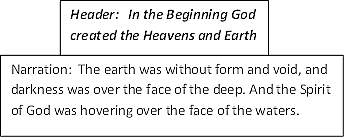
The other option is that it serves as the first ex nihilo (i.e. out of nothing) act of creation preceding the six day account. This structure would look something like:

Which is correct? I favor the latter structure. If verse 1 was merely a header, then Genesis 1 would start with a preexisting planet whose creation is outside the scope of the Biblical narrative altogether. That would be a strange “beginning”! Wouldn’t a book of beginnings[5] include the absolute beginning? Albert Barnes argues that “the very next sentence speaks of the earth as already in existence, and therefore its creation must be recorded in the first verse.” [6]
Secondly, the Hebrew conjunction waw at the beginning of verse 2, which can mean “and”, “but”, “now”, or “then”, also implies that verse 1 is a prerequisite to verse 2. It doesn’t make much sense to have a chapter of a book start with the word “and”, immediately following the chapter title. Barnes concurs that “the conjunctive particle connects the second verse with it; which could not be if it were a heading.” [7]
Finally, the author employs the Hebrew verb bara in Genesis 1:1, which typically emphasizes an act of creation that is immediate and ex nihilo. He then transitions in 1:3 to terms and activities that are mediate – dividing, gathering, and forming of existing materials into something new. In the words of the 19th Century distinguished theologian, Geerhardus Vos:
“It [Genesis 1:1] is the initial bringing forth of material out of nothing, thus the so-called immediate creating, while in the following verses mediate creation is described.”[8]
If Genesis 1:1 is an independent act of creation, the next matter to investigate is its temporal placement: Did it occur before the 1st day or within the 1st day? To answer this question, note the temporal pattern of the divine work week. God’s days begin at “morning” time with an illuminated period of work, called “day”. They end at “evening” with a dark period of rest, called “night”. The following morning restarts the cycle. The below graphic illustrates this morning-to-morning cycle:
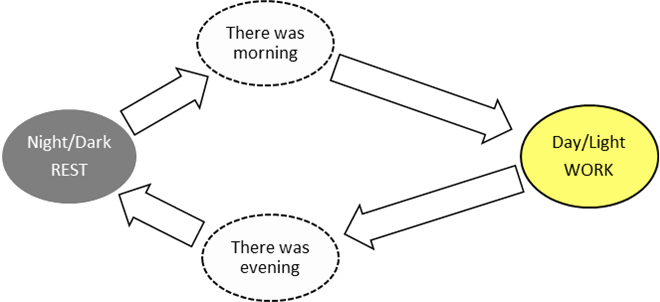
This pattern suggests that Day One began when God’s first verbal act of labor initiated the first daylight, preceded by the creative act of Genesis 1:1.
3) The first act of creation in Genesis 1:1 is the creation of the universe
We have established that Genesis 1:1 is an initial, immediate, ex nihilo act of creation that occurred immediately prior to the six days. Now let us further consider what was created during this event. The phrase “heavens and earth” is a merism; a figure of speech by which the sum of everything between two contrasting extremes is referenced by those two extremes. “Young and old” refers to all people, regardless of age. “Rich and poor” refers to all people, regardless of economic status. “High and low” refers to all places, regardless of elevation. Accordingly, “heavens and earth” refers to all matter in the terrestrial and celestial realms, i.e. the entire universe. The NET Notes defines it as:
… “the entire universe”; or “the sky and the dry land.” This phrase is often interpreted as a merism, referring to the entire ordered universe, including the heavens and the earth and everything in them.[9]
In the words of Vos:
“Heaven and earth” is equivalent to the universe, for which Hebrew does not have any word.[10]
In John 1 there is a striking parallel between creation and redemption that confirms the Genesis 1:1 merism. See the parallel passages below:
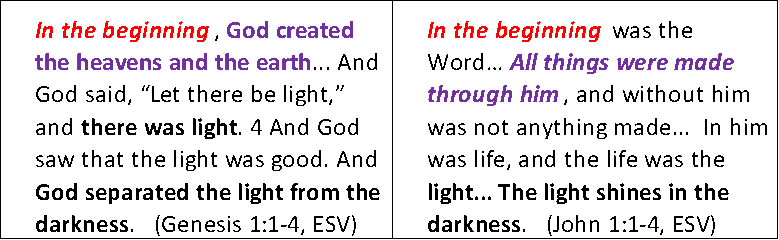
Notice that John, copying the language of Genesis 1, replaces the merism “heavens and the earth” with its referent, “all things”. Based on this Biblical evidence, we can be confident that Genesis 1:1 describes the first ex nihilo act of creation whereby the universe – the earth, the galaxies, the stars – came into being. As additional evidence, Job 38:7 pictures stars already existing when the earth was formed on Days One through Three [11]:
Job 38:4 Where were you when I laid the foundation of the earth? … 7 when the morning stars sang in chorus and the sons of God shouted for joy. (NET, Emphasis added)
Of course, there is evidence that the creation of the earth’s local luminaries (i.e. sun and moon) occurs on Day Four in the creation account. That part of the account will be addressed later in this article. For now, let’s focus on the other 99.99999% of the universe.
Dealing with the Age of the Universe
According to dominant scientific theories, the universe began with a singularity billions of years ago, and expanded to its current configuration, with many celestial bodies being hundreds of light years away from each other. The light emitted from distant luminaries has apparently taken millions of years to radiate to our earth. In other words, the universe appears to be very old.
Yet, according to Scripture, this happened very quickly. The time gap between the creation of the universe (Gen 1:1) and the remainder of the six day creation account (Gen 1:3-27) was miniscule, as God later communicates that the creation of the heavens and earth and everything therein was completed in six days:
For in six days the LORD made heaven and earth, the sea, and all that is in them, and rested on the seventh day. (Ex 20:12, ESV)
… in six days the LORD made heaven and earth, and on the seventh day he rested and was refreshed.’” (Deut 31:17, ESV)
There are some religious physicists, such as Gerald Schroeder [21], who argue that relativity and time dilation enable a both/and solution. i.e. the universe is young and old at the same time, depending on the perspective it is measured from — God’s perspective before the universe was stretched, versus our perspective after it was stretched. However, there is no indication of such a time perspective change within the narrative of Genesis. The word “day” seems to have the same meaning before and after the alleged “stretching”. So, how do we resolve the apparent conflict between science and scripture in a way that sustains a consistently literal view of the Genesis text?
In the 1857, Phillip Gosse wrote Omphalos: An Attempt to Untie the Geological Knot. This book proposed a novel young earth creationism view — the Mature Creation View (MCV). Gosse claimed that God created the illusion of a mature creation, replete with images of cosmic events in apparently old starlight. Supposedly the creation of Adam as an adult, with apparent cellular, muscular, and skeletal growth, serves as a precedent for a universe with an apparent, but artificial, past. Though this view presents a possible explanation that coincides with science, it commits the unfalsifiability fallacy. It cannot be disproven because its evidence (or lack thereof) is contained in a hypothetical history, not a real one.
MCV also presents philosophical challenges to the reality of history. If God creates fake history, we cannot trust that any history is real. God could have created me at this very moment and infused me with memories up to this moment.
Finally, this view lends itself to special pleading. Miracles do not require the presence of an exhaustive hypothetical history, but only enough history to sustain the ongoing reality. When Jesus miraculously created wine, did He have to create a hypothetical grape vine and the hypothetical wine press that juiced the grapes? Did He have to create remains of the hypothetical person who would have assembled that wine press? The answer to all of these questions is No. The ongoing reality only required the creation of the wine itself. Similarly, God did not create Adam with scars from hypothetical cuts from his hypothetical teenage years, or with hypothetical memories of those hypothetical events that caused those cuts. No, He simply made Adam with the necessary bodily systems and memories to support his ongoing existence. Applying this to the universe, I would argue that an elaborate show of past cosmic events in the starlight, such as solar flares and novas, is not required for starlight to currently exist. Such apparent events are superfluous and somewhat deceptive.
A more useful “apparent age” concept is one proposed by author and geologist Dr. Ken Coulson — Supernatural Formative Processes (SFPs). Coulson argues that the earth appears to be billions of years old because God supernaturally altered the rates of real (not hypothetical) natural processes. According to Coulson,
If all rates everywhere in the universe were doubled, the participant would not notice this doubling unless there existed an unaltered rate that could serve as a frame of reference (Poythress 2019, p. 221). I propose that God has provided this frame of reference in the refrain that occurs at the end of each creative day: “And there was evening and there was morning.” This would mean that except for the rhythm of night and day, all other rhythms were accelerated in a time-lapse fashion.[40]
So SFPs are “natural” processes that are accelerated by God and kept in synchrony with other processes, which are also sped up proportionally. SFPs are natural in the sense that they are the same processes we observe in nature today; but they are supernatural because God miraculously put them on hyperdrive! Such a notion is only believable for those who trust in a God Who is omnipotent and able to do such a thing (Job 42:1-2, Jer 32:27, Mt 19:26, Lk 1:37). With such a belief, however, SFPs can provide a simple, logical, and credible explanation for the apparent age of the universe, in contrast to Gosse’s system of make-believe history.
Is there evidence for such phenomena in scripture? The narrative of Genesis is filled with supernatural phenomena, including man and animals made from dust (Gen 2:7, 19), and Eve created from Adam’s rib (Gen 2:22). As for the rapidity of “natural” processes, Coulson argues:
Genesis itself strongly implies that God used rapidly accelerated processes to mature the biosphere: “And God said, ‘let the earth sprout vegetation, plants yielding seed, and fruit trees bearing fruit in which is their seed, each according to its kind, on the earth’” (Genesis 1:11-12 ESV; emphasis mine). [41]
The New Testament also suggests that some miracles were process oriented in nature. For example, when Jesus healed the man born blind, he did so in a way that was not instantaneous but rather gradual, albeit much more rapid than natural healing (Mark 8:22-25).
Though Coulson applies SFPs primarily to the events associated with the earth’s formation, I think his concept can be extended to the creation of the cosmos in Genesis 1:1. In other words, just before Day One, in a matter of hours, God rapidly formed the present universe from a singularity (think “big bang”!). The entire expansion and evolution of the universe, including cosmic flares and novas, actually happened, albeit very quickly! The timeline of the supernatural formative process was different than the vantage point of the six days. If a person, such as the Pre-incarnate Son of God, was standing there watching the universe unfold, he would have been watching something like a time-lapse video, not altogether different than the flower blooming videos on National Geographic documentaries. Being outside of the SFP, his motions and thoughts would have been experienced from the vantage point of the six days, but he would have seen a rapid SFP unfolding all around him!
As an Operations Research Scientist, I have worked on simulation models of supply chain operations. In such models, I created a bunch of “If-this-then-do-that” policies to determine how an “operation”, such as trucking or inventory, would interact with a set of inputted shipments. I would then run the simulation and see how effectively the whole system performed. To find an optimal configuration, I would run it with various inputs and various policies, and discover which system performed the best. One of the settings I could control was how fast I wanted the simulation to run. I would set it to run really fast. However, the simulation results were in no way related to how fast it ran, because all of the policies worked together harmoniously, and all results were reported back in units of real time. For example, if the truck speed was 60 MPH and the truck unload rate 10 pallets an hour, a simulation speed-up of 100 times would show the trucks moving on the screen at 6000 MPH and the trucks being unloaded 1000 pallets an hour. But, relatively, everything was synchronized by my policies and all calculations were reported back to me as if the trucks had moved at 60 MPH and the pallets unloaded at 10 pallets per hour. The speed up was simply for my viewing pleasure, or I should say, my viewing impatience. I didn’t want to sit and watch hours and hours of simulated real-time events when the computer is able to compute everything very rapidly. SFPs are similar to these simulation models. All of God’s laws, or policies, remained in tact for the duration of the SFP. He simply sped up their deployment. Yet, the outputs of his grand simulation appear no differently than if they had been done in real-time, which would have been billions of years.
Assuming God employed such SFPs before and during the creation week, we can be sympathetic to the scientific methods used to measure the antiquity of the universe. These methods assume a constant rate of the processes they measure, such as the speed of light and radioactive decay. Without special revelation, no scientist could detect that rates of interaction were universally and commensurately sped up. From a process point of view, the universe is many billions of “process-years” old, even though it is much younger in reality. Its infancy can only be communicated through special revelation, and received “by faith” (Heb 11:3), not through scientific measurement.
Why processes?
Why did God use processes instead of simply snapping His divine fingers and creating everything immediately without any evidence of process or history? I believe that God employed processes to support the dominion mandate of Genesis 1:28. We need a knowledge of how the world naturally works, including the dependencies between natural processes, in order to confidently practice predictive science, and thereby establish our dominion over this earth. The study of past processes helps us obtain such knowledge.
Why sped up processes?
Why did God speed up the processes instead of just letting the universe develop at normal rates over billions of years? The universe was put in place ultimately to support mankind (Psa 115:16). I believe that God employed SFPs so as not to let deep time diminish this human-centricity of the universe. The seven days in Genesis 1 are the pinnacle of the creation because they serve as an important analogy for the human work week, and for God’s redemptive purpose to bring “rest” to all of creation (Heb 4:1-11). Therefore, SFPs were used to squish God’s creative work into six human-centric work days. To God, theology is more important than constant rates of physics.
Do SFPs put the character of God at stake?
Is it deceptive of God to rapidly deploy processes that, according to today’s rates of change, should have taken billions of years? I don’t believe so. God never verbally commanded us to figure out how old the universe is based on the miracle of creation. He simply told us to take dominion over creation, which requires a knowledge of how processes should interact for future prediction. For people who reject the counsel of God and instead seek to find a godless origin of the universe in deep time, He has placed purposeful ambiguity in creation; not different than the way Jesus spoke parables to both conceal and reveal truth. For those who humbly embraced Him, parables revealed truth. For those who pridefully rejected Him, parables concealed truth. According to 2 Thessalonians 2:11, God will send “strong delusion” to those who willfully accept a lie. Nevertheless, He is ever so gracious to enable good predictive science to be done, even by those who are deceived, as His SFPs left evidence of a universe with all the same “relative” laws that we see today. In addition, He has infused enough handiwork into the universe to render them “without excuse” regarding its divine origin (Rom 1:20, Ps 19:1).
4) In Genesis 1:2, the already-formed earth was uninhabited and covered with a localized darkness
Based on what has been established so far, Genesis 1:1 describes the creation of the entire universe from nothing over a brief period of time. We now come to Genesis 1:2:
The earth was without form and void, and darkness was over the face of the deep. And the Spirit of God was hovering over the face of the waters. (ESV)
The old King James phrase, “without form and void,” has carried over into many modern translations. It conveys imagery of a chaotic swirl of disordered matter floating in the universe. Such a notion is rooted more in ancient Greek cosmogony than actual Hebrew word studies. The Hebrew phrase tohu wabohu conveys the idea of an uninhabitable wilderness, unfit for life; perhaps best rendered by Darby’s translation: “And the earth was waste and empty, and darkness was on the face of the deep”. It is elsewhere described as an empty land (Jer 4:25), contrasted with a “fruitful land” (Jer 4:26). The Jewish Aramaic Neophytil describes it as “desolate without human beings or beast and void of all cultivation of plants and trees”[12]. These descriptions provoke a very different image than the phrase, “without form and void”. If Genesis 1:1 entailed the creation of the universe and the earth, then we should not expect the earth to be a formless swirl of matter in 1:2. We should expect it to be a fully formed planet that is simply desolate and empty.
Likewise, the “deep” in Genesis 1:2 is not a fluid-like state of all existing matter as John Gill proposes[13]. Nor is it water at the outer edge of the universe, as Russell Humphreys proposes[14]. Psalm 104:5-9, a passage that is widely acknowledged as a creation text, describes the “deep” as a body of water covering the land as a garment, standing above the hills:
Psalm 104:5 He set the earth on its foundations, so that it should never be moved. 6 You covered it with the deep as with a garment; the waters stood above the mountains. (ESV, emphasis added)
This should evoke images of a fully formed earth, with mountainous landscapes, simply covered with water. The NET Notes suggest: “The substance which became the earth (dry land) lay dormant under the water.”[15]
Regarding the darkness, it may be asked: How could the universe have been filled with stars and planets when it is described as “darkness” in 1:2? Yet, such a question is misstated. The text never states that darkness pervaded the whole universe. The darkness was limited to the “face of the deep”, which was limited to Planet Earth. Barnes concurs:
It is further to be noted that the darkness is described to be on the face of the deep. Nothing is said about any other region throughout the bounds of existing things. The presumption is, so far as this clause determines, that it is a local darkness confined to the face of the deep. (Emphasis added) [17]
5) The days of Genesis 1 are literal 24 hours days
The word “day” (Heb. yom) is used in various ways in scripture. In Genesis 1 and 2 alone, it is used to represent a period of daylight (Gen 1:5a), a complete cycle of light and darkness (1:5b), and an undefined period of several days (2:4, 17). This undefined period use is perhaps employed in prophecies concerning the Day of the Lord (Zech 14:7) and the period of Israel’s restoration (Hosea 6:2). A “day” is also used to describe a year (Gen 5:27, 31). The reformers used a “year for a day” reading in Daniel’s prophecies. All of this evidence is used by Day-Age teachers to advocate the idea that the seven days in Genesis 1 are long periods of time. However, the simplest way to understand the word “day” in Genesis 1 is a regular 24 hour day. Moses places “evening” and “morning” between each day, in a series of sequential days. Nowhere else in scripture is such a convention used to convey long undefined periods, especially in a narrative genre. The Day-Age theory, and all other views which allegorize or stretch the “days” in Genesis 1, seem to be special pleading.
6) The sky, land, and seas were rapidly prepared through supernatural formative processes
Let us summarize our progress so far. Immediately preceding the First Day, God created the universe ex nihilo (Gen 1:1). The land in which God intended to place man was an empty wasteland (v2). Then God began to prepare it and fill it with inhabitants (vv3ff). This prepare-and-fill phase of creation is distinct from the initial ex nihilo event (1:1), evidenced by a comparison of the two book ends of the Genesis 1 account:
Gen 1:1 In the beginning, God created the heavens and the earth.
… [prepare and fill phase] …
Gen 2:1 Thus the heavens and the earth were finished, and all the host of them.
(ESV, Emphasis added)
Notice that the work God performed between Genesis 1:1 and 2:1 resulted in the addition of the phrase “and all the host of them” in the bookend statement of 2:1. First God creates the “heavens and earth” (Gen 1:1). Next, during the six days, He prepares the constituent parts of creation – the sky, land, and seas – and fills “all the host of them” (Gen 2:1) according to the following symmetrical pattern:

This theological pattern in no way minimizes the reality or order of these events, as some allegorists suggest, but rather adds an additional layer of meaning to them. The theology of Genesis 1 becomes very clear — God prepared and filled three domains, each dependent on those previous, yet pointing progressively toward the habitation of humanity, the pinnacle of creation. Mankind would be given stewardship over the final domain, for “The heavens are the LORD’s heavens, but the earth he has given to the children of man” (Ps 115:16).
Having already introduced God’s initial interaction with the luminary domain (Gen 1:2-3), we shall now proceed to the activities of Day Two, which are detailed in Genesis 1:6-8:
Gen 1:6 And God said, “Let there be an expanse in the midst of the waters, and let it separate the waters from the waters.” 7 And God made the expanse and separated the waters that were under the expanse from the waters that were above the expanse. And it was so. 8 And God called the expanse Heaven (Heb. shamayim). And there was evening and there was morning, the second day. (ESV, emphasis added)
Unlike the Ancient Near Eastern (ANE) [31] interpretations, the “waters above” are not a cosmic sea enveloping the world or the universe. When we look elsewhere in the Bible, we see that these waters are simply the clouds enclosing our sky:
Psalm 104:2 … who stretchest out the heavens [Heb. shamayim] like a curtain: 3 Who layeth the beams of his chambers in the waters: who maketh the clouds his chariot: who walketh upon the wings of the wind. (KJV, emphasis added)
Job 26:7 He stretches out the north over the void and hangs the earth on nothing. 8 He binds up the waters in his thick clouds, and the cloud is not split open under them. (ESV, emphasis added)
Notice how Psalm 104 invokes Hebrew parallelism to equate the waters, the clouds, and the wings of the wind. Notice also that the “stretching” of the sky in both passages is associated with the space underneath the clouds, not the whole universe. This leads to the conclusion that the seas are the waters below, the clouds are the waters above, and the “heavens” are simply the breathable, inhabitable atmosphere immediately over the land, or what we call the “sky”. The NET Notes concur: “The Hebrew word refers to an expanse of air pressure between the surface of the sea and the clouds, separating water below from water above.” [19] Jesus further strengthened this idea when He promised to return on the very same clouds He ascended into (Mt 24:30, 26:64, Acts 1:11, Lk 21:27, Rev 1:7), quoting from Daniel 7:13:
I saw in the night visions, and, behold, one like the Son of man came with the clouds of heaven, and came to the Ancient of days… (Dan 7:13, KJV)
By making such a correlation, He equated the divine clouds (Dan 7:13) and the divine waters (Psa 104:3) with the very clouds we see over our heads.
Some Young Earth Creationists (YEC), anticipating that the celestial bodies of Day Four cannot be placed in our atmosphere, argue that “heavens” must be a reference to the entire cosmos. However, this is unlikely because, according to Genesis 1:20, the “birds fly above the land across the expanse of the heavens”. Surely, outer space is not a suitable habitat for birds! To avoid the birds-in-space problem, these YEC’s sometimes translate “across the expanse” as “the face of the expanse” (YLT), to suggest that the cosmos has a surface which contains the birds. However, while the Hebrew word panim is frequently translated as “face”, it is understood as — “before”, “in the sight of”, or “in the presence of”. The sky, being a transparent, voluminous space, does not have a tangible surface or edge. Therefore, the majority of translations rightly state that the birds fly “in” or “across” the “[open] expanse” of the sky. So I agree with the NET Notes: “Though the Hebrew word can mean ‘heaven,’ it refers in this context to ‘the sky’.”[20]
Was the earth really fashioned in a couple days?
Just as God employed supernatural formative processes (SFPs) to create the universe in Genesis 1:1, I also believe that He employed similar processes on Days Two and Three of creation. Dr. John Baumgardner of Creation Ministries International agrees:
This means in my opinion the processes of nuclear transmutation, mantle convection, magma generation and cooling, together with a spectrum of tectonic and geological processes must have unfolded at rates many orders of magnitude faster than we observe today.[42]
7) The Day 1 decree involved God’s glorious light, while the Day 4 decree involved the creation of the sun and moon
It is likely that God’s presence was the source of light on Day One of the Genesis account. John 1:1-4, which parallels Genesis 1, portrays the creative light as divine light. The Psalmodic creation account in Psalm 104 states that the LORD covered Himself “with light as with a garment” (Ps 104:2). Finally, Revelation’s “back to paradise” scene describes a sun-less earth, lit up by God’s glory alone (Rev 21:23). These facts imply that the LORD was the light source during the first three days of the creation week. See the below parallels:
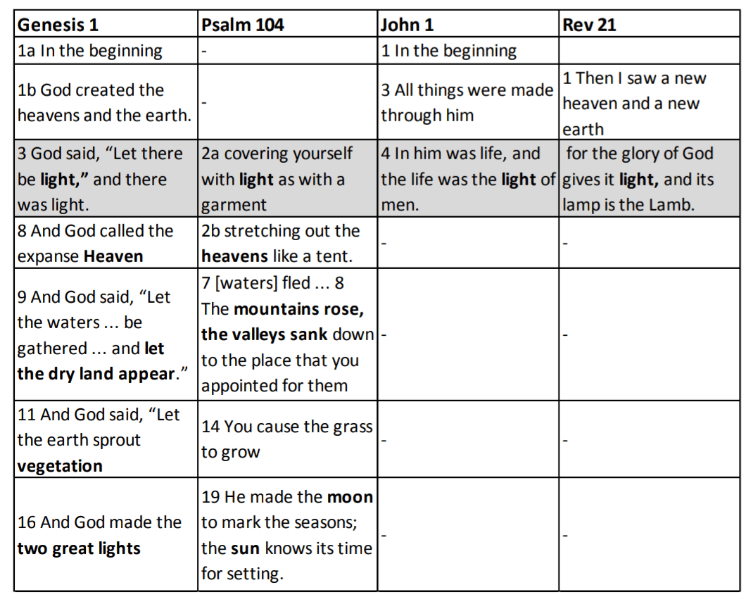
One may argue that assigning God as the light source in Genesis 1:3 diminishes the nature of the Spirit in the preceding verse, implying that He wasn’t glorious enough to illuminate the dark waters. But this problem is mitigated when we understand the distinct roles of the Trinity during creation. Since the Old Testament attributes all creation to Jehovah (Ps 33:6), and the New Testament attributes all creation to Jesus (Jn 1:3, Col 1:16) and consistently equates Jesus with Jehovah (Jn 12:41, Rev 1:8), we know that the passages in the above chart are describing the light-bearing nature of the Second Person of the Godhead (Jehovah/Jesus) during creation (Psa 104:2, Jn 1:4). It is likely that He entered the creative scene at a specific moment, in a glorious theophonic form, alongside the Spirit, and began His six-day work. Such a physical entrance is not altogether different than other physical manifestations of Jehovah in the creation account (e.g. “planted a garden” (Gen 2:8), “walking in the garden” (Gen 3:8), etc.). When Jesus entered the scene, light entered the scene!
On Day 4, however, a new luminary event occurs:
Gen 1:14 And God said, “Let there be lights in the expanse of the heavens to separate the day from the night. And let them be for signs and for seasons, and for days and years, 15 and let them be lights in the expanse of the heavens to give light upon the earth.” And it was so. 16 And God made the two great lights—the greater light to rule the day and the lesser light to rule the night—and the stars. 17 And God set them in the expanse of the heavens to give light on the earth, 18 to rule over the day and over the night, and to separate the light from the darkness. And God saw that it was good. 19 And there was evening and there was morning, the fourth day. (ESV, Emphasis added)
On Day One, “God separated the light from the darkness” (Gen 1:4), but now, on Day Four, the greater and lesser lights are “to separate the light from the darkness”. Notice the transition of luminary responsibility from God, the divine light, to these newly delegated agents of light. They would serve as signs, seasons, days and years for forthcoming humanity.
Young Biosphere author, Gorman Gray[16], claims that the darkness was caused by thick clouds covering the earth (Job 38:9), and that God “made” the lights on Day Four by removing the clouds so as to make the already-existing lights visible to an earthbound viewer. There is one problem with this interpretation; it is entirely presumptive. When God elsewhere chose to use separation and gathering to create something (e.g. the sky on Day Two), He explicitly stated these means in the account. But on Day Four, no such means are stated. In addition, Gray’s theory demands that sunlight and moonlight already existed in our solar system prior to being “made”. This is contrary to God’s creative pattern in Genesis 1. Although He used separation and gathering to “make” the “dry land” and “sky”, neither of these existed before they were made.
The favorable explanation is that God created exactly what the Bible states He created — “lights”. The “greater light” is a reference to sunlight, while the “lesser light” is a reference to moonlight. Due to the fact that the moon doesn’t produce its own light, many scholars differentiate between the lights (e.g. moonlight, sunlight) and the light source (e.g. sun), asserting that the creation of the light sources could have long-preceded their ignition. While I agree that the placement of the lights in “the expanse” (i.e. our sky) suggests such a differentiation, it does not imply that their creation is incongruent. The Bible consistently uses the lights as metonymies for the celestial bodies themselves (See Psalm 136:7-9). Therefore, I believe that the sunlight and moonlight, and their light source (the sun), did not exist in our reality before Day Four.
Out of sequence creation?
This notion that the earth preceded the sun obviously conflicts with mainstream science. The sun, measuring at 4.6 billion years old, predates all other celestial bodies in our solar system. Coulson solves this by invoking a mature creation argument, suggesting that God had a conceptual universe in His mind, evolved exhaustively from inception to maturity. This conceptual universe included the sun, the moon, the earth, and their natural interactions with each other, as observed by known “laws” of physics, astronomy, etc. God then decreed them into material existence, out of sequence if necessary, in a manner that fit His theological agenda; an agenda which places the human terrestrial habitat as a creative priority. Yet the materialized components contained all artifacts of their interaction with the “not-yet-materialized” components, as if they had interacted according to God’s conceived “natural” order. For example, if the natural conceived order would have the sun’s gravity driving the earth’s orbit, or the sun’s radiation affecting the hydrologic cycle, God would have fashioned the earth in such an affected state, even in the absence of the materialized sun [43]. Perhaps He harmonized these apparent effects with the temporary light illuminating from Himself.
Coulson’s approach is very novel and interesting. Although it may be a satisfactory solution, it still presents the same challenge that retracted me from Gosse’s model, namely the notion of a false material history. For some, the purely “conceptual” history may suffice, but I think the model should go a step further into something slightly more substantive. This leads me to a philosopher named Gottfried Leibniz.
According Leibniz, the universe ultimately contains only God and non-composite, immaterial, soul-like entities called “monads.” Monads are self-determined, and thereby cannot causally interact with one another. Instead, they causally progress of their own accord, only appearing to causally interact because God chose to materialize ones that perfectly and harmoniously coordinate with one another. An analogy to this would be two stunt people acting out a choreographed fight in movie, with perfectly timed motions that appear to be real causes (punches) and effects (knock-downs). Yet the knock-downs are not really caused by the punches, but rather by the person’s choice to fall down at a specific time. The illusion of direct causation is created by the coordination of the two people’s choices.
Theologian Millard Erickson claims that Leibniz provides a philosophical basis for compatibilism, the view that affirms causal determinism, but also affirms the free, responsible agency of humans whose actions are caused by their own desires [44]. In some sense, our souls pre-existed in God’s nature prior to the creation of the world, and He sovereignly decided to materialize souls whose self-determined actions perfectly coordinated with each other and with His plan.
This solution can also be invoked for the ‘out-of-sequence’ creation conundrum, since the lowest level ‘monads’ in Leibniz’s model include inanimate objects which hold no consciousness at all. There were an infinite number of possible monads for the sun and the earth — real soul-like immaterial entities in the depths of God’s infinite mind. God chose to materialize the ones that perfectly harmonize in a manner consistent with our observed “laws” of physics. Yet at their deepest level of existence (monadic form), they do not causally interact. God could choose to materialize either monad in any state of its self-determined existence, with or without the other one being materialized.[45]
Although this model of Leibniz may not fully correct the false “material” history dilemma, it goes one step beyond Coulson’s conceptual universe into something a bit more ontological.
Did God create all the stars on Day Four?
What about the phrase “and the stars” in Genesis 1:16? If God created all the stars on Day Four, this would conflict with our assertion that stars existed at the onset of the six day account. Additionally, most distant stars aren’t even visible to the naked eye. Their creation on Day Four would serve no purpose for signs, seasons, and days. So what is happening in this passage?
Some scholars, such as Colin House, argue that verse 16 presupposes the existence of stars, because of the Hebrew particle wĕ ʾēt, which throughout Genesis means “together with” or “along with”. Stressing this nuance, the Catholic Public Domain Version (CPDV) suggests the following rendering: “God made two great lights: a greater light, to rule over the day, and a lesser light, to rule over the night, along with the stars.” This rendering suggests that the newly created lights rule along with the stars which were already there.
Another option is that God miraculously made some of the closest stars on Day Four; stars that contribute to discerning signs, seasons, and days. I recently researched the brightest stars in the sky and discovered that most of them have light that would reach us within 50 years [18], indicating their adolescence. So, while I favor the previous option, this is also a viable alternative.
In summary, Day Four includes God’s creation of the earth’s light source — the sun — and its nighttime reflector, the moon. Their light permeated our sky and was appointed to serve forthcoming mankind in calculating times and seasons, along with the stars.
8) Genesis 2 focuses on the Metaphysical Garden of Eden
Many scholars argue that Genesis 2 is a recapitulation of Day Six of the creation account. Others believe there are several textual evidences that seem to contradict this theory. They claim that it seems implausible to fit the events of Genesis 2 into a 24-hour timeframe. Adam cultivated the garden (Gen. 2:15), named all the livestock, birds, and terrestrial wild animals (Gen. 2:20), and then entered a deep sleep (Gen. 2:21), during which Eve was created from his side. Upon seeing his new wife, he exclaimed, “At last!” (Gen 2:23, ESV), implying he had been waiting for a long time to meet her.
Regardless of the level of overlap, there is an intentional difference between these narratives. Genesis 2 clearly shifts to a local setting, employing the localized term “field” in contrast with the “earth” of Genesis 1 (2:5, 19, 20) [30]. In this setting, there is also a shift in activity. In 2:5-8, we see that the plants had not yet grown because “God had not caused it to rain on the land and there was no man to work the ground.” This is hardly a picture of the plants created on Day Three, as they would not need rain three days after the earth’s full submersion in water (1:2). This is more likely a specific garden planted by God, which needed to be watered by rain and maintained by a gardener (2:8) [24].
Finally, there is an intentional difference between the sequence of events in Genesis 1 and Genesis 2, providing additional evidence for a shift in settings. In Genesis 1, God created mature seed bearing plants and fruit trees before He created man (1:9-11). In Genesis 2, He planted a garden after man was created (2:8-9). In Genesis 1, He formed birds before Adam. In Genesis 2, He formed them after Adam (2:19). In Genesis 1, He created land animals before Adam. In Genesis 2, He created field animals, with the possible exclusion of “livestock”, after Adam (2:19-20). If Genesis 1 and 2 are referring to the same plants, animals, and birds, there is clearly a contradiction in sequence. Below is a graphical comparison:

Given these incongruities, I conclude that Genesis 1 details the initial global creation event, while Genesis 2 narrates a distinct garden account, specifically involving our federal head (Adam), his covenant garden, and its occupants — a sample of miraculously formed birds and wild beasts (Gen 2:19). Some scholars, such as Umber Cassuto, Carl Friedrich Keil, and Victor Hamilton believe that the wild animals and birds may have been created at some prior time, but had already been dispersed over all the land, obeying God’s “multiply and replenish the earth” commands. So God, by a sovereign initiative, miraculously formed particular specimens of these two types to be presented to Adam so that he could name them along with the already-present “livestock”, which were also named but not explicitly formed at this time (2:20). [26]
The Metaphysical Garden
In light of these findings, it would behoove us to press further into the nature of Eden, as it conveys several features that place it in a category beyond a natural garden. It was guarded by angels and whirling swords (Gen 3:24); inhabited by a talking serpent (Gen 3:1), later identified as the spiritual devil (Rev 12:9). It had trees that can offer life and the knowledge of good and evil (Gen 3:9). And if that is not enough, God Himself planted it (Gen 2:8), and often visited it personally (Gen 3:8). This was not an ordinary garden, but rather a very supernatural garden. In fact, I propose that Eden was a metaphysical place. Just as there is a visible Kingdom of God and a heavenly Kingdom of God, an earthly Zion and a heavenly Zion (Heb 12:22), an earthly Jerusalem and a future descending New Jerusalem (Rev 21:2), so also there was a heavenly Eden that was integrally connected to the earthly Eden. Likely Eden is the same paradise that Paul visited in a manner unbeknownst to him, whether bodily or spiritually, and heard words unlawful to be spoken by mere mortal man (2 Cor 12:3). It is the same paradise referred to in Revelation (Rev 2:7), where the tree of life spans the life-giving river flowing directly from the throne of God (Rev 22:2).
The Meta-temporal Garden
Looking closer at Revelation 22, we also discover that Metaphysical Eden has no night, but rather one perpetual day (v5). This is a clear indication that Eden’s time is not the same as Earth’s time, but rather on a different scale altogether. As a spatially metaphysical location, its time is temporally meta-temporal. A brief moment in Eden could equate to eons of time elapsed on Earth. For a Christian, such a notion should not be hard to accept; For we believe in a God who is eternal, omni-temporal, and infinite; a God who experiences our days “as a thousand years” (2 Pet 3:8). Eden’s river is directly connected to the throne of this extraordinary God (Rev 22:2).
How does such a view of time in Eden affect our understanding of the Genesis narrative? I believe that it can affect it immensely. Consider the following potential sequence of events.
- As a probationary measure, Adam was taken from his earthly domain and temporarily placed in meta-physical Eden (Gen 2:15), where time is experienced differently than terrestrial time.
- By tending the garden and passing the test of obedience, Adam would secure eternal access to the life-sustaining tree of life. However, after a very brief time there [27], he and his wife disobeyed God, which initiated a curse in the terrestrial realm.
- Several hours passed between their fall (Gen 3:7) and God’s confrontation with them (Gen 3:8), and during the events of Genesis 3:8-23, which include God communicating the curse to each involved party, Adam naming Eve, and God making clothing for Adam and Eve. During these postlapsarian hours in Eden, millions of earth years transpired in the terrestrial realm.
- Adam and Eve were expelled from Eden, and placed back into the terrestrial realm. Even though Adam was essentially the same age as when he entered Eden as an immortal, he was reintroduced into a world that experienced millions of years of the effects of his fall; a world in which he himself would now experience aging and mortality.
With such an understanding of the events of Genesis 2 and 3, we could have a system which affirms an old earth understanding of the geological ages, yet affirms a young earth understanding of death and the fall. This leads to our next point.
9) There was no animal death before the fall
The problem of natural evil is a real concern – Extinction, decay, predation, animals killing their own mates. Young earth advocates claim that these events could not exist before the fall of Adam, especially if what God created was “good” (Gen 1:4, 10, 12, 18, 21, 25, 31). Let’s first look at what the Bible explicitly allows or disallows regarding animal death at the time of creation.
Genesis 1:30 suggests that land animals and birds were created with a non-predatory nature:
“And to every beast of the earth and to every bird of the heavens and to everything that creeps on the earth, everything that has the breath of life, I have given every green plant for food.”
This conclusion is strengthened when we consider that the later post-flood diet is intentionally expanded to include meat:
“Every moving thing that lives shall be food for you. And as I gave you the green plants, I give you everything.” (Gen 9:3)
In the Biblical storyline, land animals typically experienced the same fate as mankind, likely due to their cohabitation in the land. As man was commanded to be vegetarian, so land animals were commanded to be vegetarian. As man was destroyed by the flood, so land animals were destroyed by the flood (See Gen 6:17, 19-20, 7:8, 21-23). As mankind will be restored to a peaceful state in the restored earthly kingdom, so the land animals will be restored to a peaceful state in the restored earthly kingdom (Isaiah 11:6-7).
The circumstances of sea creatures may have been different than those of the land animals. They are not mentioned in the command to eat vegetation in Genesis 1:30. They are not included in the list of animals affected by the flood. Nor are they listed as being non-predatory in the restored earthly kingdom. In fact, it appears that humans will still fish (presumably killing the fish) in the restored earthly kingdom (Ezek 47:9-10). So there does not appear to be a strong prohibition of aquatic predation in Genesis 1.
Returning to land animals, it seems that their predation (and corresponding mortality) is rooted in a deviation from their created order. In the past I have held to various old earth positions that attempted to root such a deviation in Lucifer’s rebellion. In holding such a position, I had a persuasive argument for limiting the application of Romans 5:12 and Genesis 2:17 solely to humans. I claimed that Romans 5:12 states that death passed upon “all men“, not all animals, and that God warned Adam “In the day that you eat of it, you [not your animals] shall surely die” (Gen 2:17).
I now disagree with my former self. While the context of those passages is aimed at Adam and his federal offspring, it is also evident that Adam was the federal head of the whole earth (Psa 115:16), and his curse included the whole earth — livestock, wild animals, and snakes (Gen 3:14), as well as the ground itself (3:18).
In addition, while Romans 8:19-23 includes Paul’s hope for the reversal of moral corruption in human society, sometimes called “creation” (see Mk 16:15), this passage seems to be more comprehensive than that. Everything that was affected by the first fallen human will be restored in the future glorification of humanity. Hence the term “creation” should not be limited to people, but to all affected beings, including animals. Isaiah paints a beautiful image of such a restored “Eden”, where animal death caused by predation is replaced with peace and harmony:
The wolf shall dwell with the lamb,
and the leopard shall lie down with the young goat,
and the calf and the lion and the fattened calf together;
and a little child shall lead them.
The cow and the bear shall graze;
their young shall lie down together;
and the lion shall eat straw like the ox.
The nursing child shall play over the hole of the cobra,
and the weaned child shall put his hand on the adder’s den.
They shall not hurt or destroy
in all my holy mountain; (Isaiah 11:6-9a, ESV)
I think we all get a gut-wrenching feeling that something is inherently wrong when we watch a National Geographic documentary showing an animal of prey capture and tear apart another helpless animal. This is our conscience telling us that such suffering is inherently evil, and it cannot be part of God’s original good design. It is a deviation, and that deviation was caused by Adam and Eve’s fall in the garden. By embracing the Metaphysical Eden view, we can affirm that the geological record shows a lengthy history of animal predation and suffering induced by the fall.
10) Before Adam and Eve were placed back into our world, God created other humans that lived and died for many generations
Many Biblical mysteries would be solved if pre-Adamic people lived outside the Garden of Eden. Their existence explains the mysteries regarding Cain — his fear of outsiders (Gen 4:14) [29], the city he fled to (v16), the wife he married (v17) — mysteries which are difficult to unravel when only four Adamic people are known to exist at the point of Cain’s expulsion (one having died). Second, it vindicates God from making sibling-incest the only reproductive option for Adam and Eves’ children, a practice that was an abomination long before the Law of Moses (Lev 18:9, 28). Third, it provides an identity for the “nations” that existed during Lucifer’s rebellion (Isa 14:12, Ezek 28:13). Finally, it offers a solution for one of the most controversial passages in theological history — Genesis 6.
Genesis 6 narrates an episode in pre-flood history involving an interaction between the “sons of God” and the “daughters of men”. Traditional interpretations of Genesis 6, including ancient Hebrew religious texts (e.g. Book of Enoch), some manuscripts of the LXX, and early church writings[25], understood the sons of God to be fallen angels who had intercourse with human women (“daughters of men”). This identification is often linked to the seeming reference of Genesis 6 in 2 Peter 2:4-7, and the alleged use of the phrase “sons of God” to describe angels in Job (e.g. Job 1:6, 38:7). However, Jesus seemed to preclude the possibility of angelic sexual relations (Mt 22:30). In addition, the Old Testament consistently portrays humans, not angels, “presenting themselves” before the Lord in a similar manner to the sons of God in Job 1:6 (see Deut 31:14, Josh 24:1, Judg 20:2). Therefore, human beings may be a more fitting candidate for the identity of the sons of God. Accordingly, later interpreters have identified them with the lineage of Seth, using Genesis 4:26 as their primary reasoning. Since this solution also has no clear Biblical support[28], we must seek a better solution.
In the New Testament, we see that Adam, who was formed from the dust of the ground, is called a “son of God” (Lk 3:38). Jesus Christ, whose human nature was miraculously conceived by the Spirit, is called the “Son of God” (Mk 1:1, Lk 1:35). Christians, who are miraculously regenerated by the Spirit, are called “sons of God” (Rom 8:14). From this New Testament evidence, we see that the “sons of God” are not just humans, but miraculously created humans.
I propose that God miraculously created other humans after the fall, while Adam and Eve were still in metaphysical Eden. These humans, possibly Homo Habilis or Homo Erectus, lived and multiplied for many generations, eventually giving rise to the Neanderthals and later Homo Sapiens. This all happened prior to Adam and Eve re-entering the fallen world and populating it with their own offspring.
These other humans were not necessarily pre-Adamic, since Adam was created first. However, their remains predate the remains of Adam and all Adamic offspring, since Adam was not re-introduced into the fallen world until a much later time period, perhaps the Neolithic.
Eventually, the other sons of God were infiltrated by Satan (Job 1:6), led into corruption, and engaged in sexual relationships with the female descendants of Adam. Instead of filling the earth with godly offspring (Gen 1:28), they filled it with violent offspring (6:11). As a result, God condemned all humanity to a watery judgment. Noah, the pure Adamite, and his family, were saved on the ark. Some of the Nephilim, a pre-flood offspring of the aforementioned union, also survived “afterwards” (6:4). Numbers 13:33 documents their mysterious post-flood survival, hinting that their original creation was likely miraculous in nature.
Although God promised to not repeat a mass flood judgement (9:15-17), the eventual 850 year human life span reduction and the associated increase in physical abnormalities served as lasting genetic consequences of this illicit union (Num 13:28, 1 Sam 17:4, 2 Sam 21:20, Amos 2:9, Deut 3:11).
Two passages that could challenge this view
I’ll address two passages that may pose as challenges to the aforementioned view of the sons of God.
Passage: Acts 17:26
Challenge: All nations came from one man, and thus no people preceded that one man
Many translations of this passage state that every nation came from “one man”. The Greek phrase translated as “one man” (enos aimatos) should literally be translated as “one blood” (e.g. Young’s Literal). This passage is emphasizing the hematological unity of all humans, who share the same human life, or blood, coursing though their veins (see Lev 17:11). Nevertheless, it does seem to convey the idea of “one [specific] man” as the origin of that blood. If Paul is referring to Adam, then we would have to believe that, when God created other sons of God, He somehow created them from Adam, in a manner consistent with how He created Eve from Adam’s rib (Gen 2:22). Such a creation would insure that these sons of God had a biological, though non-genealogical, connection to Adam.
Alternatively, the “one man” in this passage may be referring to Noah. The “whole earth” may refer to the 70 nations mentioned in Genesis 10, which propagated from Noah’s sons after the flood.
These are the clans of Noah’s sons, according to their lines of descent, within their nations. From these the nations spread out over the earth after the flood. (Gen 10:32)
Passage: Gen 3:20
Challenge: Eve is the mother of all humans, so other women could not have given birth before her
In this passage, Eve is given the title “mother of all living”. This suggests that she gave birth to the first humans we see in the fossil record. However, according to my proposal, God directly created the earliest humans we see in the fossil record. Eve was not their “mother” in a genealogical sense. How do we solve this issue?
The word “living” in the explanation of her name, “mother of all living”, is a word that can refer to all creatures, as in Eccl 9:4, yet all animals are not biological descendants of Eve. In fact, Adam himself is not a descendant of Eve. This hints that this sort of expression has larger associations in mind than just genealogical descent. Additionally, becoming a son could be relational rather than purely biological, as in the case of Moses becoming the son of Pharaoh’s daughter (Ex 2:10). Accordingly, Genesis 3:15 seems to imply a spiritual theme which invokes the image of the covenantal lineage (seed) of Eve defeating the spiritual serpent – the devil (see Rev 12:9). Such an understanding of Eve as the spiritual mother of all who are in a living covenantal relationship with God removes all challenges to my proposal for the “sons of God”.
Nevertheless I cannot deny that there may be a parallel physical theme, which invokes the image of the physical seed of Eve — all humans — stomping on the heads of literal snakes. Such an understanding of Eve as the physical mother of all humans would seemingly refute my “sons of God” proposal unless God somehow created the other sons of God from Eve, in a manner similar to how he created Eve from Adam’s rib (Gen 2:22).
Do other miraculously created “sons of God” jeopardize a Biblical anthropology?
Other anthropological dilemmas may arise with the notion of people genealogically preceding Adam’s descendants. Did my metaphysical makeup — my spirit and the image of God — pass down to me from Adam or from these other sons of God? What about my sinful nature? However, as already stated, there is no real dilemma if God somehow created these other humans from Adam, in a manner consistent with how he created Eve from Adam’s rib. If this is not enough, a creationist view of the spirit (God immediately creates our spirits), as opposed to a traducianist view (our parents pass down our spirits), would most adequately solve remaining dilemmas. In the creationist view, God directly breathes our spirit into us at conception, thereby infusing us with His image; for God is spirit (Jn 4:24) and thus His image is spiritual (See Col 3:10, Eph 4:24). Regarding our sinful nature, it could be argued that our sinful predisposition came neither spiritually from God, nor genetically from any person, but rather consequentially from Adam. Adam’s sin resulted in our inaccessibility to the Tree of Life. The human body requires access to the Tree of Life for full vitality. Without its sustenance, the once-vital body transforms into a mortal “body of death” (Rom 7:24-25), a body which abounds in uncontrollable cravings leading to inevitable sin and spiritual death (Rom 7:9).
11) The Cambrian era is a fitting timeframe for the six day creation event
Though this is a theological article, not a scientific one, I believe it is important to offer a concordism hypothesis to spur discussion. My hypothesis suggests that the Cambrian era (~500 million years ago) is a fitting timeframe for the six day creation event.
Leading up to this event was the Big Bang, the formation of the galaxies, and the creation of the early Earth, all miraculously accelerated with supernatural formative processes (SFPs). There also appeared pre-Cambrian life, which ranged from single cell organisms to tubular and frond-shaped, mostly immobile, organisms.
Next, during the first few days of creation, the biosphere was rapidly fashioned with more SFPs, strongly correlated with the events preceding the notorious Cambrian Explosion event:
- A sudden greenhouse effect and oxygenation of the atmosphere (Day 2)
- A sudden melting of ice and emergence of dry land, as well as the rise of Pangaea (Day 3)
- Increased solar luminosity (Day 4)
Then came the pinnacle of creation — the explosion of life on Days Five and Six. On these days, God stopped using SFPs because earth-bound sentient beings cannot be fast-forwarded like inanimate objects. They must experience ordinary time corresponding to the morning-and-evening cycles of the days of creation. Therefore, a human observer would experience events unraveling on these two days just like any other day. Nevertheless, these two days populated the earth with many “kinds” [38] of living things, including fully formed sea creatures (Gen 1:20), birds (1:21), cattle (1:25), and humans (1:27). God miraculously created these de novo, fully formed, with anatomical and genetic features reflecting their respective level in the sequence of archetypal forms.
What are archetypal forms?
Archetypal forms are universal, primal symbols and images that derive from the infinite mind of God. Man is the climactic archetype to which all prior vertebrates point, because man is made in the image of God and serves as the pinnacle of creation. God gave creatures a progression of shared biological features —anatomical, physiological, biochemical, and even genetic — pointing to His anthropocentric (man-centered) design of the earth. Archetypal forms aide mankind in relating to other creatures. For example, we can understand when a dog is excited, sad, hurt, hungry, or tired because they exhibit behaviors similar to our own. In addition, shared characteristics help us understand ourselves better. We can study the affects that foods, medicines, and environments have on small animals in order to understand how they will affect us. The miraculously created shared characteristics of the pre-fall animals and the progressively evolved shared characteristics of post-fall animals are both equally an expression of this divine teleology [46].
How do we explain the fossil record with this model?
The beauty of this model is that it correlates perfectly with the universally accepted Cambrian event which suddenly brought about most of the present-day animal phyla. Along with modern science, it affirms the lengthy time period the geologic ages. At the same time, it affirms that all death and fossilization occurred after the fall of mankind. While this is an exciting proposition, it leads to an important question: If God started with fully formed kinds of sea creatures, birds, and mammals, why does the fossil record show a progression of families of animals? For example, mammals did not appear until the Triassic period. They do not appear to have been present during the entire geologic record. I will now attempt to explain this apparent misalignment.
God miraculously created a population of each kind on Days Five and Six, commanding them to multiply on their own. These initial populations may have been miraculously multiplied and sustained, or they may have been small and largely unsustained.
In the “unsustained” population scenario, perhaps the higher kinds of animals failed to multiply as a result of their fallenness, and immediately went extinct, only leaving survivors of the lower kinds of animals; the kinds which are abundantly found in Cambrian deposits. These lower animals would seed the gradual re-filling of the earth through God’s intervening progressive creation. The fossils of the original higher kinds would be missing due to their low numbers and circumstances of death.
In the “sustained” population scenario, God miraculously created a large population of every kind. There were habitats distributed around the world wherein these initial immortal populations were divinely sustained, similar to how Israel was sustained in Goshen during the plagues of Egypt. They were death-free until each one, successively from lower to higher kinds, was subjected to mortality as a result of Adam’s sin. Once mortality struck, the respective population entered a long cycle of death, mutation, survival, and evolutionary change. In contrast to strict progressive creationism, where God progressively created new kinds of animals, this is a progressive mortality scenario, where previously created kinds became mortal after a long period of time. As expected, there would be no fossil traces of the pre-corrupted immortal populations. Fossils only suggest when something died, not when it lived. If God miraculously sustained these untainted environments for millions of years, through both habitable and uninhabitable global conditions, no fossils would be present to prove or disprove it. Their existence would be based on Biblically informed speculation, and a solid trust in God’s omnipotent capabilities.
The below Gantt graphic depicts this process, with a limited (micro) amount of evolution after each population’s fall:
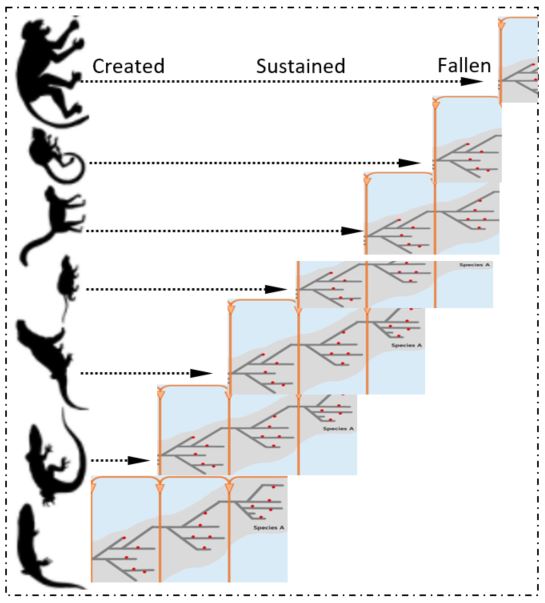
Note the tadpole looking creature at the bottom of the chart. It was created likely on the same day as the monkey at the top. However, the curse affected the tadpole creature first, forcing it into a cycle of death, mutation, and fossilization, represented by the diverging branches to the right of it. Then, after a long period of time, the fall similarly affected the lizard-like creature above it, and so the process repeated all the way up the chart, with the monkeys being affected last.
Of course, the same process could have entailed macro-evolutionary change, whereby mutations converged fallen kinds into unfallen kinds already existing in other habitats, at a time when the latter would also be corrupted by the fall. For example, the fallen tadpole-like creature evolved all the way into the lizard-like creature, at the same time the original lizard creature was also affected by the fall, and began to die. These impeccably timed mutations, or providential convergences, are depicted with the blue dashed lines below:
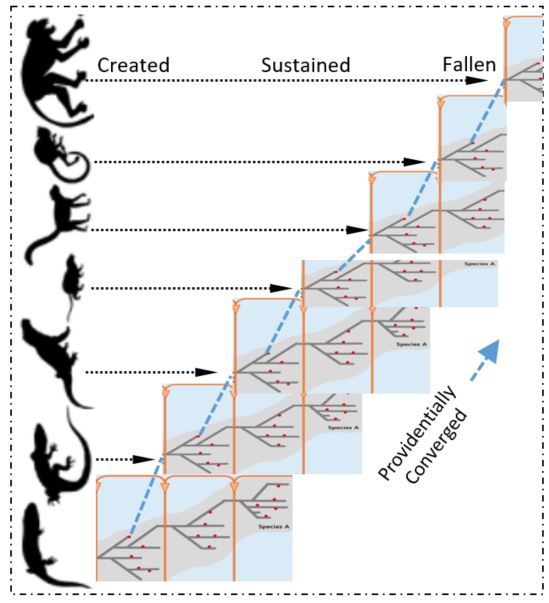
In this manner, the fossil record would show fossils of both the original Day 5/6 creatures and their evolved counterparts, indistinguishably in their respective geological deposits.
Is evolution Biblically acceptable?
The notion of animal diversification is not foreign to the Bible, as Genesis itself suggests that post-fall changes occured in the animal kingdom, such as the serpent losing its legs, and a vast array of animals transitioning from a vegan diet to a carnivorous diet. The primary problem with traditional theistic evolution models, therefore, is not with the idea of biological change, but with the idea of death before the fall. As demonstrated, the MEV view permits any level of evolution because all evolution happened after the six day creation account and after the fall, not in conflict with the miraculous creation events of Genesis One.
In addition, this model differs from traditional evolution models because it does not rely solely on natural processes and random factors. The Bible attributes the birth of any new creature, whether mutated or non-mutated, to the creative act of God, as the Creator of all life (Ps 104:30)! Regardless of whether He started with sustained or unsustained populations, all evolutionary convergence, both micro and macro, would have been divinely controlled through a combination of natural providence and supernatural intervention [39]. Creatures which appear to share common ancestry do not highlight a long history of random changes, but demonstrate an intentional design that progressively points to the final archetypal vertebrate — Humanity!
What about flood geology?
Although this article is not focusing on the tenability of flood geology, I must admit that I personally do not find it compelling. The Bible makes no explicit mention of the terrain-transforming nature of the flood. In fact, it paints a picture of an earth that was left largely in tact after the flood, with an olive tree still standing, ready for its branch to be plucked by the dove Noah dispatched (Gen 8:11). All arguments to purport the terrain-transforming nature of the flood are scientific in nature. Yet the wealth of modern scientific knowledge seems to refute them. First, radiometric dating techniques, which are generally quite reliable, correlate to demonstrate the apparent antiquity of the earth’s deposits. Second, seasonal layers in ancient ice sheets unanimously point to an apparently old earth that has had at least a hundred thousand annual seasons. Third, the geologic strata point to an earth with a lot of history; some layers having land animal tracks, rain drop impressions, and evidence of wind erosion, which are highly improbable in the flood geology scenario; and many layers devoid of fossils and artifacts that should be present if there was a turbulent flood that mixed everything together. Finally, there are over one hundred impact craters on the earth, some of which suggest an aftermath strong enough to wipe out all living things at the time. There are no historical accounts of such impacts, suggesting they occurred before written history. I could present many more reasons why Flood Geology is not a tenable model for proving the earth is young, but that is not the scope of this article.
Rather than holding to such a model that attempts to refute modern scientific methods and explain all ancient-looking formations as evidence of one earth shattering flood, I propose that the landscapes we see were formed by a combination of the Day 1-3 SFPs and the millions of years of geological change since the Cambrian era. I propose a tranquil global flood that had minimal catastrophic effects on the already-formed geological record.
The suggestion that the Genesis flood was tranquil and benign to the geological record hinges on the notion that the majority of the water came from the miraculous “fountains of the great deep” rather than rainfall. Given that God’s major judgments have always been and will always be miraculous – from the the vertical walls of water during the Exodus, to the opening, swallowing, and closing of the earth during Korah’s rebellion, to the global fiery meltdown and cosmic signs of the second coming – it should be no surprise that God maintained meticulous chemical [48] and geophysical control of the waters via these fountains. In fact, it is likely that of the average 725 ft/day of rising water, only 6 ft/day were from rain, considering the most torrential downpours ever recorded. The abatement of the water would have been just as controlled. The floodwaters would have receded at a rate of 3.8 feet per hour, or 0.8 inches per minute, minimizing surface transformation. Historical examples, like the submerged city of Fabbriche di Careggine, show that structures can remain intact after being underwater, especially at such slow rates of water level change. The main geological impact would be the washing away of top sediment layers, perhaps in areas where natural dams broke.
One Tranquil Flood view that aligns the flood with Neolithic deposits is presented by Reverend D. Gath Whitley in his “Article VII: Noah’s Flood in the Light of Modern Science” (1907). Whitley’s defense for a late Quaternary Genesis flood is threefold, encompassing paleontological, geological, and anthropological evidence. Paleontologically, he notes the sudden and widespread disappearance of large Paleolithic mammals, such as lions, tigers, and megafauna, without signs of gradual decline, and questions whether humans, climate change, or famine could be responsible. Geologically, he points to extensive clay, gravel, and sand deposits across Europe, North America, and South America, which he argues could only have been formed by a massive flood, not by rivers or melting ice sheets. Anthropologically, he highlights the abrupt disappearance of Paleolithic humans, who were replaced by Neolithic humans with distinct cultural and technological differences, suggesting a significant and sudden event.
Another view that aligns the flood with the late Akkadian period is proposed by Gaines R. Johnson of the Bible, Genesis, & Geology Ministry [47].
A Middle Ground View
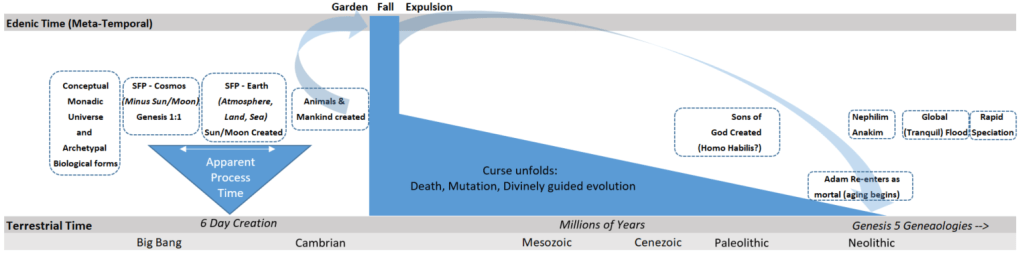
This concludes the eleven propositions of the Metaphysical Eden view. Here is a summary of the events and an accompanying illustration:
- God rapidly created the universe (minus our sun and moon) and the earth in Gen 1:1 through rapid Supernatural Formative Processes (SFPs)
- God began the creation of our biosphere in Gen 1:3, starting with the atmosphere and dry land masses… This was done in the first 3 literal days, but was sped up with SFPs. On the fourth literal day God then brought our immediate luminaries (sun and moon) into existence, already synchronized with the maturity level of the rest of the solar system.
- God miraculously created all kinds of animals on days 5 and 6, followed by the miraculous creation of Adam. These few days all happened over 500M years ago, just before the Cambrian explosion of fossils.
- God next placed Adam inside the metaphysical garden that is described in the events of chapter 2. Therein, God also created another subset of garden animals to serve as Adam’s garden companions. Adam gave them names, but still felt alone. So God created Eve from his side.
- The metaphysical garden is, to steal a popculture reference, a pocket dimension outside of “real time” Where Adam and Eve and all the animals within the garden lived harmoniously for a brief time (from their perspective) until the fall. Meanwhile the rest of the universe aged according to terrestrial time.
- The serpent, who was also in the garden, coaxed Eve to partake in the forbidden fruit.
- After Adam and Eve partook of the fruit, the material world hit the cambrian era and began to feel the affects of the fall — including death, predation, mutation. The few short hours preceding their expulsion from Eden resulted in our entire geological record! It took them until 6,000 years ago to get kicked out of the metaphysical garden and enter into the now-500 million-year-old world the rest of us experience; (but for them it was a matter of hours)
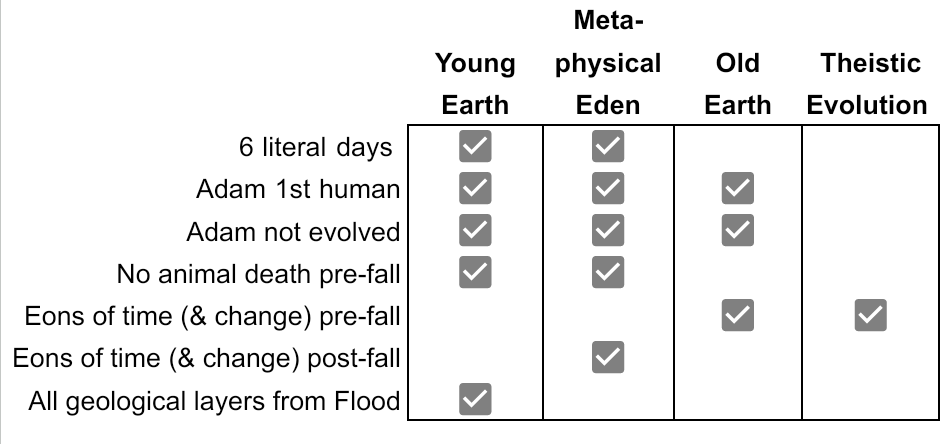
Below is a comparison of the Metaphysical Eden view and other prominent views.
I believe that the points I have made are exegetically sound, science friendly, and promote a solid bridge between creationist camps. This middle ground view:
- Includes major tenets of Young Earth Creationism: A literal interpretation of Genesis One with 24-hour days, and no animal death before the fall
- Accommodates any view of evolution (none, micro, macro, hybrid) without removing the initial miraculous creation of animals and humans
- Accepts the credibility and many of the assertions of modern science, and employs mechanisms that are broadly accepted today, such as convergent evolution.
I believe the Metaphysical Eden View offers a safe place for discussion, but discussion should be enveloped in a spirit of grace and open mindedness. Below are some areas of opportunity:
Be open to the possibility of higher degrees of evolution after creation: Many new-wave young earth creationists have a version of “microevolution” that includes not only speciation, but also descent with modification from a common ancestor at the level of the taxonomic family or even higher. More openness in this area will help the conversation.[37] I’m not asking them to believe that the original “kinds” evolved all the way into humans after the fall. I’m just asking for more openness to the possibility of divinely guided evolution occurring after the fall.
Be open to more supernatural activity in creation: Evolutionary creationists, wary of hampering the progress of science founded on methodological naturalism (MN), often shy away from miracles in creation. But I resoundingly exclaim: God did not design the world for your scientific method, but for His purposes. The truth is, MN would not have applied to Moses’s rod-turned-serpent, to the plethora of animals created during the Exodus plagues, or to the vast majority of other miracles in the Bible. Therefore, we cannot strictly force the application of MN to the creation of Adam from the dust, to the creation of Eve from his rib, or to any other creative event in Genesis 1 and 2. Nevertheless, by employing SFPs, God has made the application of MN consistent for most processes.
Expand your understanding of apparent age: Many young earth creationists employ the “mature creation” argument to describe the fully formed trees with tree rings, and the fully formed Adam with adult biological features. In order to avoid philosophical problems, I would suggest they consider SFPs as an alternative to the classic theory of Gosse, at least for the inorganic parts of the universe. They should also consider the veracity of apparent common descent in God’s mature creation of the animals; a descent that merely reflects God’s human-pointing progression of archetypal forms. On the other hand, evolutionary creationists should be open to the possibility that God created many fully “evolved” creatures de novo, prior to the fall, long before their taxonomic “predecessors” mirrored them through the mechanism of convergent evolution. An omnipotent God could masterfully sequence a genome in appearance prior to ever manifesting it through gradual mutations. Creationists of all persuasions can magnify God for creating life, both miraculously (pre-fall) and then providentially (post-fall), from a biological singularity up through the highest archetypal form — humanity!
May the God of Wonders bless you as you search for truth in the awe inspiring account of creation!
End Notes:
[1] John Sailhamer, Genesis Unbound: A Provocative New Look at the Creation Account (Colorado: Dawson Media, 2011), Kindle edition. Chapter 3.
[2] Job 42:16
[3] The New Revised Standard Version is one such translation
[4] The Masoretic punctuation of ba’reshit with a tipha disjunctive accent
[5] In Greek, Genesis means origin, creation, or generation
[6] Albert Barnes’ Notes. Genesis.
[7] Albert Barnes’ Notes Genesis.
[8] Geerhardus Vos, “Creation” chapter 6 of Theology Proper, vol. 1 of Reformed Dogmatics, ed. Richard B. Gaffin, trans. Annemie Godbehere (Bellingham, WA: Lexham Press, 2013), Kindle Edition.
[9] New English Translation (NET). Richardson, TX: Biblical Studies Press, 1996-2016.
[10] Vos, “Creation” chapter 6
[11] It could be argued that the reference to “morning stars” is merely a parallel reference to the “sons of God”. While this is possible, Job 3:9 gives a precedent for the description of literal stars as stars of the “morning” (NET), stars of the “twilight” (KJV), or stars of the “dawn” (ESV). Job was likely, therefore, referencing literal morning stars that were anthropomorphically singing; similar to the sun, moon, and stars praising God in Psalm 148:3. The Septuagint translation of Job 38:7 also supports a literal stellar interpretation: “When the stars were made, all my angels praised me with a loud voice” (LXX).
[12] Cited by Sailhamer,“Genesis,” in vol. 2 of the Expositor’s Bible Commentary, p. 27
[13] “The whole fluid mass of earth and water mixed together” – Exposition of the Old and New Testament. John Gill’s Exposition of the Entire Bible Index. N.p., n.d. Web. 23 June 2017. Genesis 1.
[14] See Humphreys, D. R.. Starlight and Time. (Arkansas: Master Books, 1994).
[15] New English Translation (NET). Richardson, TX: Biblical Studies Press, 1996-2016.
[16] Gray, Gorman. The Age of the Universe: What Are the Biblical Limits? Washougal, WA: Morningstar Publications, 2010. Print.
[17] Albert Barnes’ Notes. Genesis.
[18] http://www.astro.wisc.edu/~dolan/constellations/extra/brightest.html
[19] New English Translation (NET). Richardson, TX: Biblical Studies Press, 1996-2016.
[20] New English Translation (NET). Richardson, TX: Biblical Studies Press, 1996-2016.
[21] Physicist and Jewish theologian, Gerald Schroeder, through appeal to the wording of “day one” in Genesis One, appeal to the Jewish calendar beginning with Adam, appeal to ancient Jewish Rabbinical commentaries regarding the 24 hour days containing all the ages of the world, and appeal to the modern discovery of the expanding universe, claims that Genesis 1 is spoken with reference to cosmic time, not earth time . There are two different ways to describe time, one from the beginning moving forward, and the other looking back after the universe has expanded and time has dilated. Based on expansion rates, Schroeder shows that days One through Six of the former kind of “day” translate into (respectively) 7.1, 3.6, 1.8, 0.89, 0.45, 0.23 billions of years of the latter kind of “day”, aligning the Genesis events and time frames, with those theorized by the scientific community. This view is similar to the analogical day view, and perhaps a subset of it. The cosmic “days” are basically God “days”, which, though analogical, are of a different kind. See Gerald Schroeder. The Age of the Universe. http://www.geraldschroeder.com/AgeUniverse.aspx. See also
Schroeder, “Correction To The Calculation Of The Age Of The Universe”
[24] Some may argue that this language of God planting a garden must be symbolic or analogical, because God is a Spirit. However, the Old Testament is replete with examples of the “Angel of the Lord” literally manifesting and doing human activities – walking in the cool of the garden with Adam, eating a meal with Abraham, etc. There is no reason to believe that God didn’t literally plant a garden.
[25] Many early Christian writers — such as Justin Martyr, Irenaeus, Eusebius, Clement of Rome, Clement of Alexandria, Origen, St. Ambrose, and Commodianus – believed that the “sons of God” in Genesis 6:1–4 were fallen angels
[26] See Umberto Cassuto, From Adam to Noah: A Commentary on the Book of Genesis I- VI. See Carl Friedrich Keil and Franz Delitzsh, Biblical Commentary on the Old Testament. See Hamilton, Victor P., The Book of Genesis.
[27] It is possible that the time for Adam to name the subset of animals created in the garden was very brief, possibly a matter of minutes, depending on the size of the subset. Likewise, the time for God to induce Adam to fall asleep and to miraculously create Eve could also have been brief. If the temporal relationship between Eden and Earth was linear (e.g. 1 million years on earth per minute in Eden), this prelapsarian time in Eden would be identified with the brief geological period on Earth immediately preceding the onset of the Cambrian explosion. If the relationship is nonlinear, such an identification is unnecessary.
[28] There is no evidence that Seth’s sons were more godly than the rest of mankind. In fact, by the time of the flood, only eight people were saved out of the entire world. If all the descendents of Seth were so godly why did they also perish in the flood? And why wouldn’t such godly men know that it was improper to marry any of Cain’s ungodly women? Also, if we look at the names of Cain’s descendants we see that some included the name of Elohim. For example in Genesis 4:18, 20 we see the name of “Mehuyael” and “Methusael” having the “el” of Elohim and “Yabal” has the “Ya” of Yahweh. Finally, Adam lived another 800 years after begetting Seth and he had other “sons” and “daughters”. Likewise “Seth lived eight hundred and seven years and had sons and daughters” (Genesis 5:7). All of the daughters of Adam, Seth, and Cain were in fact “daughters of men [Adam]”. Others insist that instead of a biological line of Seth, it is referring to the spiritual/covenantal remnant in Seth’s line. Yet this is just as troubling. It confuses God’s specific covenantal reference of “sons of Yahweh” (Dt 14:1) with the generic reference “sons of Elohim” (Gen 6:4). The latter is used physically, and perhaps metaphysically, to describe miraculously created humans. The former, however, is used redemptively and covenantally. Plus, one must do hermeneutical gymnastics to force “sons of God” to include godly women, and “daughters of men” to include ungodly men.
[29] Some scholars claim that Cain’s fear of outsiders was anticipatory of future Adamic offspring, based on God’s command for Adam to fill the earth and the redemptive promise of Genesis 3:15. Such a notion isn’t tenable. A plain reading suggests that Cain was addressing an immediate concern. In addition, both Cain and his dad broke God’s commands. So Cain’s perspective of man’s track record was one of failure, not obedience. He has no strong reason to believe that anyone would obey God’s command to fill the earth, and every reason to believe that Adam would die before having any more offspring (Gen 2:17, 3:9). Finally, how can we expect Cain to perceive the redemptive truth of Genesis 3:15? Cain followed the way of Balaam, the way of curses, lies, and greed; not blessing (Jude 1:11, 1 Jn 3:12). Such a person is blinded by the devil, and lacks faith in any of God’s promises. Therefore, the anticipatory view asks too much of Cain’s character.
[30] Of course, one could argue that 2:5 contains a reference to the “earth”. But the fact that it describes the setting of the plants of the field solicits a more restricted use. Throughout Genesis, the unqualified sense of the word “earth” (Heb. erets) is often restricted, simply meaning “the ground” or “the land”. For example, the “earth” that was flooded in Genesis 6-9 is the same “earth” described in Genesis 11, from whence mankind traveled “eastward” to settle in the “land of Shinar” (11:2). Other restricted uses of “earth” are found in 12:10, 26:1, 34:1, and 36:20. Even outside of Genesis, “earth” may be a local reference, depending on the context. For example, the Psalmist, speaking of the Red Sea parting, mentions the “earth” shaking (Ps 77:18). Surely, this is limited to the ground surrounding the Red Sea, not the whole globe.
[31] The ANE hermeneutic is intriguing, but not very satisfying for various reasons: (1) Enuma Elish and Eridu Genesis have multiple gods fighting over silly things and creating the world through triumph. (2) These sources may have references to divine rest and/or primordial chaos, but these likely originated from partially truthful story-telling that passed down from Adam through his descendants long before Moses wrote the prophetically revealed account. That’s no different than our stories, which often get passed down containing some truth mixed with error. (3) Unlike the ANE accounts, the “waters above” in Genesis are not a cosmic sea enveloping the world or the universe. When we look elsewhere in the Bible, we see that these waters are simply the clouds enclosing our sky (Ps 104:2-3, Job 26:7-8). (4) God’s prophets, including Jesus, consistently challenged the ideas of the world, the idolatry of the people groups around them, and the faulty wisdom of this age. Their approach was often quite polemic and corrective. So while I do agree that there are some cultural, communicative, and language distinctives in each generation, I reject authorial intent being grounded in an evil pagan worldview. (5) As a scientist myself, I am quite suspicious of the scientific propositions that are guided by methodological naturalism. We have a very supernatural God, who has clearly done many supernatural things, which could easily have included the creation of the universe ex nihilo. (6) I think the best place to establish our Old Testament hermeneutic is in the way the New Testament quotes and understands it. The Gospels have countless examples of Jesus affirming the literality of the events in Genesis, such as the creation and marriage of Adam and Eve, Noah’s flood, the promises to Abraham, and Sodom and Gomorrah’s judgment.
[37] https://evolution-outreach.biomedcentral.com/articles/10.1186/s12052-020-00124-w
[38] There is no evidence in Genesis, Leviticus, or Deuteronomy, for understanding “kind” (Heb. mîn) as a technical term corresponding with precision to family, genus, or species. It seems to be solely a classification term, referring to a “multiplicity” of animals of different basic morphology and behavior, not reproductive boundaries. God’s command to reproduce never uses the word mîn. Therefore, evolution of any degree is permitted by the text. — See “The “Kinds” of Genesis 1: What is the Meaning of Min?” by A. Rahel Davidson Schafer, https://digitalcommons.andrews.edu/cgi/viewcontent.cgi?article=1225&context=jats, Page 97
[39] Evolutionary creationists and progressive creationists debate how often such divine tampering occurred. Evolutionary creationists claim that God gifted his creation only with the currently observed natural laws; laws which are divinely fated to produce life as we see it. They place the miracle in the laws themselves. Progressive creationists, on the other hand, reject the notion that unaided natural laws can explain the intelligent design that we see in creation, or the sudden appearance of new creatures in the fossil record. They claim, instead, that God periodically created new kinds of creatures. Progressive creationists place the miracle, not only in the laws, but also throughout history. A modified approach is proposed by Gordon C. Mills in “A Theory of Theistic Evolution as an Alternative to the Naturalistic Theory” (Perspectives on Science and Christian Faith 47 (June 1995): 112-122.). He proposes “that in the history of the origin and development of living organisms, at various levels of organization, there has been a continuing provision of new genetic information by an intelligent cause.” Instead of proposing ex nihilo creation throughout history, Mills proposes divine genetic engineering throughout history. This view, often called progressive mediate creationism, is thus a hybrid between evolutionary creationism and progressive creationism.
[40] Ken Coulson, 2011. Creation Unfolding: A New Perspective on Ex Nihilo. Phaneros Press (February 14, 2020). Kindle Edition. Chapter 4.
[41] Ken Coulson, New Creation Blog, found at: https://newcreation.blog/how-did-god-oxygenate-the-atmosphere-during-creation-week/
[42] Baumgardner, J.R. 2000. “Distribution of Radioactive Isotopes in the Earth.” In Radioisotopes and the Age of the Earth, edited by L. Vardiman, A.A. page 87. Quoted by Coulson, Creation Unfolding.
[43] Coulson, Chapter 6. The Conceptual Universe.
[44] Erickson, Millard J. Christian Theology edition by Erickson. Ada: Baker Academic, 1990, p. 358.
[45] Two sources of referenced for a general understanding of monads were:
Leibniz, Gottfried: Metaphysics
McDonough, Jeffrey K. and Tran (Jen) Nguyen. Monad, 2017, doi:10.4324/9780415249126-DA082-1. Routledge Encyclopedia of Philosophy, Taylor and Francis.
[46] Richard Owens was a key advocate of this philosophy. For a deeper understanding, please refer to the Reason to Believe article “Archetype or Ancestor? Sir Richard Owen and the Case for Design”: https://reasons.org/explore/publications/articles/archetype-or-ancestor-sir-richard-owen-and-the-case-for-design
or to Ken Coulson’s extremely helpful video “Why do humans and chimpanzees share similar anatomy? Part 2” at https://www.youtube.com/watch?v=VNfFX-Hkvi4
[47] https://www.kjvbible.org/greenland_ice_sheet.html
[48] A common issue brought up by skeptics is the salinity issue. Allegedly the global flood mixing ocean water with freshwater sources would have drastically altered salinity levels, making it difficult for many aquatic organisms to survive. Freshwater is currently only 2.5% of the Earth’s water. Totally covering land, would increase it from 2.5% up to some larger percent, no greater than 30% (which is the land surface percentage). Admittedly, this is a challenge for any global flood position. One solution could be that the fountains of the deep were uniformly spread throughout the Earth, miraculously matching the salinity of the area they were feeding. This continual influx would have kept the salty areas salty and the fresh area fresh, and the intersections brackish. Rain clouds bringing fresh water would have only been over the former land areas, not over the ocean.
 The Middle Ground
Chad, Your presentation on Creation views is very well laid out. I have held to the Young Earth view early in my Christian days but later switched to Old Earther. Now I strongly hold to the view held by Intelligent Design (ID) community (See The Discovery Institute) https://www.discovery.org
ID basically states that the physical world in all of its complexity down to the atomic level is far too complex to have evolved. There has to be a higher creator, namely God. ID does not address the time element of Old vs Young earthers. I think we might find out we were all wrong on timing but we know God created this universe and all of us in it!
LikeLiked by 1 person
Thanks Lew! I’ve read a lot of resources from the Discovery Institute. They’re a great organization. Though they swam uphill for many years, I think they have gotten more traction in the scientific community as of late.
LikeLike