

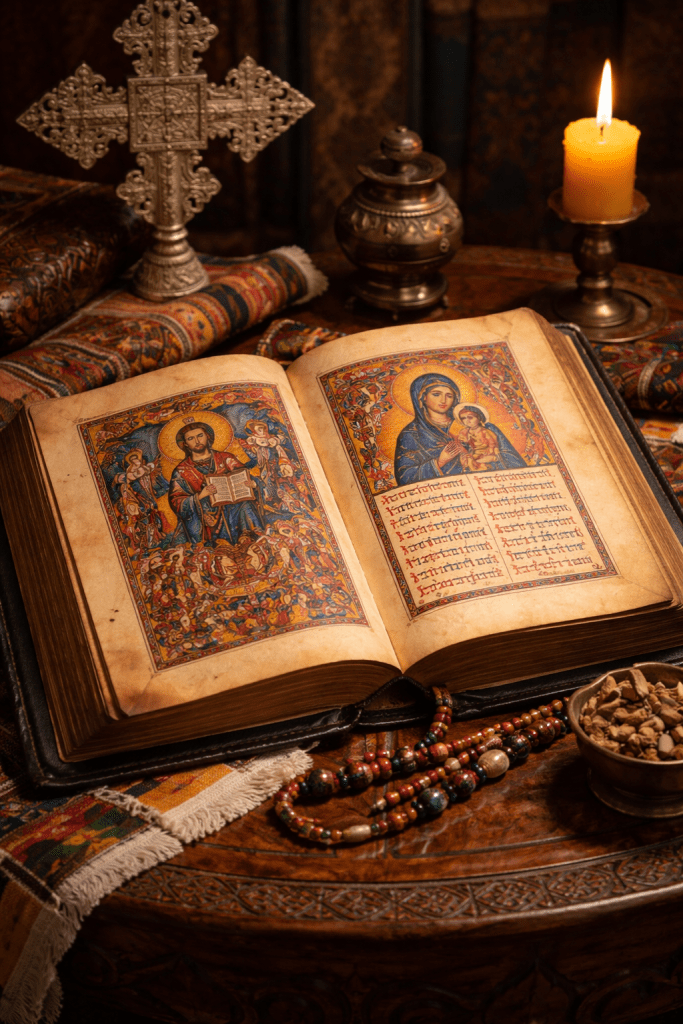
The below video has rapidly gained attention for revealing a provocative and largely unknown dimension of Christian scripture through AI analysis, allegedly uncovering the Ethiopian Bible’s 22 additional books and post-resurrection teachings of Jesus that have been excluded from Western Christianity for centuries.
This brief article will provide a brief structured refutation of this video, highlighting major discrepancies and problematic claims from a conservative evangelical standpoint:
1. Questionable Authenticity and Canonical Authority of the Ethiopian Bible
Claim: The Ethiopian Bible contains 88 books, including 22 excluded from the Western canon, and is presented as the “original” or “most complete” Christian scripture.
Evangelical Response:
– The Protestant canon of 66 books is based on rigorous historical, theological, and apostolic criteria established through centuries of church councils and guided by the Holy Spirit’s providence.
– The Catholic and Orthodox churches, while having larger canons than Protestantism, do not recognize all 88 Ethiopian books as canonical.
– Simply being ancient or preserved in isolation does not guarantee divine inspiration or authenticity.
– Early church fathers and councils consistently rejected many of these extra texts (e.g., Enoch, Jubilees) because they contained teachings inconsistent with apostolic doctrine.
– The fact that these books were “cut” or “excluded” reflects careful theological discernment, not conspiratorial censorship.
2. Misrepresentation of Church History and Scriptural Formation
Claim: The Council of Nicaea (325 AD) and Roman authorities arbitrarily shaped scripture to maintain political control, excluding texts that taught direct access to God without clergy.
Evangelical Response:
– The Council of Nicaea did not determine the biblical canon; its focus was on Christological orthodoxy (e.g., the deity of Christ), not canon formation.
– The canon emerged over centuries through the consensus of the early Church guided by apostolic teaching, not imperial politics.
– The claim that texts were excluded because they taught direct access to God ignores biblical teachings on the priesthood of all believers and the role of church leadership.
– Institutional authority in the church is biblically mandated (e.g., apostles, elders, pastors), and does not contradict personal faith or access to God.
– The suggestion that Rome suppressed “dangerous” truths undermines the historic, unified witness of the early Church.
3. Theological Discrepancies in the Ethiopian Texts
Claim: The Ethiopian Bible contains post-resurrection teachings vastly differing from the New Testament, including warnings about corrupt religious leaders and a highly expanded cosmology account.
Evangelical Response:
– The canonical New Testament provides a clear, consistent account of Jesus’ resurrection, ascension, and teachings.
– Extra-biblical “post-resurrection” narratives that contradict or add to Scripture violate the principle of *sola scriptura* and risk heresy.
– Some texts in the Ethiopian canon (e.g., 1 Enoch and Jubilees) expand angelic roles and cosmic speculation in ways that can blur the distinction between God’s sovereign creative work and the activity of created beings, going beyond what is clearly taught in the universally received Scriptures.
– Warnings against false teachers are biblical but not unique to these texts and do not justify accepting additional writings that conflict with orthodox doctrine.
– Describing the body as a “garment” and emphasizing mystical “inner light” aligns with unbiblical mysticism, not biblical anthropology.
4. Misinterpretation of Spiritual Authority and Church Role
Claim: True faith is a daily personal awakening, independent of rituals, buildings, or religious institutions; the “kingdom of God” is fully inside every person.
Evangelical Response:
– While personal faith and spiritual renewal are vital, Scripture affirms the importance of the Church, sacraments, and community worship (Hebrews 10:25).
– The kingdom of God is both “already” and “not yet” — present spiritually but also visibly manifested through the Church and Christ’s return.
– The text’s rejection of “institutions” conflicts with biblical teachings on the Church as Christ’s body and the necessity of spiritual oversight.
– The overemphasis on internal spirituality without external obedience or doctrine risks subjective, individualistic faith prone to error.
5. Unsubstantiated Claims About Suppression and Conspiracies
Claim: The Western Church deliberately hid these Ethiopian texts to maintain control, suppressing authentic Christian teachings.
Evangelical Response:
– Such conspiracy theories lack credible historical evidence and undermine trust in the historic Church.
– The exclusion of texts was grounded in theological consistency, apostolic authorship, and doctrinal soundness, not political expediency.
– The narrative unfairly portrays the Church as a power-hungry institution rather than a guardian of God’s revealed truth.
– The idea that AI “discovered” hidden truths and “shocked” scholars exaggerates the novelty and significance of these manuscripts, which have been known and studied for centuries.
6. Overreliance on AI as a Source of Theological Authority
Claim: The AI system Grock revealed facts that scholars have been afraid to admit, implying technology surpasses traditional theological scholarship.
Evangelical Response:
– Theology and biblical studies require careful exegesis, historical context, and spiritual discernment, which AI cannot provide.
– AI’s pattern recognition cannot determine divine inspiration or doctrinal truth.
– Trusting a machine over centuries of scholarship poses risks of misunderstanding and misapplication.
– True theological authority comes from Scripture and the Holy Spirit, not from technological tools.
Summary
From a conservative evangelical perspective, this video’s major claims are undermined by:
– Questionable canonical legitimacy of the Ethiopian Bible’s expanded books.
– Historical inaccuracies regarding the formation of the biblical canon and the role of the early Church.
– Theological errors reflecting Gnostic and mystical influences incompatible with biblical orthodoxy.
– Misrepresentations of church authority and the communal nature of Christian faith.
– Unsupported conspiracy claims about deliberate suppression by Rome.
– Inappropriate elevation of AI findings above established theological scholarship.
Thus, the video’s narrative is fundamentally flawed theologically, historically, and doctrinally, and should be approached with caution and discernment consistent with biblical teaching.
 The Middle Ground