

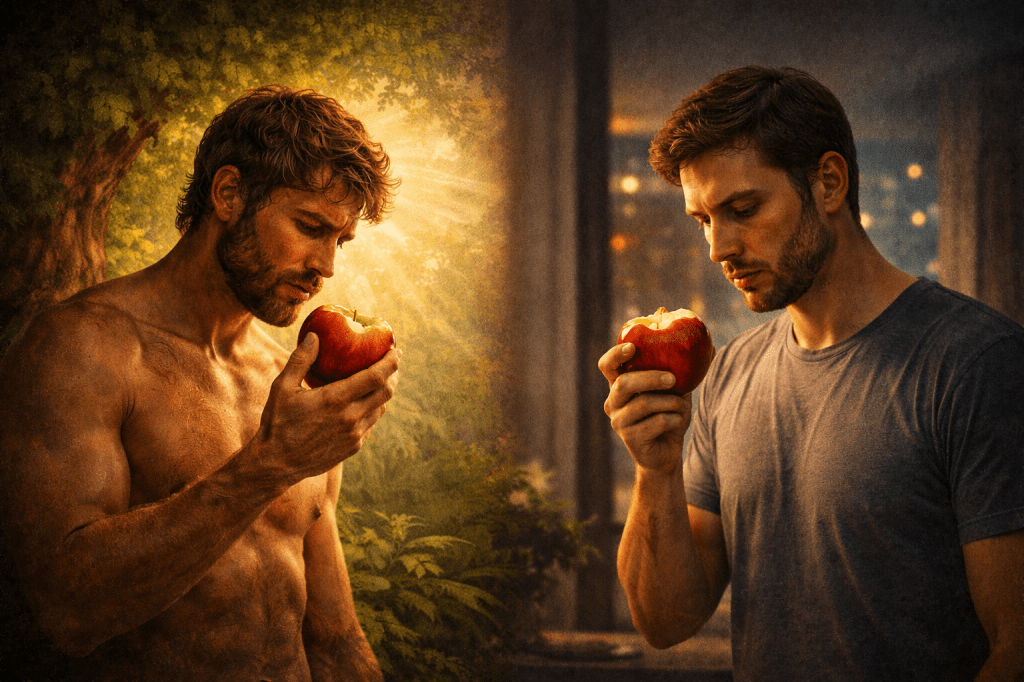
One of the most persistent accusations leveled against Reformed theology is that God is unjust for allowing Adam’s sin to propagate to his offspring without their consent. The objection is usually framed emotionally: “How is it fair for me to be condemned for a choice I didn’t make?”
Of course, we should already recognize that sin carries consequences beyond the immediate offender. Parents may be held responsible for the actions of their children, having to pay restitution for transgressions they did not commit. In a similar way, a husband’s unlawful financial decisions can legally bind his wife to loss of property or damaged credit, imposing real consequences on her for actions she did not commit. Within families, a single act—abuse, abandonment, or addiction—can alter the course of children’s lives for decades.
Scripture presses this reality even further. Through Adam’s sin, the creation was cursed for the entire human race, affecting every one of his descendants (Rom 5:12). David and Bathsheba’s child was sentenced to death as a direct consequence of their transgression (2 Sam 12). The list goes on and on. Therefore, we should not be strangers to the idea of shared or far-reaching consequences. And yet, even granting all of this, eternal punishment can still seem severe compared to these temporal judgments.
The Reformers did not ignore this issue. On the contrary, they addressed it directly—and their answer is deeper and more morally satisfying than many critics realize.
Adam, Our True and Fair Representative
In Reformed theology, Adam is not merely the first man; he is a public person, the covenantal head of the human race. Humanity’s connection to Adam runs deeper than simple ancestry—Scripture teaches that, in some real sense, we were all “in” Adam. Romans 5 and 1 Corinthians 15 make this explicit: through one man, sin and death entered the world, and in Adam “all die.” This idea of corporate identity shows up elsewhere in Scripture. Hebrews 7 says that Levi “paid tithes” to Melchizedek while still “in the loins of his ancestor” Abraham, even though Levi wasn’t born for generations. Matthew 2:15 applies Hosea 11:1 (“Out of Egypt I called my son [Israel]”) to Jesus, showing that Israel was somehow represented in Christ, the true Son. These passages reveal a biblical pattern: God often views people as being “in” their representative head—whether Adam, Abraham, Israel, or ultimately Christ.
But is it really fair to say we were “in Adam” when none of us remembers being there or making his choice? Scripture’s answer is yes—and it’s not because God arbitrarily assigned us a flawed representative. Adam wasn’t morally inferior or unfit for headship. He was created upright, without corruption, with full moral clarity, genuine freedom of will (yes, in a libertarian sense), and placed in the most favorable environment imaginable for obedience. And still, he sinned.
Luther’s recurring point—especially in The Bondage of the Will—was this:
“If Adam fell under perfect conditions, none of us would have stood longer.”
Vermigli concurred, teaching that Adam was chosen because he was most fit, and God knew that no human would have exercised free will better in his place.
Ursinus taught the same thing; that Adam’s sin is justly imputed to us not only because he was our federal head, but because we would have fallen in the same way.
Turretin later makes the point even more explicit:
“The covenant made with Adam was not unjust… because Adam represented all, and God knew that all would have consented in him.”
This is sometimes called “virtual consent”. Not that we consciously approved Adam’s act, but that God—who does not operate on educated guesses—knew the relevant counterfactuals with certainty. This knowledge was not probabilistic but grounded in God’s exhaustive understanding of each creature’s nature prior to its creation. In Leibnizian terms, God knows the full range of actions each moral agent (or what Leibniz called a “monad”) would freely perform in any given set of circumstances, consistent with a compatibilist account of freedom. On that basis, God knew with certainty that any of us placed in Adam’s position would have consented to the same rebellion.
The justice of imputation is therefore not arbitrary; it is morally coherent. Our own lives continually confirm its fairness. The unregenerate affirm virtual consent through their insufficient use of common grace, failing to respond rightly to the light, restraint, and moral power God graciously supplies. Even the regenerate—who possess a spiritual nature beyond what Adam had—continue to sin, confirming that Adam’s failure was not an anomaly, but a clear revelation of what mutable creatures do when left to their own self-determinism. As Paul rightfully states:
Rom 5:12: “… death was passed on to all men, because all sinned.” (BSB)
We all sinned in Adam, because we are all Adam.
Sin by Privation, Not Production
Another common caricature is that God “gave” Adam’s descendants a sinful nature, as though depravity were a substance He injected into humanity. Scripture presents the matter differently.
When Adam fell, God did not add evil to human nature; He judicially withdrew access to the Tree of Life (Gen. 3:22–24). That tree functioned as the original life-giving sacrament—a physical sign through which God communicated and sustained spiritual life. Cut off from that appointed means, humanity was condemned to mortality. Corruption followed not by divine production, but by creaturely privation. Human beings were never designed to possess eternal life in themselves, but to receive it through God’s ordained means; once that sacramental life was withdrawn, mortality inevitably took hold; And its consequences were dire for all humanity.
Paul vividly describes the spiritual impact of mortality in Romans 7. He speaks of sin operating through his “members,” his “body of death” (Rom 7:24)—the mortal body experiencing the full effects of separation from the vivifying source of life. This body is plagued by exhaustion, pain, disordered desires, hormonal volatility, anxiety, anger, and cravings that exceed lawful bounds. Hunger becomes gluttony. Desire becomes lust. Fear becomes cowardice. Rest becomes sloth. This is not neutral terrain. A mortal body, cut off from sustaining life, inevitably exerts pressure toward sin. It is no wonder that Paul calls the sinful nature the “flesh” (Gal 5:16-21).
This view of depravity is not typical traducianism, or the idea that Adam somehow metaphysically transmits the soul itself—and thus spiritual death—to his progeny. Rather, Adam transmits mortality, and when that mortality is combined with humanity’s exclusion from the Tree of Life, the result is a condition that invariably leads to willful sin and personal spiritual death, even at the most granular level of moral light in human infancy. For that reason, no human is born innocent. As David confesses, “The wicked go astray from the womb; they err from birth, speaking lies” (Ps. 58:3).
Guilty Infants?
Scripture does not portray infants as morally neutral. Rather, it assumes that humans possess moral light appropriate to their nature, even when that light is extremely minimal. John the Baptist, for example, responds to Christ in the womb (Luke 1:41–44), indicating real—though very granular—moral awareness.
Many evangelicals, including many in the Reformed tradition, have held that infants who die (especially those of covenant families) are received into glory. Passages often cited include David’s confidence that he would be reunited with his child (2 Sam. 12:23), Jesus’ welcome of children into the kingdom (Matt. 19:14; Mark 10:13–16), and Paul’s description of believers’ children as “holy” (1 Cor. 7:14). Yet any such hope must be grounded not in infant innocence, but in God’s mercy and faithfulness to His covenant promise (Acts 2:39). There is a suggestion that such mercy is offered inversely to the level of light received. Jesus taught a parable about the servant who knew his master’s will and disobeyed receiving a severe beating, while the one who did not know received a lighter one (Luke 12:47–48). Surely such a concept would be applied to infants, who know the least.
Only One Better Than Adam
Importantly, the inevitability of personal sin, even in infancy, does not remove responsibility. The onslaught of intrinsic temptations does not force sin, but it invariably leads every human being—without exception—to willful transgression and condemnation. Every human from conception, that is, except one.
Jesus Christ assumed this same mortal condition. Paul says God sent His Son “in the likeness of sinful flesh” (Rom. 8:3). Yet unlike Adam and his progeny, Christ possesses life in Himself (John 5:26); He is not dependent upon an external, sacramental source of life. For this reason, the removal of the Tree of Life did not imperil Him as it did the rest of humanity. Indeed, He is life itself (John 14:6). Hebrews affirms that He was tempted in every way as we are, yet without sin (Heb. 4:15). Christ did not bypass the human condition; He overcame it.
And that is precisely the point. If Jesus alone emerges sinless from this environment, then the rest of us cannot plausibly claim that we would have done better than Adam—or that God has wronged us.
Bibliography
Luther, Martin. The Bondage of the Will. Translated by J. I. Packer and O. R. Johnston. Grand Rapids: Revell, 1957.
Vermigli, Peter Martyr. Commentary on the Epistle to the Romans. Edited and translated by John Patrick Donnelly. Kirksville, MO: Truman State University Press, 1994.
Vermigli, Peter Martyr. Loci Communes. Florence, 1576.
Ursinus, Zacharias. The Commentary of Dr. Zacharias Ursinus on the Heidelberg Catechism. Translated by G. W. Williard. Phillipsburg, NJ: Presbyterian & Reformed, 1985.
Turretin, Francis. Institutes of Elenctic Theology. Translated by George Musgrave Giger. Edited by James T. Dennison Jr. 3 vols. Phillipsburg, NJ: Presbyterian & Reformed, 1992.
 The Middle Ground