

Today’s message is Christmas-related, particularly about the providence of God in the birth of Jesus.
Let’s start with that word: providence. It kind of sounds like the word provide, doesn’t it? And that’s not accidental.
In essence, both words share the same idea of looking ahead and preparing for future needs.
We often hear that God is omnipotent—all powerful.
We often hear that God is omniscient—all knowing.
But we don’t hear nearly enough about the fact that God is also omnisapient—all wise.
Philip Yancey once said,
“A God wise enough to create me and the world I live in is wise enough to watch out for me.”
God is the master chess player. He is always a move ahead. He looks down the annals of history, decides the ends He wants to accomplish, and then He puts the means in place to bring those ends about.
And those means include everything—the good, the bad, and the ugly.
History really is His-story.
And while we love to speculate about alternate realities—“what if this hadn’t happened?” or “what if that decision had gone differently?”—with God, there is no Plan B.
Scripture tells us that Christ was foreordained before the foundation of the world (1 Peter 1:20). And when the serpent successfully tempted Eve to sin in the garden, God immediately promised the serpent that history would be characterized by enmity between his seed and the woman’s seed—and that her seed would win.
From that moment on, the Old Testament becomes the story of God preserving the seed of the woman.
Think about Joseph.
Dream → pit → prison → palace → prominence.
Why? To preserve Israel during a devastating famine.
Think about Esther.
A Hitler-like figure named Haman plots to annihilate the Jews, and at the same time God raises up a Hebrew orphan girl and places her on the throne “for such a time as this”—to preserve Israel from destruction.
Over and over again, we see an all-wise God placing the right people in the right places at the right times, ensuring that the ultimate Seed of the woman—our Savior Jesus Christ—would be born into this world.
Why Matthew Begins With a Genealogy
Now let’s turn to Matthew chapter 1.
“The book of the genealogy of Jesus Christ, the son of David, the son of Abraham.” (Matthew 1:1)
I know what you’re thinking:
“Chad, why are we in Matthew 1? These are genealogies. Boring stuff. An exercise in mispronunciation!”
Beloved, all Scripture is God-breathed and useful (2 Timothy 3:16). And this chapter—far from being filler—is absolutely critical.
In the Old Testament, God demanded accurate genealogies going all the way back to Mount Sinai (Numbers 1). Israel’s land was divided by tribe. Many functions were divided by tribe. The priesthood belonged to the Levites. And the throne belonged to the house of David.
God promised King David:
“I will raise up your offspring after you… and I will establish his kingdom.” (2 Samuel 7:12)
From that point forward, Israel waited for David’s greater Son—the one who would rule eternally. The title “Son of David” became synonymous with Messiah.
So any account identifying the Messiah must prove that He is the Son of David.
That’s exactly what Matthew is doing.
And as Matthew walks through the genealogy, he intentionally highlights some surprising names:
- Tamar — a harlot
- Rahab — a Gentile harlot
- Ruth — a Gentile Moabitess
- Bathsheba — partner with David in adultery
Don’t ever believe that a bad past disqualifies you from God’s purposes.
Matthew also shows us every possible combination of parenting outcomes:
- bad father → bad son
- bad father → good son
- good father → good son
- good father → bad son
We love sayings like “chip off the old block,” but Scripture reminds us that your future is not determined by your parents’ past.
Your future remains your choice.
Fourteen, Fourteen, Fourteen
Matthew then summarizes the genealogy this way:
“So all the generations from Abraham to David were fourteen generations, and from David to the deportation to Babylon fourteen generations, and from the deportation to Babylon to the Christ fourteen generations.” (Matthew 1:17)
Why fourteen?
The Jews were big on gematria, where letters are assigned numerical values. The Hebrew name David adds up to fourteen.
Fourteen.
Fourteen.
Fourteen.
David. David. David.
Matthew even intentionally omits a few insignificant generations—on purpose—so the message would be unmistakable:
Jesus is the Son of David.
Satan’s Apparent Victory
But then we hit a serious problem.
Matthew 1 mentions King Jechoniah—also called Coniah or Jehoiachin. He was the last Hebrew-appointed king in Judah. According to 2 Kings 24, he did what was evil in the sight of the Lord, leading to one of the greatest tragedies in Israel’s history: the Babylonian exile.
God finally had enough of Israel’s idolatry, oppression, and Sabbath-breaking, and He allowed Babylon to besiege Jerusalem.
And then comes the devastating prophecy in Jeremiah 22:
“Write this man down as childless… for none of his offspring shall succeed in sitting on the throne of David.”
Jechoniah wasn’t literally childless—he had sons—but God was saying, “Consider him as childless.” His entire line was disqualified from the throne.
If the Messiah must sit on David’s throne, this would disqualify Jesus from being the Messiah!

Hold on…
Don’t throw in the towel yet…
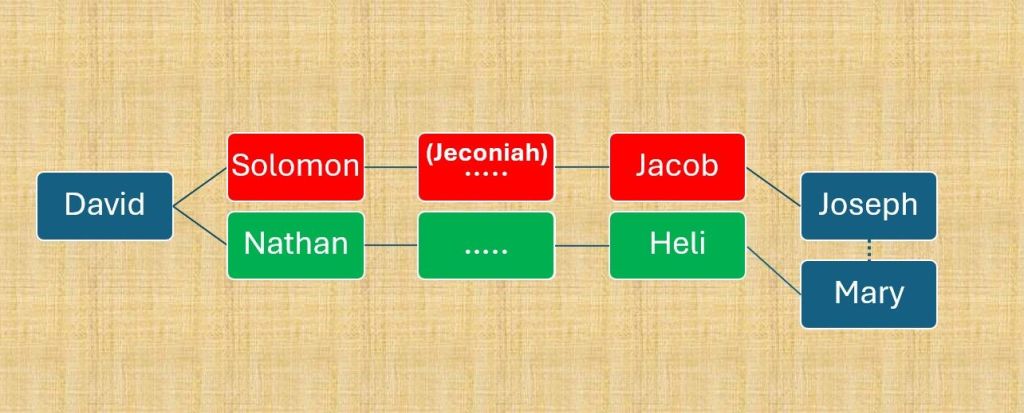
Matthew tells us in verse 16:
“Jacob the father of Joseph, the husband of Mary, of whom Jesus was born.”
But Luke says something entirely different.
Jesus, when he began his ministry, was about thirty years of age, being the son (as was supposed) of Joseph, the son of Heli (Lk 3:23)
Notice he says Joseph was the son of Heli, while Matthew said Joseph was the son of Jacob. In fact, these accounts have different lineages all the way back to David; Matthew’s tracing through Solomon; Luke’s through Nathan.

What in the world is going on here? Biblical contradictions? Not at all.
Scholars explain it beautifully: Matthew gives Joseph’s biological lineage. Luke gives Mary’s lineage, legally applied to Joseph.
Numbers 27 established that if a man had no sons, his daughters could inherit. Mary, the daughter of Heli, becomes the legal heir (assuming she has no brothers). When she marries Joseph, Joseph then inherits her lineage.
What a powerful story of providence! Satan attacked David’s line again and again:
- Through David’s sin
- Through Solomon’s idolatry
- Through generations of corruption
- Finally through Jechoniah’s curse
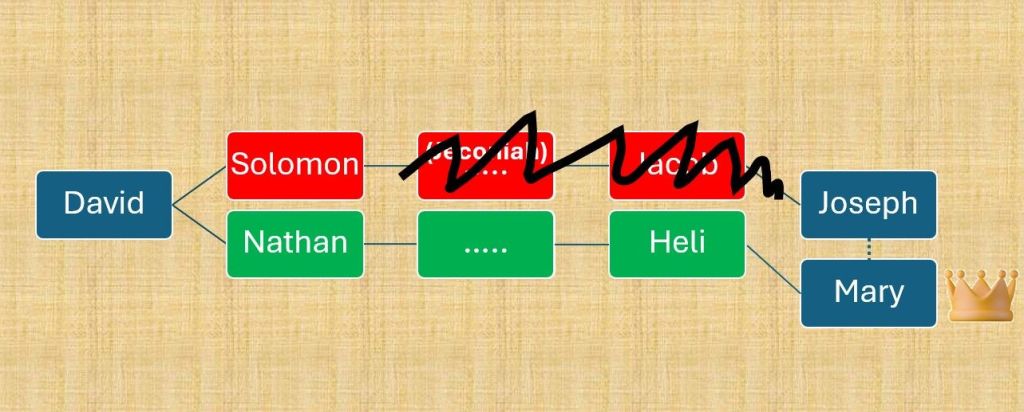
Satan thought he finally won this time. But he forgot something. Four hundred years earlier, God had already provided an alternate line—through Nathan (which literally means “to give”).
Through Mary’s lineage, Jesus remains the legal heir to David’s throne.
Providence wins again.
God Is Still Staging Nathans
So let me ask you:
Has your past been littered with failure?
Has the line of Jechoniah been destroyed in your life?
Do you feel disqualified by sin, broken relationships, financial collapse, or bad decisions?
God has a Nathan for you.
“In everything God works for the good.” (Romans 8:28, NCV)
Everything means everything.
God’s purpose is not your comfort—it’s your conformity to Christ (See the next verse–8:29). Just as He provided a lineage for Christ’s incarnation, He is making provision for Christ’s formation in you.
Your destiny is glory.
Just as Joseph was adopted into Mary’s royal line, you will be adopted into glory, qualified to reign with Christ.
God values:
- character more than comfort
- purity more than plenty
- endurance more than convenience
Failure is never the end—it’s often the catalyst.
God has been staging a Nathan all along.
Do you believe that today?
Merry Christmas from Middle Ground Theology!
 The Middle Ground