


In Part 1 of this series, we explored the interpretive differences of opposing eschatology camps. We were also introduced by Richard Pratt to a useful hermeneutical approach – Historical Contingency in the interpretation of unqualified prophecies. Can the head scratching issues of eschatology hermeneutics be resolved by interpreting some prophecies as conditional “forth-telling” rather than unconditional “fore-telling”? Part 2 in this series will delve a little deeper into how we can apply Pratt’s findings to other major prophecies.
Applying Pratt’s Approach
As a baseline pattern, let us consider the prophetic timeline of the destruction of Nineveh:
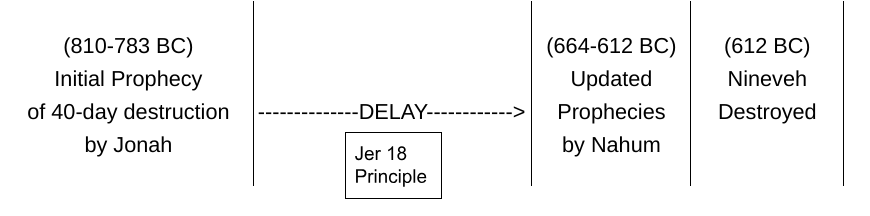
The pattern is simple. In 810-783 BC, an initial unqualified prophecy was given by Jonah, regarding Nineveh’s destruction in 40 days. That prophecy was apparently contingent, because Nineveh’s destruction was prevented by their repentance, in alignment with the promise of Jeremiah 18. After a long delay, and a regression in Nineveh’s behaviors, new prophecies were given by Nahum in 664-612 BC. These prophecies, once again, promised their destruction. Shortly thereafter, Nineveh was destroyed.
This pattern can be extended to many categories of prophecy. One such category is the prophesied restoration of Israel.
Israel’s Restoration Promises
Below is a depiction of the prophetic timeline of the restoration of Israel, following a pattern similar to that of the Nineveh example

Centuries before the coming of Christ, the Old Testament prophets prophesied a future restoration of national Israel; a return to their land and a time of prosperity and peace under the rule of the Davidic-Messianic King. Due to their relapse into disobedient behaviors after their return from Babylonian exile, they never fully experienced the restoration they were promised. After the first Advent of Christ, many of the prophecies regarding the restoration were reiterated in various forms (Acts 1:6-7, 3:19-21, Rom 11:28). As these reiterations suggest, and as Kaiser argues, God’s assurance-based covenantal promises to Israel demand a future fulfillment; including the land, prosperity, seed, and spiritual blessings 1. Yet, even Kaiser admits that their delay will cause a slightly modified fulfillment. Regarding the sin and guilt offerings described in Ezekiel’s millennial temple (Ezek 40-48), he says:
“I argue that he’s trying to talk about worship in the future under terms known in that day, just like they talk about war in the future; they don’t have any tanks, no B-29’s, no F-16’s, no atomic bombs, no guided missiles. They have swords and spears and knives. So the Bible talks about war in the future, armageddon for example, under the imagery of the implements known in that day … So with worship, [Ezekiel] talks about the worship of God under words that were known for worship in that day.” 2
While both Kaiser and Pratt come to similar conclusions regarding the nullification of literal animal sacrifices in the restored kingdom, I believe that Pratt’s hermeneutic is stronger than Kaiser’s. Kaiser diverts from his typical literal interpretation to an allegorical interpretation, suggesting that Ezekiel uses contemporary images “trying to talk about worship in the future”. Pratt’s hermeneutic, more correctly, advocates that Ezekiel used contemporary language to convey literal realities that would have been realized if conditions were met. Had Israel responded favorably in the day Ezekiel prophesied, those temple prophecies would have come to pass literally in every detail. Nevertheless, the prophecies were contingent, suggested by God’s requirement that Israel inquire of Him repentantly:
“I will yet for this be inquired of by the house of Israel, to do it for them” (Ezek 36:37)
“If they are ashamed of all that they have done, make known to them the design of the temple” (Ezek 43:10)
Israel’s delay in meeting this condition has resulted in a delayed fulfillment; a modified fulfillment wherein Jewish animal sacrifices will be replaced with spiritual “sacrifices” of both Jew and Gentile (Rom 12:1-2, Php 4:18, Heb 13:15-16, 1 Pet 2:5, Rev 8:3-4).
Contrary to Kaiser’s view, these realities also seem to challenge the need for a future third temple, as its sacrifices are rendered unnecessary by the sufficient sacrifice of Christ (Heb 9:11-14, 10:1-18, Col 2:13-17). In addition, the New Jerusalem is described differently in Revelation than in Ezekiel. It is 1,400 by 1,400 miles (Rev. 21:16), while Ezekiel’s refurbished Jerusalem is only about 10 square miles (Ezek. 48:15-19, 30-35; 45:6). The New Jerusalem of Revelation has no temple (Rev 21:22), while Ezekiel’s New Jerusalem has a glorious temple (Ezek 40-48), as does Isaiah’s (Isa 66:20, 22). To explain this discrepancy, futurists typically locate Ezekiel’s city in the millennium and Revelation’s city in the eternal state after the millennium. However, that is problematic, as a majority of the prophecies fulfilled in Revelation 21-22 are ones that futurists typically ascribe to the millennium. 3
Therefore, while I endorse some dispensational-ish themes regarding the future conversion of Israel, their inheritance of the land (along with the whole world per Romans 4), and their role in blessing all the families of the earth, I believe that Pratt’s hermeneutic allows for a more accurate understanding of how those themes culminate and how some fulfillments become modified.
Moving on to another category of prophecy, I will now demonstrate how this pattern can also be applied to the prophesied events preceding Israel’s restoration, namely, the events prophesied in the Olivet Discourse.
The Olivet Prophecies
Instead of employing strained hermeneutical methods to deal with Jesus’s prophecies of His imminent return to His contemporary generation, we can instead understand His prophecies as literal but delayed. The below illustration depicts the same pattern evidenced in the prior examples:
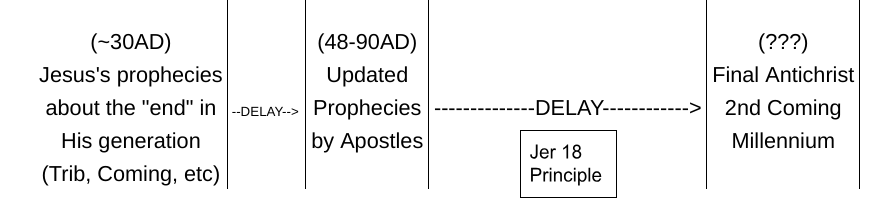
The pattern begins with Jesus’s prophecies stated around 30 AD. As suggested earlier, several categories of these prophecies seem to dictate their imminent fulfillment when taken at face value. They caused the apostles to believe that they were in the last hour (1 Jn 2:18), that Christ was coming very soon (Heb 10:37, Jas 5:8, Rev 22:12), and the end of all things was “at hand” (1 Pet 4:7). Yet, along with their prayerful expectation of imminence, the apostles also realized that the fulfillments may have been delayed. In 2 Thessalonians 2:2-3, Paul states that the coming of Christ may not be “at hand” and that other things need to precede it. In Revelation 6:10, John has a vision of martyrs under an altar, crying out, “How long, Sovereign Lord, holy and true, until you judge the inhabitants of the earth and avenge our blood?” This language suggests an unanticipated and unwanted delay between the expected and actual fulfillment of prophecy. What could have caused such a delay? Some of Jesus’s own statements, along with updated prophecies and themes written by His apostles, suggest that contingencies were implied, which evidently interrupted the fulfillments. I categorize these into two primary themes:
1. The Unfinished Mission to All Nations:
In Matthew 24:14, Jesus suggested the condition that the Gospel must be preached to the whole world as a witness before the end comes (Mt 24:14). Peter later reaffirms that believers can hasten the coming of the day of God through their obedience (2 Pet 3:12), implying that they can delay it through their disobedience. Although Paul took the Gospel to the Roman “world” (Rom 10:18, Col 1:6), the comprehensive Gospel distribution by God’s chosen nation to all tribes of the earth was curtailed, as Israel rejected the Gospel and the adolescent church largely abandoned Paul’s mission (2 Tim 1:15, 4:16). So, perhaps the failure of God’s people to spread the Gospel to the entire world could have contributed to the obvious delay in fulfillment. This delay reflects God’s patient endurance with the Gentiles. Peter tells his increasingly restless disciples that God is patient, not wanting anyone to perish, but for all to come to repentance (2 Pet 3:9). His timing often extends beyond human expectations in order to allow for repentance and salvation.
2. The Unfinished Sanctification of the Jewish Nation:
Because of their ongoing resistance to the Gospel, and according to His Jeremiah 18 principle, God had originally extended Israel’s scattering from seventy years, to seventy weeks of years (Jer 25:11-12, Dan 9:24). Even though Jesus’s first coming triggered prophecies offering the Jews their ultimate deliverance “from the hand of [their] enemies” based on His Abrahamic oath (Lk 1:70-74), their continued rebellion has now extended that scattering to an indefinite duration. Jesus told the Jews that the kingdom would be taken from them (temporarily) and given to another nation (Mt 21:43), and that Jerusalem would be trampled on by the Gentiles until the times of the Gentiles are fulfilled (Luke 21:24). Because of this horrible turn of events, Jesus wept over Jerusalem, knowing that the Jewish dispersion should have instead been the Jewish regathering (Mt 23:37-39). Yet, according to Romans 11, God has a plan to win Israel back to Himself, provoking them via the mass conversion of Gentiles. The hardening of Israel will only last until the fullness of Gentiles has come in (11:25). This implies an extended divine timetable that includes a delayed yet glorious fulfillment of God’s promises to Israel.
A Possible Middle Ground
Given the aforementioned patterns, I propose that an amalgamation of preterist, amillennial, and futurist concepts emerge regarding the conveyance and fulfillment of Old and New Testament prophecies:
Hypothetical Preterist Conveyance
It is critical that we delineate between the conveyance of a prophecy and its fulfillment, as historical contingency requires that the interpretation of the former is not to be equated with that of the latter. All prophetic statements made regarding the tribulation, the coming of the Messiah, the resurrection, the judgment, and the restoration of the kingdom, were intended to be fulfilled in a literal manner for the original recipients, in the original location, with the original sequence and continuity of timing. In other words, the conveyance of these prophecies intended for a hypothetical full preterism. Had conditions been met, all prophetic fulfillments would have completed in the past; but the conditions were not met. Therefore, the interpretation of fulfillments must be a separate exercise, which we will now proceed with.
Preterist Fulfillment
While Jesus prophesied a hypothetical full preterism, in which “all things which are written may be fulfilled” in one generation (Lk 21:22), contingencies resulted in the 70AD destruction of Jerusalem fulfilling many, but not all of the Olivet prophecies.
- The disastrous phenomena listed in Matthew 24:7-9, and signified by the first five seals of Revelation 6, have apparent fulfillment in the events leading up to 70AD. Earthquakes (Mt 27:54, 28:2, Ac 16:26), famine (Ac 11:28), false prophets (Ac 13:6, 1 Jn 4:1), and persecution (Ac 8:1, 12:1, Rev 1:9) were commonplace in New Testament life. Extra-Biblical sources also support a historical fulfillment of these. The Jewish-Roman War (66-73 AD) fits the description of “nation rising against nation and kingdom against kingdom”, with various Jewish factions and the Roman Empire clashing. The Jewish historian, Josephus, records instances of severe famine during the siege of Jerusalem. The Roman historian, Tacitus, describes repeated earthquakes, food shortages, and extreme Christian persecution.
- The Roman armies surrounding Jerusalem and desecrating the Jewish temple (Lk 21:20), was a significant event in the Jewish-Roman war. As Jesus prophesied, the temple was annihilated (Mt 24:2).
- Jesus warning the people of Judea to flee to the mountains (Mt 24:16-20) was fulfilled accurately, as many Christians heeded the warning and escaped the city before its destruction.
- Jesus prophesied a period of “great distress” against the Jewish people (Lk 21:23). The descriptions given by Josephus suggest that the suffering and atrocities of the Jewish people during the siege of Jerusalem were unparalleled.
While history suggests the above fulfillments, some prophecies were left unfulfilled in the First Century. For example, while the surrounding, desecrating and destroying of Jerusalem and its temple seemingly fulfilled Daniel’s mid-70th week onslaught by the “people of the prince that shall come” (Lk 21:20, Mt 24:2, 15, Dan 9:26-27), the emergence of that little-horn prince (7:8), with his treaty-forming trickery (9:27, 11:23), sacrificial mockery (9:27, 2 Thess 2:4) and satanic miracle-working (2 Thess 2:9, Rev 13:14), has no clear historical intersection with 70AD. Instead, the one prophesied 3.5-year collection of events targeted at the Jewish people (top picture below) has been contingently split into two distinct 3.5-year periods; a Jewish-focused inception of “great tribulation”, and a later expanded-scope antichrist attack at the end of the age, with a mysterious time gap in between (bottom picture below):


So what happens during this mysterious time gap? That leads to our next category of fulfillment.
Ongoing “Amillennial” Fulfillment
Because of the apparent contingency, Jesus did not come back in the First Century. He did not ride in on the clouds and destroy the antichrist with the brightness of His appearing (2 Thess 2:8). The trumpets did not blow, and the angels did not gather the elect in the air. An indefinite delay has occurred, and the following principles have emerged:
The Grafting Principle: In Romans 11, Paul uses the analogy of grafting to show that Gentile believers share the same spiritual promises as elect Israel. By faith, they have been grafted into Abraham’s seed (Gal 3:29). Just as Ishmael was a beneficiary of Abraham’s “great nation” promise along with his brother Isaac (Gen 17:20, 21:18); So Gentile believers are now part of God’s royal priesthood (Ex 19:6, 1 Pet 2:9, Rev 5:10), the covenants of promise, and the commonwealth of their elect Jewish brethren (Eph 2:11-14). Following the same priority of Jesus, these promises were first available to the Jew, and then offered to the Gentiles (Mt 10:5, 15:25, Rom 1:16). Of course, the blessing of the nations through Israel was always promised (Gen 12:3, Isa 60:3). However, this co-heirship in spiritual benefits and elevated status was a mystery that is now revealed (Eph 3:3-6).
The Antichrist Principle: While the great tribulation that the Jews experienced was prophesied to be the cataclysmic event that ushered in the coming of the Messiah (Mt 24:21), the destruction of the antichrist (2 Thess 2:4-8, Dan 7:21-26), and the resurrection of the dead (Dan 12:1), the latter events did not occur at that time. Apparently, the prophecies regarding the final antichrist still remain to be fulfilled. In the meantime, the antichrist motif remains in full force throughout the church age. The term “antichrist” appears in the Johannine epistles several times as an ongoing threat to the church, not limited to the one beast (1 John 2:18, 1 John 2:22, 1 John 4:3, 2 John 1:7). This antichrist principle is also evidenced in “the mystery of lawlessness” that was “already at work” in Paul’s day (2 Thess 2:7). Even Revelation seems to expand the scope of the beast, portraying him as an amalgamation of all the beasts of Daniel 7:4-7 – leopard plus bear plus lion (Rev 13:2). Because of this, Kim Riddlebarger suggests that “there is reason to believe that the beast John sees in Revelation 17 is ultimately greater than Rome.” 4
The Tribulation Principle: Since the tribulation is inextricably tied to the antichrist, any extension of the antichrist principle seems to require an extension of the tribulation principle. Similar to the grafting principle, the tribulation of God’s people was ordained for the Jews first and then for the Gentiles (Rom 2:9-10). In the New Testament, there are several passages that mention the likelihood of tribulation for all believers, not just the Jews (Jn 16:33, Acts 14:22, 2 Tim 3:12). In Revelation, Jesus warns the church of Ephesus (a non-Jewish church) of impending tribulation, and John sees a vision of a great multitude coming out of “great tribulation” that no one could count, from every nation, tribe, people and language (Rev 7:9,14).
The “Already/Not Yet” Kingdom Principle: The “already/not yet” principle refers to the understanding that aspects of God’s kingdom have already been inaugurated but await full consummation in the future. Because Christ is here by the indwelling, commissioning, and obedience of His kingdom citizens, the kingdom has come in some sense (Mt 12:28, Lk 17:20-21, Rom 14:17, Col 1:13). Yet, the physical arrival of the king and His tangible earthly rule are yet to occur in the future (Mt 25:31-34, 2 Pet 1:11). This tension shapes Christian living by calling believers to embody kingdom principles in the present, anticipating the full realization of God’s kingdom in the future. Although the originally stated prophecies didn’t anticipate the gap between the first century and future comings of the King, the contingencies apparently caused the fulfillments to be torn into two pieces. This phenomenon explains the “inception-delay-completion” pattern witnessed in several fulfillments, such as John the baptist initially but not finally fulfilling the prophecy of eschatological Elijah (Mal 4:5-6, Mt 11:13-14, Mk 9:9-13, Rev 11:3-6), or the Day of Pentecost initially but not finally fulfilling the prophecy of Israel’s eschatological outpouring of the Holy Spirit (Acts 2:17-21, Joel 2:28-32).
Futurist Fulfillment
Many prophetic fulfillments, either in their entirety or their completion, are reserved for the future. Immediately after the future manifestation of the antichrist and his persecution of the saints, Christ will return to fulfill the remainder of the Olivet prophecies (Mt 24:29). He will meet His resurrected church in the air (1 Thess 4:17), and destroy the antichrist with the brightness of His appearing (2 Thess 2:8). His wrath will be unleashed on the earth, eventuating in its complete refurbishment by fire (2 Pet 3:7-10).
Of course, these futurist fulfillments have debated sequences. Pre-tribulational advocates believe that the church will be raptured before the antichrist arises in a future great tribulation. However, this view has many problems. As discussed above, the “Great Tribulation” proper, with its parallel five seals (Mt 24:4-13 vs Rev 6:1-11), has an initial fulfillment in the 70AD destruction of Jerusalem, and perhaps a secondary fulfillment in the tribulation principle spanning the church age. The rapture did not precede these. It is also doubtful that the rapture will precede the rise of the final antichrist. Several reasons are provided in Alan Kurschner’s book “Antichrist Before the Day of the Lord”:
- THE CHURCH PASSING THROUGH GREAT TRIBULATION: Revelation depicts an innumerable, multinational crowd, “pictured as having been delivered to heaven”, after passing through “great tribulation” (Rev 7:9, 14) 5
- A SINGLE “COMING” AFTER THE TRIBULATION: While pre-tribulational advocates attempt to extend the Parousia to include Paul’s rapture-coming at the beginning of the tribulation and the Olivet-coming of Christ (in judgment) at the end of the tribulation, “The focus of both Jesus and Paul is on the same period of the parousia—the inception” 6
- THE COMING AFTER THE DECEPTION: In line with the Olivet post-tribulational coming (24:29-30), which follows counterfeit messiahs and satanic deception (24:23-24), Paul claims that “The day of the Lord will not happen until two events happen first: (1) the rebellion comes, and (2) the man of lawlessness is revealed” (see 2 Thess 2:1-4) 7
- THE COMING (AND DAY OF THE LORD) AFTER THE CELESTIAL DISTURBANCE: In Joel 2:31, “Joel explicitly specifies that this celestial disturbance will signal the day of the Lord”, just as Revelation’s celestial disturbance precedes the “day of wrath” (Rev 6:12, 17), and the Olivet celestial disturbance precedes Christ’s coming on the clouds (Mt 24:29-30) 8
- THE LAST TRUMPET AT THE COMING INTRODUCING THE GATHERING: The post-tribulational trumpet in the Olivet discourse (Mt 24:31) aligns with the trumpet of the archangel that happens at the rapture (1 Thess 4:16, c.f. 1 Cor 15:52), “because … it will be blown at his descent when the parousia begins, with both passages mentioning a universal gathering of God’s people.” 9
- THE “GATHERING” INTRODUCING THE “DAY OF THE LORD”: Both Jesus and Paul associate the coming of Christ with the “gathering” of God’s people; Jesus placing it after the tribulation (Mt 24:31), and Paul placing it with the rapture (2 Thess 2:1, 1 Thess 4:15, 17). “Paul describes the aforementioned gathering and parousia as ‘the day of the Lord’.” (1 Thess 5:1) 10
- A SINGLE RESURRECTION AFTER TRIBULATION: “Daniel 11:36–12:3 contains a sequence of four key events corresponding to the same sequence in Matthew 24”, placing the singular resurrection event after the rise of the little horn and unparalleled tribulation (Dan 12:1-3); thereby putting Paul’s resurrection of the “dead in Christ”, which attends the rapture, after the tribulation (1 Thess 4:16). 11
These observations suggest the following succession of events:

This post‑tribulational sequence was the universally accepted teaching of the early church up until the 1800s. Although critics challenge it with two perceived weaknesses, these concerns are not actually problems at all.
1. The Concern About Believers Experiencing God’s Wrath
Critics argue that the church must be removed before the trumpet and bowl judgments because believers are “not appointed to wrath” (1 Thess 5:9; Rev 3:10, 6:17). Yet the post‑tribulational view fully affirms this truth without requiring the church to be raptured to Heaven prior to those judgments.
Revelation 7 explicitly describes the “servants” (6:11, 7:3, 22:3) of God being sealed before the wrath of God is unleashed. This sealing functions the same way God protected Israel in Goshen during the plagues of Egypt. Israel was geographically proximate to the judgments, yet divinely shielded from them. The judgments fell on Egypt, not on God’s covenant people. God’s ability to preserve His people in the midst of judgment is a consistent biblical pattern. Thus, post‑trib does not place the church under God’s wrath; it places the church under God’s protection during His wrath.
2. The Concern About the “Thief in the Night” Motif (Imminence)
Critics also appeal to the “unknown day and hour” language, suggesting that a flexible rapture timing better fits the “thief in the night” imagery. But the post‑tribulational interpretation has long shown that this motif does not require a signless, any‑moment event.
Jesus Himself anchors the thief imagery in the days of Noah (Mt 24:36-43). And this is decisive:
- The flood did not come without warning.
- Genesis indicates a long, defined period of divine patience (often associated with the 120 years of Genesis 6:3).
- Noah publicly preached righteousness (2 Pet 2:5) and announced the coming judgment.
The timing of the flood was not “imminent” in the modern sense. It was known, announced, and signaled. Yet Jesus says the flood came upon the world like a thief to the unbelieving world who ignored the warnings and lived as though nothing were coming.
This is exactly Paul’s point in 1 Thessalonians 5:1-4:
- The Day of the Lord comes like a thief to them (the unbelievers).
- But “you are not in darkness that the day should overtake you like a thief.”
The thief imagery describes the suddenness of judgment for the unprepared, not the unpredictability of the timeline for the faithful. The early church understood this perfectly. They unanimously expected the rise of the man of sin, the great tribulation, and then the coming of Christ—a known sequence, not a surprise attack.
Regardless of the rapture timing, Christ’s return will result in His universal rule on a refurbished earth, as described in described in Revelation 20-22. At this time, God’s divine oaths to Abraham and David will be consummated. His (conditional) promises to Israel will find their complete fulfillment in His multi-national elect (Isa 19:25), obviously with modifications to the location and nature of worship. For more information about this future millennial period and its relationship to the New Heavens and Earth, check out my series “An Amillennial friendly Premillennialism“.
Approaching Eschatology with Humility
In conclusion, embracing a literal interpretation of prophecies, an anchored hope in prophecies qualified by assurances, and an allowance for contingency-based delays and modifications for prophecies lacking such qualifications, offers a nuanced approach that draws from the strengths of various eschatological camps. This method preserves the precision of a literal hermeneutic, respecting the inherent meaning of prophetic texts, yet acknowledges the weight of progressive revelation and the complexities of prophetic fulfillment.
Embracing the idea of contingency allows for a dynamic engagement with God’s unfolding plan, acknowledging that His wisdom surpasses our comprehension. It encourages humility, recognizing that our understanding is finite, and the full realization of certain prophecies may elude our full grasp. While it may cause us to cry out in frustration with the martyred saints, “How long oh Lord” (Rev 6:12), it also spurs us to hasten the coming of the day of God through radical obedience and evangelism (2 Pet 3:12), and to plead for a reduced hour of trial and deception, hoping, “Who knows? Maybe God will turn and relent” (Jonah 3:9). Such a dynamic engagement promotes the theme of imminence, which is lacking in many post-tribulational positions.
Most importantly, this approach fosters unity among those who may differ on certain details. It encourages interaction, rapprochement, and the discovery of middle ground. As we tread these prophetic landscapes, the journey itself becomes a testament to our trust in the Author of history, who holds the future in His sovereign hands.
Click the SUBSCRIBE button at the bottom to get emails when new articles publish!
Click the link to our FACEBOOK Group at the bottom. Come and join the conversation!
End Notes:
- Check out my article on Romans 11. https://answersinthemiddle.com/2023/07/05/what-about-israel-an-expanded-elect-israel-view-of-romans-11/ ↩︎
- Walter C. Kaiser Jr. Video Transcription “Premillennialism and the Story of Scripture With Dr. Walter C. Kaiser. Found at: https://www.youtube.com/watch?v=LgeiwSEzxN8 ↩︎
- Check out the section “Spurgeon’s Historic Premillennialism” in my article “An Amillennial Friendly Premillennialism”. https://answersinthemiddle.com/2019/07/25/an-amillennial-friendly-premillennialism/ ↩︎
- Riddlebarger, Kim. The Man of Sin: Uncovering the Truth About the Antichrist. Grand Rapids, MI: Baker Books, 2006. The Return of the Beast in Revelation 17. ↩︎
- Ibid. The Innumerable Multitude Rapture ↩︎
- Kurschner, Alan. Antichrist Before the Day of the Lord. Kindle edition. Pompton Lakes, NJ: Eschatos Publishing, 2013. Four Reasons the Rapture is in Matthew 24:31, Reason #3 ↩︎
- bid. Paul on the Apostasy and Revelation of the Antichrist ↩︎
- Ibid. The Celestial Disturbance Event ↩︎
- Ibid. Paul on the Resurrection and Rapture ↩︎
- Ibid. Paul on the Apostasy and Revelation of the Antichrist ↩︎
- Ibid.Four Reasons the Rapture is in Matthew 24:31, Reason #2 ↩︎
- Ibid.Four Reasons the Rapture is in Matthew 24:31, Reason #2 ↩︎
- Charles H. Spurgeon and the Nation of Israel: A Non-Dispensational Perspective on a Literal National Restoration. by Dennis M. Swanson, Head Librarian and Director of Israel Studies, The Master’s Seminary Sun Valley, California. 2000. “The Church of Christ,” NPSP 1:213-14. http://www.romans45.org/spurgeon/misc/eschat2.htm ↩︎
 The Middle Ground
One thought on “Back to the Future: A Preterist Friendly Futurism (Part 2)”