


In this article, the Middle Ground is taking on an often debated question related to baptism: Who should be baptized? Credobaptists claim that baptism is reserved only for believers, while Paedobaptists claim that infants should be included. This issue has caused a great divide between denominations and churches.
Baptist and Pentecostal denominations, as well as most other evangelical and non-denominational churches practice credobaptism. Most Presbyterian denominations and United Methodists practice paedobaptism. I won’t address the non-evangelical paedobaptist denominations or views in this article (e.g. Roman Catholic baptismal regeneration for infants).
My goal is to briefly interact with the two positions and then offer a proposal. Let’s begin with the credobaptist view.
The Credobaptist Arguments
Credobaptists rely primarily on the New Testament in order to determine the recipients of baptism.
First, baptism is always commanded to be done in tandem with the believer’s response, such as faith, repentance, or calling on the name of the Lord. It is never explicitly commanded for infants:
Mk 16:16 Whoever believes and is baptized will be saved, but whoever does not believe will be condemned.
Acts 2:38 And Peter said to them, “Repent and be baptized every one of you in the name of Jesus Christ for the forgiveness of your sins, and you will receive the gift of the Holy Spirit. (ESV)
Acts 8:36 As they were traveling down the road, they came to some water. The eunuch said, “Look, there’s water! What would keep me from being baptized? ” 37 [And Philip said, “If you believe with all your heart you may.” And he replied, “I believe that Jesus Christ is the Son of God.”][i] 38 Then he ordered the chariot to stop, and both Philip and the eunuch went down into the water, and he baptized him. (HCSB)
Acts 22:16 And now why do you wait? Rise and be baptized and wash away your sins, calling on his name.’ (ESV)
These commands all assume recipients who can directly respond to the commands, not infants. As Reformed Baptist pastor Sam Storms notes, “I can’t help but notice the absence in the New Testament of any explicit portrayal of an infant ever being baptized.”[ii]
Second, New Testament narratives entailing baptism always include belief and/or confession:
Mt 3:6 and they were baptized by him in the river Jordan, confessing their sins.
Acts 8:12 But when they believed Philip as he preached good news about the kingdom of God and the name of Jesus Christ, they were baptized, both men and women.
Acts 16:31 And they said, “Believe in the Lord Jesus, and you will be saved, you and your household.”32 And they spoke the word of the Lord to him and to all who were in his house.33 … and he was baptized at once, he and all his family.
Notice in these passages that baptism immediately follows a personal response to the Gospel, rather than preceding it. Storms notes, “The narrative examples in the New Testament portray baptism as being administered only to believers.”[iii]
Finally, the New Testament epistles presume that the baptized audience consists of saved people. They are described as those who have already received forgiveness, new life, and the Spirit:
Rom 6:3 Do you not know that all of us who have been baptized into Christ Jesus were baptized into his death? … 7 For one who has died has been set free from sin.
Gal 3:27 For as many of you as were baptized into Christ have put on Christ.
Col 2:12 having been buried with him in baptism, in which you were also raised with him through faith in the powerful working of God, who raised him from the dead.
1 Cor 12:13 For in one Spirit we were all baptized into one body— Jews or Greeks, slaves or free—and all were made to drink of one Spirit.
As Storms argues,
Baptism is portrayed in the New Testament as a symbol of the beginning of spiritual life (Gal. 3:27; Rom. 6:3-4; Col. 2:12), as well as “an appeal to God for a good conscience” (1 Peter 3:21). Unless one is prepared to predicate salvation and spiritual life of unbelieving infants, or suggest that they are capable of making a conscious appeal to God for a good conscience, it would appear that baptism is restricted to those who consciously trust Christ.[iv]
The Paedobaptist Arguments
Paedobaptists do not agree with the credobaptist logic. They understand that the New Testament command to be baptized is made to believing adults, but this command does not preclude infants from being a part of the visible aspects of the covenant. In the Old Testament, commands were given to the community, including the infants, even though the infants couldn’t personally heed those commands. For example, in Deuteronomy 29:9-11, God told the covenant community, including the “little ones”, to “keep the words of [the] covenant and do them” so that they could “prosper”. How could the “little ones” keep and do the words of the covenant? They couldn’t! Yet they were included in the group. This is no different from the New Testament command to repent and be baptized (Acts 2:38), which, if heeded, resulted in a promise of the Spirit, for the recipients and their “children” (v39).
But how can baptism be a sign of salvific realities for someone who isn’t saved yet? For children of believers, baptism is not a symbol of an existing salvation, but rather a grace-dispensing sacrament which leads them (hopefully) to a future faith and salvation. It serves as a pictorial Gospel presentation, rather than a verbal one, which somehow affects the child from the point of baptism to the point of conversion, and even beyond. In this sense it has saving power, though not direct regenerative power:
1 Pet 3:20 … God’s patience waited in the days of Noah, while the ark was being prepared, in which a few, that is, eight persons, were brought safely through water.21 Baptism, which corresponds to this, now saves you, not as a removal of dirt from the body but as an appeal to God for a good conscience, through the resurrection of Jesus Christ.
Just as Noah and his household were baptized into the flood waters, so an adult believer should baptize his entire family. In accordance, “household” baptisms in the New Testament would have included infants:
Acts 16:15 And after she was baptized, and her household as well…
1 Cor 1:16 I did baptize also the household of Stephanas…
The New Testament focuses on narratives of adult baptisms because Christianity was so new. Mass evangelism of adult crowds and households (represented by their adult heads) was happening at an accelerated rate. The Book of Acts therefore focuses on the initial evangelization of the Roman world, not on the ongoing church life (and sacraments) for the second and third generation church.
Of course the above arguments rest on silence and speculation, not on an explicit command to baptize infants. However, paedobaptists offer an additional line of evidence — the covenantal argument:
- Covenant Theology: Throughout the Bible, God relates to his people by way of a covenant of grace. Covenant theology provides the basic framework for rightly interpreting Scripture.
- Continuity of the Covenant of Grace: The Bible teaches one and the same way of salvation in both the Old and the New Testaments, despite some different outward requirements.
- Continuity of the People of God: Since there is one covenant of grace between God and man, there is on continuous people of God (the church) in the Old and New Testaments.
- Continuity of the Covenant Signs: Baptism is the sign of the covenant in the New Testament, just as circumcision was the sign of the covenant in the Old Testament.
- Continuity of Households: Whole household are included in God’s redemptive covenant.[v]
Paedobaptists argue for a continuity between the Old and New Covenants. God’s gracious promises to Abraham flow from the Old Covenant into the New Covenant seamlessly. The church is the continuation of ancient Israel, and the heir of those promises (Gal 3:29). The New Covenant is only “new” in a quantitative sense, not a qualitative sense. It has more blessings and more fulfilments than the Old Covenant, but it is still the same overall covenant, which most reformed people call the “covenant of grace”. It should therefore be administered like the Old Covenant. In the Old Covenant, the entire household was given the Abrahamic sign of circumcision, a sign and seal which pointed to spiritual realities — cleansing, separation, and a circumcised heart. Salvation was always by faith, and those believing adults who received the covenant sign were to receive it as an outward expression of their faith, like Abraham:
Rom 4:10 How then was it counted to him [Abraham]? Was it before or after he had been circumcised? It was not after, but before he was circumcised.11 He received the sign of circumcision as a seal of the righteousness that he had by faith while he was still uncircumcised. The purpose was to make him the father of all who believe without being circumcised, so that righteousness would be counted to them as well
Infants were also to be circumcised, as God’s covenant was with Abraham and his offspring. God told Abraham,
Gen 17:9…As for you, you shall keep my covenant, you and your offspring after you throughout their generations.10 This is my covenant, which you shall keep, between me and you and your offspring after you: Every male among you shall be circumcised.11 You shall be circumcised in the flesh of your foreskins, and it shall be a sign of the covenant between me and you.
This covenant was conditional however. If those infants didn’t grow up into a vibrant faith, but rather broke the covenant, they would be cut off from the covenant community (Gen 17:14).
In the New Covenant, baptism replaces circumcision. This replacement is allegedly implied by Paul in Colossians:
Col 2:11 In him also you were circumcised with a circumcision made without hands, by putting off the body of the flesh, by the circumcision of Christ,12 having been buried with him in baptism, in which you were also raised with him through faith in the powerful working of God, who raised him from the dead.
Paedobaptists claim that covenant “households” are still implied in the New Testament. Children of believers are described as “holy”:
1 Cor 7:14 For the unbelieving husband is made holy because of his wife, and the unbelieving wife is made holy because of her husband. Otherwise your children would be unclean, but as it is, they are holy.
In addition, the presence of New Testament apostasy warning passages, such as Hebrews 10:29, and excommunication passages, such as Matthew 18:17, suggest that there is a mix of believers and unbelievers (or pre-believers) in the New Covenant household, just as there was in the Old Covenant. The New Covenant is therefore conditional, and outwardly administered to believers and their unbelieving infants.
Credobaptist Counter Arguments
Credobaptists disagree. To them, Colossians 2:11-12 emphasizes fulfillment: the type being replaced by the antitype. Physical circumcision is now replaced with the circumcision of Christ, not with baptism. In fact, there are instances where New Covenant members were both circumcised and baptized after being saved (Acts 16:3).
Physical circumcision was tied to the Messianic “seed” promise, first introduced in Genesis 3:15. It was a sign of the promised “seed” who would bless all nations (Gen 17:7, Gal 3:16). Since Israel was chosen to be the holy genealogy for this “seed”, and the male reproductive organ is the instrument through which “seed” is emitted, circumcision was a fitting sign for the Israelite blood line. Every Jewish male was an imperfect picture of the ultimate circumcised Jewish male – Jesus Christ. He is the perfect covenant-head, which every Old Testament covenant-head pointed to; He’s the greater Adam, the greater Noah, the greater Abraham, the greater Moses, the greater Levi, and the greater David. His circumcision “made with hands” on the eighth day (Lk 2:21) has thus rendered the forward-pointing rite obsolete. The promised Seed has now come. He was circumcised, not only after birth, but also figuratively at His crucifixion, when He was “cut off” from the land of the living (a type of circumcision made “without hands” – Col 2:11). This brought the long line of circumcised males to its termination. Male members of the covenant community no longer needed to be circumcised thereafter. They could identify with the new spiritual community without circumcision, similar to females in the Old Covenant, or Noah in the Noahic administration, who never received a permanent physical sign on their body.
For credobaptists, the New Covenant exhibits more discontinuity than continuity, and is of an entirely new nature. They offer several reasons:
- The Old Covenant saints “did not receive what was promised, since God had provided something better for us [New Covenant members], that apart from us they should not be made perfect.” (Heb 11:39-40). Of course, Old Testament saints could be forgiven (or have their sins passed over), but the true benefits of their faith didn’t formally take effect until the New Covenant (Rom 3:25, Mt 27:53, Eph 4:8, Heb 9:15).
- The “new birth” in the New Covenant is not just more of the Holy Spirit, but an indwelling of the Spirit that transforms the entire person in a way that didn’t exist before (Ezek 36:26, Jn 7:37-39, 2 Cor 5:17)
- The New Covenant is spiritual and eschatological in its application to the church:
- The focus is no longer physical houses of worship or temples, but worship in “spirit and truth” (John 4:24).
- The focus is no longer on physical families but on the household of God (Eph 2:19, Mt 12:48-50, Mk 10:30), including sons/daughters in the faith (1 Tim 1:2, 2 Tim 1:2, Tit 1:4, Phlm 1:10, Jn 19:26), and brothers/sisters in Christ (Rom 8:29). Regarding “household” baptisms, Storms argues, “In all examples of so-called ‘household’ baptisms the broader contexts make clear that only ‘believers’ were baptized. As for Acts 16:15 and 16:33, members of the ‘household’ were old enough to hear and understand ‘the word of the Lord’ spoken to them.”[vi]
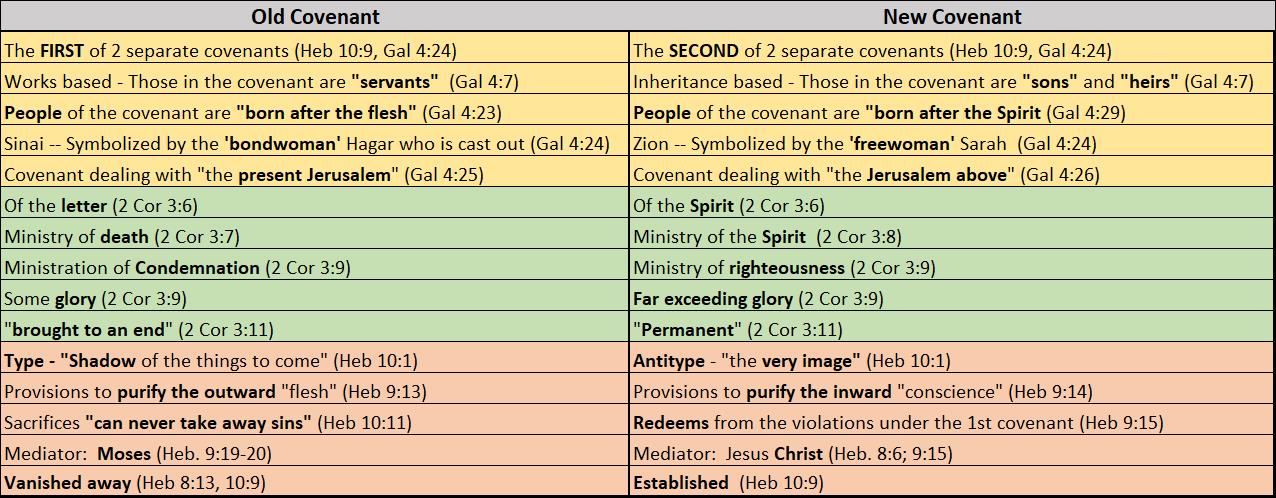
- The promise of the forthcoming New Covenant, found in Jeremiah, notes distinct differences between the Old and New Covenant. The New Covenant is “not like the covenant that I made with their fathers on the day when I took them by the hand to bring them out of the land of Egypt, my covenant that they broke” (Jer 31:31-32). Unlike the Mosaic Covenant, this covenant is not breakable, not conditional, and it applies only to the elect. Its members “shall all know [God], from the least to the greatest” (Jer 31:34). They will “not turn from [God]” (Jer 32:40). Storms notes, “This promise that every member of the new covenant will experience personal and first-hand intimate saving knowledge of God is one of the main reasons I don’t baptize infants.”[vii]
- The New Testament, in three covenant-comparing passages (Galatians 4, 2 Corinthians 3, and Hebrews 8-10), places a major contrast between the Old and the New Covenant. See the chart below:
Paedobaptist Counter Argument
Paedobaptists agree that the New Covenant has many aspects of fulfillment, and that it will ultimately include only the elect. But they suggest an “already-not-yet” scenario, where the New Heavens and the New Earth (the “not yet”) will be characterized by the perfectly fulfilled New Covenant, but the church age (the “already”) has an imperfectly fulfilled New Covenant. Richard Pratt argues:
These fulfillments take place in a manner unanticipated by OT prophets. Instead of happening completely and all at once, the restoration expectations were fulfilled and are being fulfilled over a long stretch of time. Jesus explained this process of fulfillment for the Kingdom of God after the exile in the parable of the mustard seed (Matt. 13:31-32). He explained that the grand kingdom would begin very small, slowly grow, and finally reach full maturity. It helps to think of this NT perspective on the fulfillment of restoration prophecies in three stages: the inauguration of fulfillment in the first coming of Christ; the continuation of fulfillment between the first and second comings of Christ; and the consummation of fulfillment at the return of Christ.[viii]
The church age only approximates the perfect spiritual state. It still has a visible church which may not perfectly align with the “true” church. When God declares “for they shall all know me, from the least of them to the greatest”, it means that the covenant has a lot of true believers, in contrast to the Old Covenant, where there were few. The phrase “least to greatest” never included every individual, especially not infants, but rather all classes of adults (see its use in Jeremiah 6:13, and 8:10). The New Covenant will temporarily operate like the Old Covenant, with a visible administration, conditional aspects, and a mixed membership, until the perfect state comes and those aspects aren’t needed.
The Middle Ground
As one can see, the debate goes on and on. Both sides have fairly persuasive arguments and counter arguments. However, I think they are competing on the wrong playing field altogether.
Years ago, I read a couple books by author and pastor Douglas Van Dorn: Covenant Theology: A Reformed Baptist Primer[ix], and Waters of Creation: A Biblical Theological Study of Baptism[x]. Van Dorn exposed me to an argument that just blew my mind! An argument so simple, yet so hard to discover in the weeds of the current debate: New Testament baptism comes from Old Testament baptism! What? You mean the debate shouldn’t be focused on the Abrahamic covenant of circumcision? Yes. That’s exactly right. Baptism comes from baptism and its associated covenant, not from circumcision and its associated covenant. Approaching the issue from this perspective casts a whole new light on the debate.
Baptism, as a sacrament, existed alongside circumcision in the Old Testament and never replaced it. There were several types of Old Testament water baptism, including many ritual washings for impurities, but only one Old Testament water baptism was initiatory (as the New Testament baptism is) — the baptism of the Levitical priesthood in Exodus 29:
Ex 29:1 “Now this is what you shall do to them to consecrate them, that they may serve me as priests … 4 You shall bring Aaron and his sons to the entrance of the tent of meeting and wash them with water.
Members of the visible covenant community (circumcised Levite males) received a special ordination and baptism later in life, anointing them for priestly service within the covenant community. This baptism is a good place to start if we want to trace initiatory baptism from the Old to the New Testament. But the question is, “Is there a clear connection between this priestly ordination baptism and New Testament baptism?” There are several reasons why I believe the answer is “yes”, but I’ll focus on three: The priestly covenant, the priesthood of believers, and the baptism of Jesus the greater priest.
The priestly covenant
I would agree with paedobaptists that New Covenant members (both now and in the millennial kingdom) are portrayed as the greater Abrahamic covenant community (Lk 7:28, Gal 3:29); but we shouldn’t limit our scope to that covenant only. All Old Testament covenants have their ultimate fulfillment in Christ. This includes the Noahic, the Abrahamic, the Mosaic, the Levitical (priestly), and the Davidic (kingly) covenants. The New Testament church is a Noahic household (1 Pet 3:20-21), a seed of Abraham (Gal 3:29), as well as “priests and kings” (1 Pet 2:9 BBE, Rev 1:6). However, we should focus on the Old Testament covenant, which is directly pertinent to the aforementioned initiatory baptism – the Levitical covenant.
Most covenant theology books fail to mention the Levitical covenant, as well as its relationship to baptism. Yet Jeremiah claims that the “covenant with Levi” is in the same class as the “covenant with David” (Jer 33:20). It is of such importance that God reserved a whole book of the Torah for it – Leviticus. As Van Dorn notes, “A whole book of the Bible dedicated to a covenant that few even know exists. Yet chapter after chapter delineates the tedious and sometimes strange duties of the priests”[xi]. My goal is to demonstrate that baptism has everything to do with the fulfilled Levitical covenant, and not much to do with the fulfilled Abrahamic covenant.
The last prophetic book of the Old Testament, Malachi, gives us invaluable information regarding this priestly covenant and how it would connect to the New Covenant. In Chapter 2, God mentions this long-standing covenant He had with Levi:
Mal 2:4 So shall you know that I have sent this command to you, that my covenant with Levi may stand, says the LORD of hosts. 5 My covenant with him was one of life and peace, and I gave them to him. It was a covenant of fear, and he feared me. He stood in awe of my name… 8 But you have turned aside from the way. You have caused many to stumble by your instruction. You have corrupted the covenant of Levi, says the LORD of hosts”
In Chapter 3, God prophesies that He will send a messenger of this Levitical covenant who will come to purify the Levites, adjust their wayward behavior and reestablish righteous offerings:
Mal 3:1“Behold, I send my messenger, and he will prepare the way before me. And the Lord whom you seek will suddenly come to his temple; and the messenger of the covenant in whom you delight, behold, he is coming, says the LORD of hosts.2 But who can endure the day of his coming, and who can stand when he appears? For he is like a refiner’s fire and like fullers’ soap. 3 He will sit as a refiner and purifier of silver, and he will purify the sons of Levi and refine them like gold and silver, and they will bring offerings in righteousness to the LORD. 4 Then the offering of Judah and Jerusalem will be pleasing to the LORD as in the days of old and as in former years.
Although the coming of “Elijah” (Mal 4:5) will ultimately be fulfilled in the last days (Revelation 11:6), we see a preliminary application of this prophecy to John the Baptist:
Mark 1:2 As it is written in the prophets, Behold, I send my messenger before thy face, which shall prepare thy way before thee … 4 John did baptize in the wilderness, and preach the baptism of repentance for the remission of sins. (KVJ)
This provides a clear connection between Old and New Testament baptism. John the Baptist is a “messenger of the covenant” who purifies faithful, repentant Israel, God’s originally intended “kingdom of priests” (Ex 19:6), through water baptism. Does this connection stop with John the Baptist? Of course not. John’s “baptism of repentance for the forgiveness of sins” (Mark 1:4) continues in the preaching and baptism ministry of Jesus, and ultimately in that of the apostles, who would proclaim “repentance and forgiveness … to all nations” (Luke 24:46), which is synonymous with the Great Commission to “make disciples of all nations, baptizing them” (Mt 28:18). Of course the post-Pentecost baptisms would also include a powerful “Spirit Baptism” (Acts 1:5, 19:3-6), but the connection to John’s baptism and Malachi’s Levitical prophecy remains. Therefore the Levitical purification of the repentant people of God continues throughout the entire New Testament economy.
The priesthood of believers
According to Isaiah 61:6-9 and 66:20-21, post-exilic Israel is called the “priests of the Lord”. Even from this Old Testament prophecy, the New Testament priesthood is anticipated. And I’m not talking about a subset of believers who wear a black shirt and a white collar. I’m talking about the priesthood of all believers. Van Dorn notes, “The NT has much to say about the ‘priesthood of all believers’… The NT language of our worship and service as Christians is cast in OT sanctuary-priestly language.”[xii] The priesthood of the believer is a driving characteristic of New Covenant life. When we are baptized, we “put on Christ” as a priestly garment (Gal 3:27, compare Ex 29:8). We present our bodies as living sacrifices (Rom 12:2). We offer up sacrifices of praise (Heb 13:5). Our acts of sacrificial service are offerings to God (Php 2:17). Our financial gifts are called “fragrant offerings” (Php 4:18). Our prayers are symbolized as priestly “bowls of incense” (Rev 5:8, 8:3). Our Gospel ministry is a “priestly service” (Rom 15:16, 2 Cor 2:15). It’s no wonder why the book of Hebrews, heavily focused on Christ’s priesthood, pictures us coming to the throne room as baptized priests, with a “heart in full assurance of faith, with our hearts sprinkled clean from an evil conscience and our bodies washed with pure water”(Heb 10:22).
The baptism of Jesus the greater priest
As believers, we are buried with Christ in baptism (Rom 6:3), so it makes sense that the purpose of Christ’s baptism is related to the purpose of our baptism. The Book of Acts confirms this, as it depicts various groups of people being anointed and empowered by the Holy Spirit, or promised such an empowerment, at the time of their baptism (Acts 2:38, 8:12-15, 9:17-18, 10:47, 19:5-6), just as Jesus was empowered at His baptism (Mt 3:16, Acts 10:38). So let’s take a look at Jesus’ baptism, and we will find that it fits well with Levitical Baptism.
I believe that Jesus was fulfilling an Old Testament law at his baptism, and it wasn’t circumcision (he had already been circumcised). He was baptized to “fulfill all righteousness” (Mt 3:15). Matthew’s use of the word “fulfill” relates to the Law and Prophets. According to Deuteronomy 6:25, “righteousness” is directly linked to obeying the Law. With this in mind, we can assert that Jesus’ baptism was performed to fulfill the stringent requirements of the Levitical baptism:
- He was 30 years of age (Num 4:3, Lk 3:23)
- He was baptized by another Levitical priest (Ex 29:4,9; John was a Levite – Lk 1:5-9)
- He was without defect (Lev 21:16- 23)
Of course a priest had to be a male that descended from the tribe of Levi (Num 3:15). However, these restrictions no longer apply in the new age, where God promises that He “will take for priests and for Levites” people “from all the nations” (Isa 66:20-21). Jesus is the greater priest, which requires Him to be of a different order than Levi, namely, that of Melchizadek (See Heb 7:15-17, Ps 110:4).
Jesus confirmed that His baptism fulfilled priestly ordination by instantly going into the temple and quoting Isaiah 61:1-2, claiming to fulfill it (See Luke 4:16-19). Van Dorn notes the significance of this proclamation:
The quote from Isaiah 61 needs to be understood not merely as the anointing of Messiah, but as Jesus being anointed into the priesthood … Jesus’ baptism was a baptism ordaining him to serve before God as his High Priest … Everywhere in Isaiah 61 we find allusions to the priesthood and the Levitical Law. In fact, not only are these allusions, they are the very details of ordaining the priest! It says, “You shall be called priests of the Lord; they shall speak of you as the ministers of our God” (61:6).[xiii]
In summary, the priest was baptized in water to ordain him into priestly service. Jesus’ baptism fulfills this law as we see in his subsequent three year priestly ministry that began immediately after his baptism and climaxed in His sacrifice as a priest on the cross. Christian baptism follows this example. Our baptism is rooted in this Old Testament baptism, and through it we are formally initiated into the ministry of the priesthood of the believer.
Timing of Baptism
Does this new proposed middle ground solve the issue of baptismal timing? Not necessarily. Credobaptists could claim that Levites were already members of the visible community or the “people of God”, but were baptized into their ministry role later in life. This special ministerial anointing could have its fulfillment in the New Testament Spirit baptism, which occurs at salvation.
Paedobaptists, on the other hand, could employ a discontinuity in Levitical practice, suggesting that the New Testament universalization of the priesthood now demands its responsibilities to be practiced by believers and their families throughout their entire Christian lives.
Nevertheless, with this new perspective, the credobaptist version has more common ground with the paedobaptist view than any other credobaptist position. Why? Because it allows for continuity from the Old to the New Covenant. Other credobaptist views do not
Suggested change for Credobaptists
Many credobaptist churches have “Children’s Church” during weekend services, which seems to acknowledge that children are part of the church community. Similarly, Christian parents often refer to their children as “Christians,” encourage them to identify as such from a young age, and teach them to express faith by saying “I love Jesus” or singing songs like “Jesus Loves Me.” Infants and young children should therefore be regarded as non-communicant members, as paedobaptists suggest. They could then become communicant, anointed, ministerial members once they profess genuine faith and are baptized. Adopting this perspective fosters significant common ground with the paedobaptist view.
In addition, Credobaptists should consider baptizing children because the Bible emphasizes the value of childlike faith, which Jesus Himself commends (Matthew 18:3). Children are often capable of expressing genuine trust and love for God in the aforementioned ways appropriate to their age. These simple but sincere expressions reflect a faith that is real, even if not fully mature. By recognizing and affirming such faith through baptism, credobaptists can honor the spiritual capacity of children while nurturing their lifelong journey of discipleship within the church community.
Conclusion
In conclusion, the exploration of baptism as the fulfillment of the Levitical covenant offers a compelling middle ground in the longstanding debate between credobaptism and paedobaptism. This approach upholds the importance of personal faith, but also honors the rich connection between this sacrament and historical covenants. As such, it invites the broader Christian community to reflect on the depths of baptism’s significance, encouraging unity and mutual respect among differing practices and beliefs.
To get email notifications when new articles are published, click SUBSCRIBE
References:
[i] V37 Not in the earliest manuscripts. It shows up in Codex Laudianus.
[ii] Sam Storms. A BRIEF DEFENSE OF BELIEVER’S BAPTISM. March 17, 2015. Found at: https://www.samstorms.com/enjoying-god-blog/post/a-brief-defense-of-believers-baptism
[iii] Storms. A BRIEF DEFENSE.
[iv] Ibid.
[v] Booth, Randy. Children of the Promise: The Biblical Case for Infant Baptism, 1995. p. 8
[vi] Storms. A BRIEF DEFENSE.
[vii] Ibid.
[viii] Dr. Richard Pratt’s article “Jeremiah 31: Infant Baptism in the New Covenant”. IIIM Magazine Online, Volume 4, Number 1, January 7 to January 13, 2002
[ix] Dorn, Douglas Van. Covenant Theology: a Reformed Baptist Primer. Waters of Creation Publishing, 2014.
[x] Dorn, Douglas Van. Covenant Theology: Waters of Creation: A Biblical Theological Study of Baptism, 2009.
[xi] Van Dorn. Covenant Theology. Kindle Version.
[xii] Van Dorn. Waters of Creation. Introduction. Pg xx.
[xiii] Ibid. Part I: The Baptism of Jesus, Pg 5.
 The Middle Ground
One thought on “Bridging the Waters of Paedobaptists and Credobaptists”