

The Millennial Maze
Revelation 20 is a very curious, often debated passage that has divided theological camps for hundreds and hundreds of years. The main area of debate is the 1000 year period, or the millennium, which appears for the first time in verse 2. This enigmatic 1000 year period has no specific mention elsewhere in the Bible. And it immediately raises questions about the timing of Christ’s second coming. Will Christ return before a future millennium (premillennial), or will he return after an already-occurring millennium (amillennial)? My goal is to briefly review the passage and consider these two main positions – Premillennialism, and amillennialism. I’ll then present a middle ground — a version of premillennialism that I believe is “amillennial-friendly”. Let’s first outline the relevant sections in Revelation, starting with Chapter 19, verse 11.
| Verses | Code | Description |
|---|---|---|
| 19:11-16 | S | Second coming |
| 19:19-21 | BFK | Beast, false prophet, and kings gathered and destroyed |
| 20:1-6 | SB*FR*1000 | The 1000 years, preceded by Satan’s binding and the first resurrection |
| 20:7-9 | FD | Satan released to lead a final deception |
| 20:10 | SD | Satan destroyed |
| 20:11-15 | GWT | Great white throne judgment of the dead |
A simple sequential reading of these sections supports premillennialism, as the second coming (S) precedes the millennium (SB*FR*1000):

However, the amillennial position argues that recapitulation (or rewinding), a device used in the Daniel’s Old Testament apocalypse, is also prevalent throughout the Book of Revelation. As an example, Revelation 20:13-14 recapitulates back to the storyline of 20:11-12, making those two pairs of verses parallel in time. Another example is the repetition of the events of Revelation 11:18 (judgment of dead and rewarding of saints) again in Revelation 20. In fact, amillennialists claim that Revelation 20:1 recapitulates back to the beginning of the church age, rather than following the events of Revelation 19. Below is a picture of this concept:
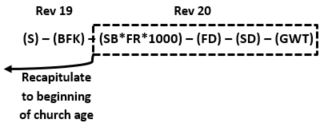
This results in something like this:
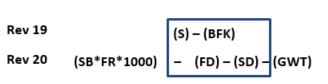
In this scheme, the first resurrection (FR) is the spiritual resurrection, or new birth, given to believers throughout the church age. Satan’s binding (SB) is his inability to hinder the spread of the Gospel during this time. The box then shows that Chapter 19’s uprising and defeat of the beast, false prophet, and kings of the earth (BFK) is allegedly the same series of events as Chapter 20’s final deception (FD) and destruction of Satan (SD), all of which occur at the second coming of Christ (S).
This amillennial scheme is aimed at maintaining two non-negotiable principles: 1) a single physical resurrection immediately following Christ’s second coming, and 2) a single judgment immediately following Christ’s second coming. Amillienialists do not believe that the rest of scripture supports the idea of a 1000 year period between resurrections and/or judgments. They place the single physical resurrection at the second coming of Christ (S) after the church-age millennium, based on the idea that “The rest of the dead did not come to life until the thousand years were ended” (20:5). The word “until” supposedly suggests that the rest of the dead do come back to life after the millennium. This post-millennial resurrection is allegedly a physical resurrection, in contrast to the spiritual First Resurrection. In fact, they believe that, not only do the wicked rise in this resurrection, but also the righteous dead who participated in the First Resurrection. This physical resurrection is then immediately followed by the Great White Throne (GWT) judgment, a judgment of all resurrected people, both good and evil.
These two non-negotiable principles are primarily derived from texts outside of Revelation. For example, Matthew 25:31-32 says that “When the Son of Man comes in his glory, and all the angels with him, then he will sit on his glorious throne. Before him will be gathered all the nations”. This judgment seems to occur all at one time, rather than as a judgment seat for the righteous followed by a separate judgment for the wicked a thousand years later. In addition, Paul’s epistles seem to consistently describe a single judgment of both the wicked and the just, the bad and the good, at the end of history (Rom 2:7-8, 2 Tim 4:1, 2 Cor 5:10).
As for the resurrection, in John 5:28-29 Jesus tells us that “an hour is coming when all who are in the tombs will hear his voice and come out, those who have done good to the resurrection of life, and those who have done evil to the resurrection of judgment.” Daniel 12:2 paints a similar picture: “And many of those who sleep in the dust of the earth shall awake, some to everlasting life, and some to shame and everlasting contempt”. Again, there is not much indication of a 1000 year gap between the resurrections. The two amillennial non-negotiables cannot simply be overlooked, but need real consideration.
Why I’m a Premillennialist
Even though the amillennial position has many compelling arguments, I am still convinced that the context of Revelation places the millennium of Chapter 20 in the future, after the second coming of Christ. I’ll briefly list the arguments that persuade me the most.
A future reward
First of all, the millennium, the period when the saints are resurrected and granted judgment (Rev 20:4), is presented as a reward that comes after their age-long persecution at the hand of the beast, false prophet, and dragon. In Revelation 11:11 we read, “After the three and a half days a breath of life from God entered them [the martyred two witnesses] and they stood up on their feet, and great fear fell on those who saw them.” Immediately following this resurrection event, the twenty four elders announce that “the time has come for the dead to be judged, and to give the servants and the prophets and the saints and all those who fear your name their reward” (v18, Emphasis added). This places the resurrection, the judgment of the dead, and the reward for both the wicked and the righteous in the future after the symbolic 1260 days of persecution (11:3), which days the amillennialists claim are the church age. Jesus claims that this reward-giving happens at His coming –“I come quickly; and my reward is with me, to give every man according as his work shall be” (Rev 22:12, KJV, Emphasis added). In the meantime, the persecuted saints “that were slain for the word of God and for the testimony which they held” (6:9, KJV, Emphasis added) are pictured as dead souls under the altar, crying out to God: “How long, Sovereign Lord, holy and true, until you judge the inhabitants of the earth and avenge our blood?” (v10). They are told to wait a little while longer until their full number has been completed (v11). These same people are the ones who, after enduring extreme suffering during the 1260 days [42 months] at the hand of the beast (Rev 13:5), are rewarded in Revelation 20 during the millennium: “I also saw the souls of those who had been beheaded because of the testimony about Jesus and because of the word of God…. They came to life and reigned with Christ for a thousand years” (Rev 20:4, NET). This demonstrates that the resurrection, judgment, and kingdom reign don’t occur until after the current period of persecution. [i]
Deceived Nations
The amillennial scheme, which places Satan’s binding during the church age, would force us to believe that the nations are not deceived right now. Satan is bound “so that he might not deceive [Gr. πλανάω] the nations any longer” (20:3, ESV). I could list several New Testament passages that show Satan is still deceiving people, but I’d rather show it directly from the context of Revelation. According to the amillennial position, the 42 months of persecution in Revelation 13, and the 1260 days of persecution in Revelation 12 are one and the same as the supposed deception-free millennium. Yet these very periods use the exact same Greek word, πλανάω, to describe deception that is occurring therein:
Rev 12:9 So that huge dragon – the ancient serpent, the one called the devil and Satan, who deceives [Gr. πλανάω] the whole world – was thrown down to the earth, and his angels along with him. (NET)
Rev 13:14 and by the signs that it is allowed to work in the presence of the beast it deceives [Gr. πλανάω] those who dwell on earth, telling them to make an image for the beast that was wounded by the sword and yet lived. (ESV)
I’ve heard some amillennialists claim that the deception in Revelation 20 is of a different category than the deception in these passages, perhaps more universal, but I find that explanation wanting. I am persuaded that deception is still running rampant during the church age, but will be eradicated in the future millennial period.
Consistency of the Verb “Come to Life”
Amillennialists claim that the phrase, “They came to life” (20:4), refers to the spiritual resurrection which occurs when someone is born again. They then place the single physical resurrection at the second coming of Christ (S) after the church-age millennium, based on the idea that “The rest of the dead did not come to life until the thousand years were ended” (20:5). The problem that I see here is that the same verb – “come to life” – is used in two totally different ways within one sentence of each other. “Came to life” first means something spiritual (v4). “Come to life” then means something physical (v5), without any contextual reason for such a change. I can’t personally buy that.
Revelation 19-20 Sequence
Another pre-millennial indicator is the sequence that is strongly suggested in Revelation chapter 20. We are told that “the devil who had deceived them was thrown into the lake of fire and sulfur where the beast and the false prophet were” (20:10, ESV). The latter clause asserts that Satan ends up in the Lake of Fire, where the beast and prophet had already been cast in 19:20. I’m sure an amillennial teacher can explain this through recapitulation that is offset, or not perfectly parallel, but I think the answer is much simpler: Chapter 19 and 20 are sequential.
Isaiah Chapter 24
This sequence of events in Isaiah 24 aligns with the premillennial understanding that Christ’s return will bring judgment (vv1-21), followed by a period of His enemies being bound (v22a), followed by their final punishment after “many days” (v22b). These events seem related to the eschaton, as they are aligned with similar cosmic signs — the “moon confounded” and the “sun ashamed” (v24, c.f. Mt 24:29-30, Rev 6:12-13).
Early Church Beliefs
The last evidence that I’ll provide is the beliefs of the early church. Augustine’s interpretation of Revelation 20 in his seminal work “The City of God” significantly influenced the shift towards amillennialism. However, most patrisric scholars agree that, before Augustine, earlier church fathers, including Justin Martyr and Irenaeus, advocated for a millennial reign of Christ on earth following His return. The fact that these fathers were closer to the apostolic era should add considerable weight to their views.
Two Possible Scenarios for the Final Deception (FD)
Mortal Nations View
The narrative of Gog and Magog in the context of the Millennium presents two fascinating scenarios. The first scenario involves mortal nations deceived by Satan. In this view, these nations are composed of human beings who have survived the tribulation and entered the Millennium in their mortal state. Despite Christ’s reign of peace, these mortals still possess free will and can be tempted by Satan’s deceptions once he is released from his thousand-year imprisonment. This scenario emphasizes the enduring nature of human susceptibility to temptation and rebellion, even in an era of divine rule. Below are some objections answered for this scenario.
Survivors after Christ’s return?
One objection leveled against premillennialism concerns survivors. Revelation 19 seems to depict the universal destruction of all unbelievers at the second coming of Christ. John prophesies, “the rest were slain by the sword” (v21). Paul’s epistles also seem to support such a universal desolation:
“…When the Lord Jesus is revealed from heaven with his mighty angels in flaming fire, inflicting vengeance on those who do not know God and on those who do not obey the gospel of our Lord Jesus.” (2 Thess 1:7-8, ESV)
The question is: How could any mortals survive to become the nations who rebel after the millennium? (See Rev 20:8). My answer to this is two-fold. First of all, Revelation 19:21 is speaking of the “rest” of those who came against Christ. But who specifically came against Him? “The beast and the kings of the earth with their armies.” (Rev 19:19). There is no mention of any non-militant people, especially children. Secondly, the prophecies in the Old Testament specifically tell us that there will be survivors:
Therefore a curse devours the earth, and its inhabitants suffer for their guilt; therefore the inhabitants of the earth are scorched, and few men are left. (Isa 24:6, ESV)
The sons of those who afflicted you shall come bending low to you, and all who despised you shall bow down at your feet; they shall call you the City of the LORD, the Zion of the Holy One of Israel. (Isaiah 60:14, ESV)
Then everyone who survives of all the nations that have come against Jerusalem shall go up year after year to worship the King, the LORD of hosts, and to keep the Feast of Booths. (Zech 14:16, ESV)
According to these passages, the survivors include “sons of those who afflicted” God’s people. It seems like the children of the wicked will be spared because of their ignorance. This is fitting, as most evangelicals believe that God spares young children from hell. Perhaps He will also spare them from the final destruction, allowing them the chance to make a choice for Christ in the millennium. I admit that I don’t have an explicit mechanism for their survival. Yet I do see God sealing others for the express purpose of protecting them from the earth transforming judgments of the Seventh Seal (Rev 7:1-4). If God wants them there, He can protect them, as He protected Israel in Goshen during the horrific judgments of Egypt. This leads to the next objection.
Cohabitation of glorified and unglorified people?
This objection concerns the notion of glorified, resurrected saints alongside unglorified mortals. How can such a notion be possible? The answer is simple: It happened 2000 years ago, when Jesus Christ was glorified and walked on this earth alongside mortals. He walked with them, talked to them, let them touch him, and ate with them (See John 20-21). There was also a resurrection that occurred when Christ died on the cross, in which “the tombs also were opened and many bodies of the saints who had fallen asleep were raised and coming out of the tombs after his resurrection they went into the holy city and appeared to many” (Mt 27:52-53). Assuming these people were in some glorified state, we should have no problem with immortals cohabiting with mortals. With the promise that there is no death in the New Heavens and Earth, I would estimate that there is an even more glorious fulfillment of the promise in Isaiah 65:20, in which the survivors live for the entirety of the millennium, surpassing even the oldest of ages in the pre-flood world. Surely, the New Earth will have even more life sustaining capacities than the pre-flood world.
In light of the type/antitype fulfillments in the New Testament, the relationship between these surviving “nations” and the glorified inhabitants of Zion may roughly, but not exactly, follow the prophecies given in the major prophets. Following John’s insistence that nothing unclean will enter the New Jerusalem (Rev 21:25-27), the major prophets consistently depicted the post-exilic Gentiles bringing their honor, wealth, and praise to Israel (Isaiah 60:5-7, Zech 14:16-19), perhaps only to the anterior (not interior) of the New Jerusalem, while remaining distinct nations (Isa 19:25).
‘Souls’ in a physical millennium?
Another common objection is that the people referenced in Revelation 20 are “souls”, implying that they are in Heaven in their intermediate state during the church age. But this objection fails to consider the fact that “They came to life and reigned” (Rev 20:4). Yes, they are first pictured as disembodied martyred saints, but then John sees them rise from the dead. They then begin to reign. Where does this reign occur? In Heaven? No, we are told earlier in the Book of Revelation that “they shall reign on the earth” (Rev 5:10).
Demonic Nations View
The second scenario for the final deception (which I prefer) suggests that Gog and Magog represent, not human entities, but demonic forces or nations entirely comprised of demonic beings. This interpretation aligns with some eschatological views that see the final rebellion as a cosmic confrontation between good and evil, involving supernatural elements beyond human comprehension. Satan’s release would thus rally these demonic nations for one final assault against the kingdom of God. Five reasons are presented for this “Demonic Nations” view.
1. Lake of Fire Inhabitants:
Revelation 20:10 mentions that the lake of fire is prepared for the devil and his angels. Since there isn’t another specific account of the angels being cast into the lake of fire, Gog and Magog could represent it.
2. Prophetic Punishment of Demons:
Isaiah 24:21-22 suggests that the millennial prisoners “gathered in the pit” for “many days” includes the “host of the heaven” (interpreted as angelic beings). If Gog and Magog are not representing this category, it would be missing altogether from Revelation.
3. Angelic Nations and Principalities:
Both the Old Testament (Dan 10:13, 21, 12:1) and the New Testament (Eph 6:12) describe a structured angelic realm, consisting of princes and principalities. This makes the reference to demonic “nations” a possibility.
4. Kings associated with the Bottomless Pit:
Revelation 9:11 introduces Abaddon/Apollyon, a named demon-king associated with the bottomless pit. Thus it is fitting that Gog, the only other named king ascending from the bottomless pit “up onto” the earth – other than Satan Himself – could also be a demon (Ezek 38:3, Rev 20:9).
5. Mysterious nature
The Book of Revelation pictures Babylon, one of the most powerful and well known nations of all time, to depict the human enemies of God’s people. One could argue that it pictures Magog, one of the most unclear and unidentifiable nations of all time, to depict the supernatural enemies of God’s people. This mysterious depiction of the final attack invokes a literary ambience similar to that of Melchizedek, whose origin is also undisclosed and likely supernatural.
One potential objection to this “Demonic Nations” view regards the deception of demons. Aren’t demons already deceived? Yes, in one sense, but not in all senses. Ezekiel 38:10-11 depicts Gog and Magog suddenly having the evil notion to attack a land of unwalled villages, a peaceful people dwelling securely. Being unbelieving pagans, they were already deceived in one sense, but they were not previously deceived enough to attack God’s people who were dwelling securely under His protective hedge. How much more suicidal would it be for demons, an already-defeated company (Col 2:15), to launch a final attack on God’s glorified people securely dwelling in the New Jerusalem? I would consider that a whole new level of deception!
Premillennial Assumptions That Need Challenged:
What about the two non-negotiables – The Single Physical Resurrection, and the Single Judgment? Can these be explained away? No, I honestly think that these two ideas aren’t just “amillennial”, but Biblical. In fact, I believe Premillennialists need to take a fresh look at the account, challenge certain assumptions, and perhaps find that the two non-negotiables can be true within a premillennial framework.
Assumption: The wicked “come to life” after the thousand years
The first assumption that needs challenged is the notion that the wicked dead are resurrected after the millennium. Premillennialists place a second physical resurrection (for the wicked) after the future millennium, based on the idea that “The rest of the dead did not come to life until the thousand years were ended” (20:5). But do the wicked really ever “come to life”, as those of the First Resurrection? I don’t believe so. Long before John, Isaiah prophesied that, while the righteous dead “will live, their bodies will rise” (Isa 26:29); the wicked “live no more, those departed saints do not rise” (Isa 26:14). The Great White Throne scene does not pertain to those who have “come to life” in any way, but rather to the “dead, small and great” (20:12, cf. v13). Just because the dead “stand” before God does not mean they have “come to life” in the Johannine sense, which includes a quality beyond mere physical life. They don’t have “life” nor are they written in the book of “life” (v12). John, who authored Revelation, elsewhere speaks of those who are raised up in the resurrection – “those who have done good to the resurrection of life, and those who have done evil to the resurrection of judgment” (Jn 5:29, ESV, c.f. Dan 12:2). This is the same lingo as Revelation 20. We have those of the First Resurrection who come to “life” (i.e. the resurrection of life), and those of the Second “Death” who face the Great White throne judgment (i.e. the resurrection of judgment).
Of course, many object that the word “until” must imply a reversal of circumstances afterwards (i.e. they didn’t come to life until …. But afterwards they came to life). Is that a valid assumption? I’ll refer the reader to Anthony Hoekema:
“The Greek word here translated “until,” achri, means that what is said here held true during the entire length of the thousand-year period. The use of the word until does not imply that these unbelieving dead will live and reign with Christ after this period has ended. If this were the case, we would have expected a clear statement to this effect.”[ii]
Kevin DeYoung has some good insights as well:
“Most of us have probably read it to mean something like this. “The rest of the dead did not come to life until the thousand years were ended, and then after the thousand years they did come to life.” We read “until” as indicating a change in their situation after the thousand years. But I want to argue that that is not how we should read “until.” The word “until” can have the force of during, or right up to, or throughout, and does not have to indicate a change in the circumstances after the time.”[iii]
DeYoung goes on to mention various New Testament references where the word achri does not necessitate a change of affairs afterwards:
Now, let me just give you some verses where this happens in Scripture. And then, we will be wrapping up the answer to this question. Acts 23:1, I’ll just read it. Paul looked straight at the Sanhedrin and said, “My brothers, I have fulfilled my duty to God in all good conscience until (achri) this day.” Now, does Paul mean I’ve been fulfilling my duty until this day, and starting right now, I don’t have to do my duty anymore? No. In Acts 26:22 Paul says, “But I have had God’s help to (achri) this very day, and so I stand here and testify to small and great alike.” Until, achri, this very day. Now, does Paul mean that God has helped me until this day, and I’m glad that I made it here. But after today I am not going to get any help? No. He doesn’t mean to say that until indicates a change in circumstance. Romans 5:13, “For before the law,” actually, until (achri) the law, “was given sin was in the world, but sin is not taken into account where there is no law.” So until the law was given, sin was in the world. Does Paul mean that after the law was given, then sin was no longer in the world? No. He is clearly making the point right in up until this time, this was true. I will give you one more. Romans 8:22, “We know that the whole creation has been groaning as in the pains of childbirth right up to (achri) the present time.” Right up to the present time. Nobody understands Paul to be saying, “All of creation has been groaning and suffering until I wrote this down in 60 A.D., and now creation has stopped suffering.” No, the “until” has the force of right up to, or during. [iv]
So let’s summarize what these guys are saying. The phrase – “The rest of the dead did not come to life until (achri) the thousand years were ended (teleo)” – does not mean that the wicked came to life after the thousand years were ended, in the Johannine sense of that term. All it means is that the wicked dead didn’t live through the entirety (teleo) of the millennium. Since the word achri can be translated as “while” (e.g. Mt 5:25, 14:22, Jn 9:4), I would translate the Greek like this: “The rest of the dead did not come to life while (achri) the thousand years were fulfilled (teleo)”. What happens after the 1000 years should not be assumed by the word achri.
With this understanding we can advocate a single resurrection at the coming of Christ — “those who have done good to the resurrection of life, and those who have done evil to the resurrection of judgment” (Jn 5:29, ESV, c.f. Dan 12:2). Those of the First Resurrection, resurrected to life, are transformed into the likeness of Christ and rewarded with the Kingdom. Those of the Second Death, resurrected to death, shall stand before their judge in a post-mortem state, and are immediately sent into hellfire. Matthew 25 pictures this scene:
When the Son of man shall come in his glory, and all the holy angels with him, then shall he sit upon the throne of his glory: And before him shall be gathered all nations: and he shall separate them one from another, as a shepherd divideth his sheep from the goats: And he shall set the sheep on his right hand, but the goats on the left. Then shall the King say unto them on his right hand, Come, ye blessed of my Father, inherit the kingdom prepared for you from the foundation of the world … Then shall he say also unto them on the left hand, Depart from me, ye cursed, into everlasting fire, prepared for the devil and his angels. (Mt 25:31-34, 41, KJV)
This same judgment scene – characterized by the King sitting on His throne, judging the wicked according to their works, and casting them into hellfire – is described in Revelation 20:11ff:
And I saw a great white throne, and him that sat on it, from whose face the earth and the heaven fled away; and there was found no place for them. And I saw the dead, small and great, stand before God; and the books were opened: and another book was opened, which is the book of life: and the dead were judged out of those things which were written in the books, according to their works. And the sea gave up the dead which were in it; and death and hell delivered up the dead which were in them: and they were judged every man according to their works. And death and hell were cast into the lake of fire. This is the second death. (Rev 20:11-14, KJV)
But doesn’t the Great White Throne account come after the thousand year account? How can we say that there is a single resurrection and judgment immediately following the second coming of Christ, when this prophecy comes after the thousand year reign prophecy? This leads me to the next assumption that needs challenged.
Assumption: Everything in Revelation 20 is Sequential
I don’t believe the entirety of Revelation 20 is sequential. I agree with the amillennialists, who argue that recapitulation, or rewinding, is present throughout the Book of Revelation. For example, right in Chapter 20, verses 13-14 recapitulate back to the storyline of verses 11-12, making the events of those two passages parallel in time. However, I think that amillennialists put recaplitulation in the wrong spot! Rather than recapitulating the millennium to the beginning of the church age, I think that the Great White Throne judgment scene (vv11-15) recapitulates to the beginning of the millennium (v4).
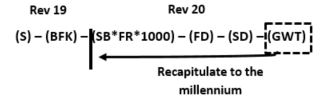
This results in something like this:
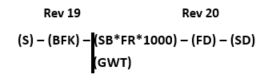
This seamlessly merges the single resurrection and judgement (FR & GWT) into one event which occurs at the time of Christ’s second coming (S).
Several other textual indicators support this recapitulation.
- Jesus promised His disciples that they would sit on twelve thrones and judge the twelve tribes of Israel “when the Son of Man will sit on his glorious throne” (Mt 19:28). In Revelation 20:4, the saints sit on thrones, apparently judging, while in 20:11, Jesus sits on the throne judging. Rewinding Rev 20:11 to 20:4, thus making both Christ’s judgement seat and the saints’ judgement seat simultaneous, would fulfill His promise in Mt 19:28.
- According to Mt 25:31, the judgment occurs “when the Son of man shall come in his glory”, not 1000 years later. And He consistently refers to it as the “day of judgment” (Mt 12:36), not an extended period of judgment, or multiple judgments.
- Millennial prophecies place the lake of fire (a penalty of the judgment) parallel with, not after, the prophesied earthly reign: “… from one new moon to another, and from one sabbath to another, shall all flesh come to worship before me … And they shall go forth, and look upon the carcases of the men that have transgressed against me: for their worm shall not die, neither shall their fire be quenched” (Isa 66:24, c.f. Mt 25:41, Mk 9:48, Rev 14:10-11, 21:14)
- Paul promises that the saints shall judge the world (1 Cor 6:2). It seems most fitting to have that judgment occurring in 20:4 when the saints are seated on thrones and given “judgment”. Surely this wouldn’t happen apart from or subsequent to Christ’s judgment of the wicked, but rather simultaneously.
- The final judgment scene in Daniel 7, which is very similar to the Great White Throne scene, has an entire court setup with many thrones, not just a single throne for the Ancient of Days
“As I looked, thrones were placed, and the Ancient of Days took his seat; his clothing was white as snow, and the hair of his head like pure wool; his throne was fiery flames; its wheels were burning fire. A stream of fire issued and came out from before him; a thousand thousands served him, and ten thousand times ten thousand stood before him; the court sat in judgment, and the books were opened. (Dan 7:9-10, ESV)
J. Webb Mealy, a New Testament Scholar, also incorporates this recapitulation into his new premillennial model, which he calls New Creation Millennialism:
Observing the principle of recapitulation at play, I understand that John has a second vision of the events of Rev. 20:4-10 in Rev. 20:11-15. First he sees the judgment according to works done in mortal life, which takes place at Jesus’ coming in glory. [v]
If the two aforementioned premillennial assumptions are challenged, we can land on an “amillennial friendly” premillennialism; one which maintains the two amillennial non-negotiables. I can envision the following sequence of events:
- Christ returns at the Second Coming
- Those who were martyred by the beast are resurrected into a glorified state (i.e. The First Resurrection). Along with all prior residents of Heaven, they are rewarded with the kingdom, and placed on thrones, from which they will participate in the judgment.
- Satan is bound and deception ceases
- The beast, false prophet, and kings of the earth who gathered to war against Christ are destroyed
- The ungodly stand before the heavenly court in a post-mortem state and are cast into the lake of fire, which is the Second Death
- Mortal Nations Scenario: The children of those who came against Christ are spared, and enter the millennium as mortals along with glorified saints, potentially remaining alive during the entire millennium.
- The millennium lasts a long time (maybe 1000 literal years or symbolically some other long period), wherein Christ and His glorified saints reign “in the earth”
- At the end of the millennium, Satan is released for a short season.
- There is a final attempted attack against the glorified saints
- Mortal Nations Scenario: The surviving mortal nations are deceived, launching one last attack against the glorified saints.
- Demonic Nations Scenario: Demonic forces are deceived into launching one final attack against the glorified saints.
- Fire comes down from Heaven, sweeping them into the Lake of Fire. They thus join the ranks of the Second Death, the prior judgment declared against the wicked.
Click here to go to part two of this series.
Press the SUBSCRIBE button at the bottom to get emails when we publish new articles.
Click on the Link to our Middle Ground Theology Facebook Page at the bottom to interact with our growing community.
End Notes:
[i] These points are eloquently defended by Dave Mathewson on Page 243 in the article he wrote for the Journal of the Evangelical Theological Society : “A Reexamination of the Millennium in rev 20:1-6” found at https://www.etsjets.org/files/JETS-PDFs/44/44-2/44-2-PP237-252_JETS.pdf
[ii] Anthony Hoekema, sermon on Amillennialism. Found online at: http://www.sermonindex.net/modules/articles/index.php?view=article&aid=3149
[iii] Kevin DeYoung. Making Sense of the Millennium. October 9, 2009. Found online at: https://www.thegospelcoalition.org/blogs/kevin-deyoung/making-sense-of-millennium-part-2/
[iv] Kevin DeYoung. Making Sense of the Millennium.
[v] J. Webb Mealy. THE NEW CREATION MILLENNIALISM PARADIGM: A RADICAL BIBLICAL-ESCHATOLOGICAL ALTERNATIVE TO EVERLASTING TORMENT. Found at: https://rethinkinghell.com/2018/09/19/the-new-creation-millennialism-paradigm-a-radical-biblical-eschatological-alternative-to-everlasting-torment/
 The Middle Ground
One thought on “An Amillennial Friendly Premillennialism (Part 1)”